
Your Asthma Action Plan: A Fillable, Doctor-Ready Guide
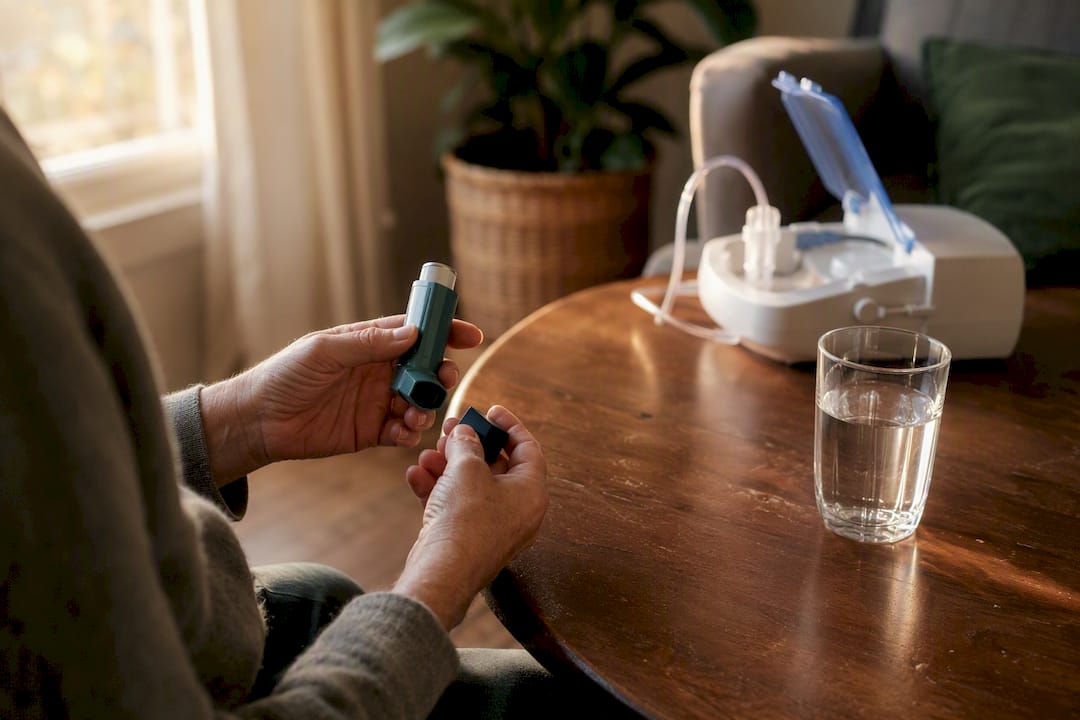
An asthma action plan is a personalized, written worksheet you build with your healthcare provider that lays out daily care, what to do when symptoms flare, and exactly when to seek emergency help. It works only when it reflects your own triggers, medicines, and peak-flow numbers, not a generic template. Your next step is simple: download a fillable plan below, bring it to your next appointment, and ask your clinician to complete and sign it with you.
TL;DR:
- A personal peak-flow baseline is essential for accurate zone determination, and it should be rechecked regularly as it can change over time.
- Using a peak-flow meter provides more precise guidance than symptom-based plans, especially for adults, but symptom-only plans are still effective if no meter is used.
- The plan’s success depends on ongoing updates from your healthcare provider, including recent peak-flow data and trigger assessments, rather than static, outdated information.
- Clear, specific instructions for each zone, including exact medication doses and emergency thresholds, are vital to avoid confusion during emergencies.
- Visiting a clinician to review, customize, and sign your plan ensures it reflects your current condition and triggers, improving safety and effectiveness.
Table of Contents
- Where to Download a Free Asthma Action Plan Template
- What Goes Into an Asthma Action Plan
- How Do You Get an Asthma Action Plan From Your Doctor?
- Filling Out Your Plan: Zone by Zone, Step by Step
- Tracking Triggers and Medicines on Your Plan
- How Garden State Medical Group Personalizes Your Plan
- What Most Advice on Asthma Plans Gets Wrong
- Book a Visit to Build or Update Your Plan
- Sources
- FAQ
Where to Download a Free Asthma Action Plan Template
You do not need to build this document from scratch. The CDC publishes a fillable asthma action plan PDF with fields already formatted for medicines, peak-flow ranges, and Green/Yellow/Red instructions, and the NHLBI offers its own version built around the same traffic-light structure. The American Lung Association distributes similar plans aimed at schools and caregivers.
Picking the right one comes down to three quick questions:
- Is this for a child? Choose a pediatric version with a signature line for school nurses and daycare staff.
- Do you use a peak flow meter at home? A peak-flow-based template gives your numbers more precision than a symptom-only version.
- Do you skip the meter entirely? A symptom-based plan works fine and relies on how you feel and how often you’re using quick-relief medicine.
Once you’ve picked one, save it to your phone or print two or three copies. You’ll want one for home, one for the clinician’s office, and one for school or work.
What Goes Into an Asthma Action Plan
Every credible plan is organized around the same traffic-light system CDC uses: Green, Yellow, and Red. Each zone maps to a specific range of your personal-best peak-flow reading, which is the highest number you’ve blown on a peak flow meter over a two-week stretch when your asthma was well controlled.
- Green Zone: You’re breathing normally with no cough, wheeze, or chest tightness, and your peak flow sits at or above your personal best. This is your everyday baseline.
- Yellow Zone: Symptoms are creeping in (nighttime cough, shortness of breath during activity) and peak flow drops to roughly half to just under your best.
- Red Zone: Severe symptoms, trouble speaking or walking, and a peak flow reading less than half of your personal best.
Peak flow tip: Your personal best isn’t a one-time measurement. Clinicians often re-check it during stable periods because it shifts as you age or as treatment changes, so note the date next to the number on your plan.
The rest of the form has dedicated space for your daily controller medicine and dose, your quick-relief inhaler and how many puffs to take, and a block for phone numbers: your clinician’s office line, an emergency contact, and instructions to call 911 in the Red Zone.
How Do You Get an Asthma Action Plan From Your Doctor?
Your primary care provider or pulmonologist writes the plan, but you supply half the raw material. Walk into the appointment with the following:
- A list of every asthma medicine you currently take, including over-the-counter inhalers.
- Your actual inhalers, so the clinician can check technique and expiration dates.
- Two to four weeks of peak-flow readings if you have a meter at home.
- A simple symptom diary noting when you coughed, wheezed, or needed rescue medicine.
- Any triggers you’ve already noticed, even if you’re not sure they’re connected.
Ask your clinician three direct questions while you’re in the room: What peak-flow number counts as your personal best? At what point should you start oral steroids at home? How soon should you follow up if the Yellow Zone doesn’t resolve?
Pro Tip: Ask for two signed copies on the spot, one for your records and one to hand directly to the school nurse or daycare director. A plan sitting in a drawer at home does nothing during a classroom flare-up.
For school-age kids, most districts require a signed authorization before a child can carry or self-administer a rescue inhaler. Give caregivers a plain-language walkthrough of what each zone looks like in your child specifically, not just what the form says.
Filling Out Your Plan: Zone by Zone, Step by Step
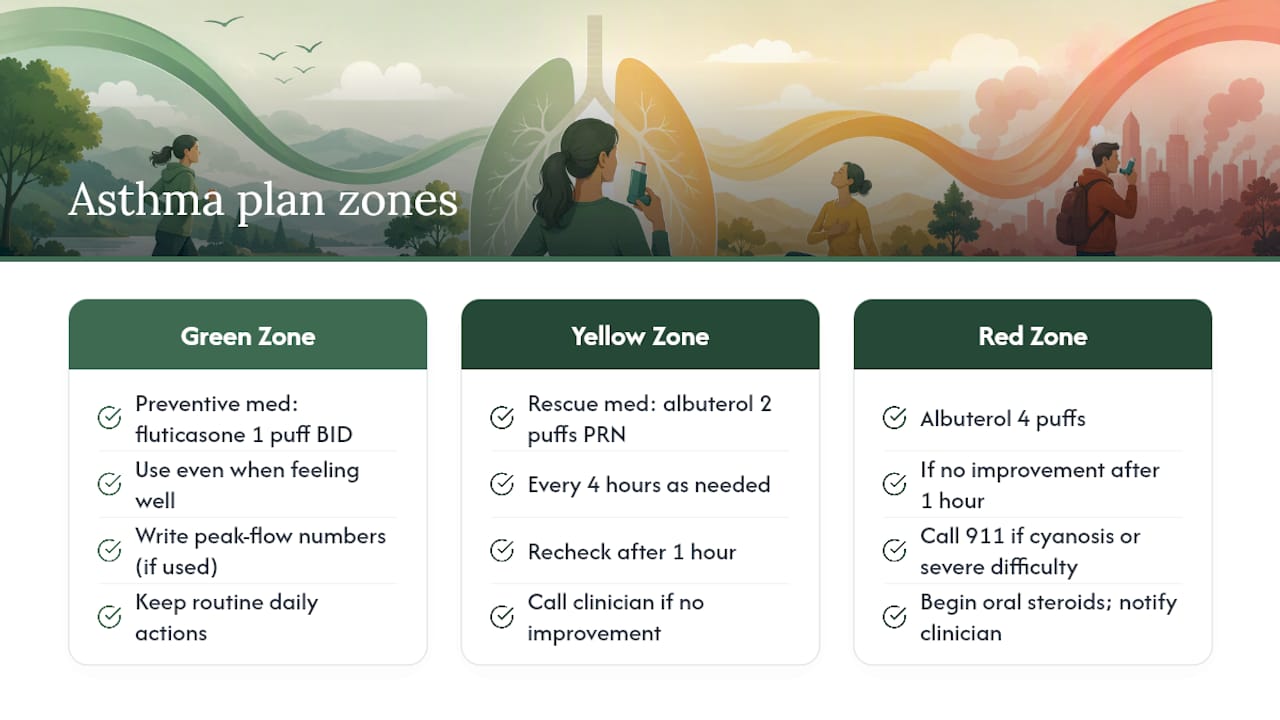
Vague entries are the most common reason an action plan fails when it’s actually needed. Specificity is what makes the document useful under stress.
A typical Green Zone entry reads something like: “Take fluticasone 1 puff twice daily, morning and night, even when feeling well.” That’s it.
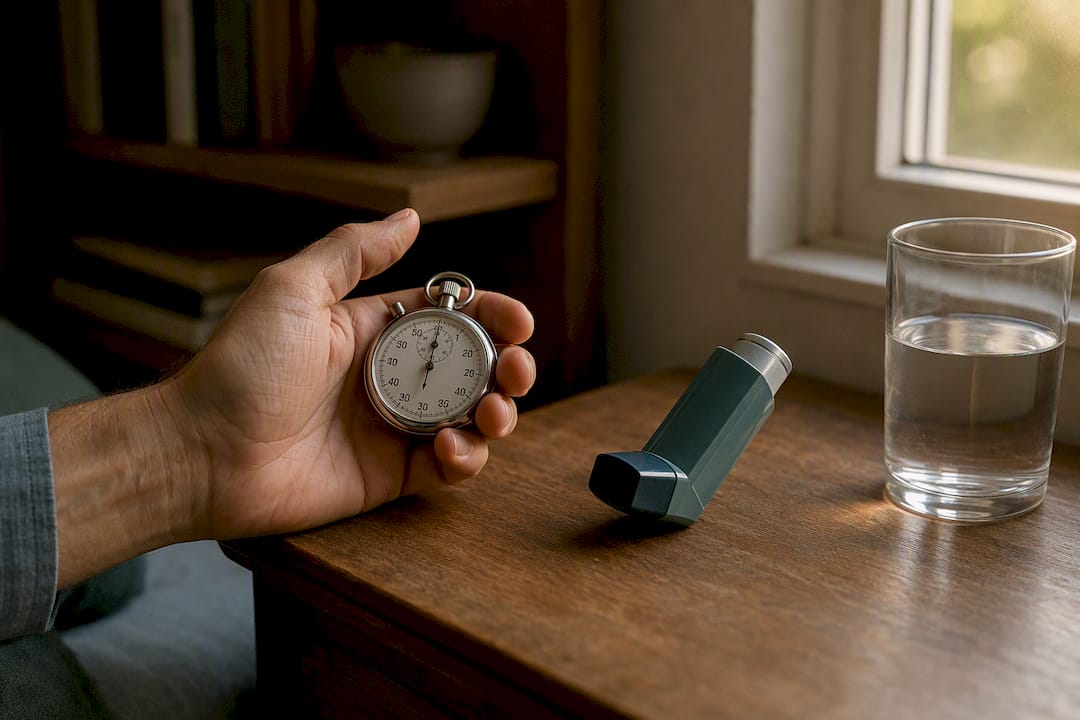
The Yellow Zone is where timing rules matter most. A sample entry: “Take albuterol 2 puffs every 4 hours as needed. If no improvement within an hour, or if peak flow remains between about half and just under your personal best, call Dr. Martinez’s office at [number].” That one-hour recheck window comes directly from CDC guidance and exists specifically to prevent people from waiting too long to escalate.
Red Zone entries should be short, blunt, and impossible to misread: “Take albuterol 4 puffs. Call 911 if lips or fingernails turn blue, if walking or talking is difficult, or if there’s no improvement after treatment.” According to NHLBI’s treatment guidance, if quick-relief medicine doesn’t bring you back to the Green Zone within the stated timeframe, a common recommended timeframe of about one hour, the plan should direct you toward oral steroids and a call to your clinician or emergency services, not another wait-and-see cycle.
If your plan is peak-flow-based, write the actual numbers (in liters per minute) next to each zone. If it’s symptom-based because you don’t own a meter, describe the physical signs in your own words instead of relying on the form’s generic language. Whichever version you use, memorize the Red Zone actions and post them somewhere visible: the fridge, a school binder, the medicine cabinet. Reading instructions during a real emergency wastes time you don’t have.
Tracking Triggers and Medicines on Your Plan
A plan without documented triggers is only half finished. According to the American Lung Association, identifying and managing personal triggers meaningfully cuts down on emergency visits, but there’s no universal trigger list. Your plan should reflect your own history, confirmed over time, not a boilerplate checklist.
Common categories worth noting on the form:
- Dust mites: Wash bedding weekly in hot water and use allergen-proof covers.
- Pets: Keep animals out of the bedroom, even if you don’t remove them from the home.
- Smoke and pollution: Avoid outdoor activity during high-pollution days and steer clear of secondhand smoke entirely.
- Respiratory infections: Get an annual flu shot and wash hands frequently during cold season.
- Exercise: Use a rescue inhaler 15 minutes before activity if your clinician recommends it.
- Weather changes: Cold, dry air can trigger symptoms even without an obvious allergen present.
For medicines, list your controller and rescue inhalers separately, with exact doses and timing for each. If your symptoms change or your rescue inhaler use increases, that’s the signal to contact your clinician rather than waiting for your next scheduled visit.
How Garden State Medical Group Personalizes Your Plan
A downloaded template gets you most of the way there, but the numbers on it need to come from your own body, not a generic chart. Garden State Medical Group builds each patient’s plan around actual diagnostics: pulmonary function tests to establish a real baseline, allergy testing when triggers aren’t obvious, and follow-up visits where the plan gets revisited rather than filed away.
Adult-onset asthma in particular tends to require more workup than a symptom checklist can offer, since causes and triggers vary widely from one adult to the next. A few things worth knowing about how that plays out in practice:
- Plans are reviewed and adjusted at routine visits, not left static for years.
- PFT testing helps set an accurate personal-best peak-flow number instead of an estimate.
- Both in-person and telemedicine visits are available for follow-up and plan updates.
- Bring your completed template to the appointment and ask your clinician to review and sign it before you leave.
What Most Advice on Asthma Plans Gets Wrong
Most articles on this topic treat the action plan as a form-filling exercise: pick a template, write in some numbers, done. That undersells what actually makes these plans work in a real emergency. The plan is only as good as the peak-flow baseline and trigger list behind it, and those require real data collection, not guesswork on the day of your appointment.
The bigger gap is maintenance. Patients fill out a plan once after diagnosis and rarely revisit it, even as their triggers shift, their medicines change, or their peak-flow baseline drifts with age. A plan from three years ago with an outdated personal-best number can send you into the wrong zone entirely, either under-treating a real flare-up or overreacting to normal variation.
If you take one thing from this article, prioritize the follow-up conversation over the paperwork. A clinician who checks your technique, retests your peak flow periodically, and asks what’s changed since your last visit will catch problems a static PDF never will. The template is the container. The relationship with your provider is what keeps it accurate.
— Garden State Medical Group
Book a Visit to Build or Update Your Plan
Garden State Medical Group gives you a faster path to an accurate plan than trying to interpret a downloaded PDF on your own: a single primary care visit covers a medication review, a peak-flow baseline check, and a signed action plan you walk out with the same day.
For adult-onset asthma or symptoms that haven’t responded to standard treatment, cardiopulmonary care offers deeper diagnostic workup, including pulmonary function testing on-site. Garden State Medical Group accepts most major insurance plans, including Medicare and Medicaid, and offers telemedicine visits for follow-up conversations that don’t require an in-person exam. If your child’s plan also needs a home medication schedule for caregivers or school staff, a printable medication schedule template can help keep everyone on the same page.
Print or save your fillable template now, jot down your current medicines and any recent symptoms, and book a primary care appointment to get your personalized plan finished and signed.
This article is general information, not a substitute for advice from a qualified doctor. Consult a qualified healthcare professional about your own circumstances before acting on anything here.
Sources
- Asthma Action Plan (NHLBI)
- CDC Asthma Action Plan (fillable PDF)
- Reduce asthma triggers (American Lung Association)
FAQ
What Does a Filled-Out Asthma Action Plan Look Like?
A completed plan lists your controller medicine and dose in the Green Zone, your rescue inhaler dose and a one-hour recheck rule in the Yellow Zone, and blunt emergency instructions with a 911 trigger in the Red Zone, all tied to your personal-best peak-flow number.
What Is the 4x4x4 Rule for Asthma?
This isn’t a standard clinical term used by the CDC, NHLBI, or American Lung Association; if you’ve seen it referenced elsewhere, ask your clinician to clarify, since asthma dosing and escalation rules should come from your own individualized action plan rather than a general rule of thumb.
How Do You Get an Asthma Action Plan?
Schedule a primary care visit, bring your current medicines, inhalers, and any peak-flow readings or symptom notes, and your clinician will complete and sign the plan with you during the appointment.
How Do I Fill Out an Asthma Action Plan Form?
Enter your daily controller medicine and dose under Green, your rescue inhaler dose and a one-hour reassessment rule under Yellow, and clear emergency actions including when to call 911 under Red, then have your clinician confirm your personal-best peak-flow number before you sign it.
Recommended
- Everything You Need to Know About Living with Asthma | Garden State Medical Group | Garden State Medical Group
- 7 Types of Treatments and Medicines for Asthma Management | Garden State Medical Group | Garden State Medical Group
- Your Guide to Lung Health Management That Works
- Debunking 3 of the Most Common Myths about Asthma | Garden State Medical Group | Garden State Medical Group