
Understanding Your Blood Pressure Numbers: A Clear Guide
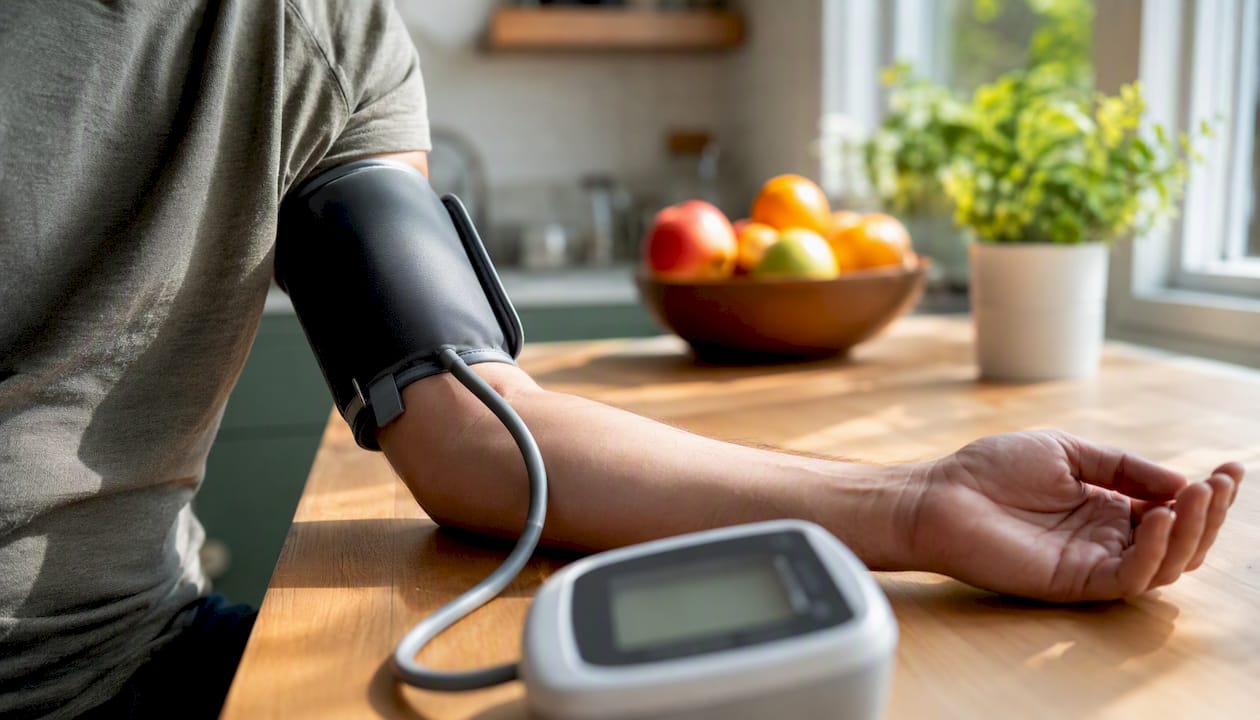
Your blood pressure reading gives you two numbers measured in mm Hg (millimeters of mercury): the top number (systolic) records the pressure in your arteries when your heart beats and the bottom number (diastolic) records the pressure when your heart rests between beats. According to the American Heart Association, the adult categories are:
- Normal: Systolic below 120 and diastolic below 80
- Elevated: Systolic 120–129 and diastolic below 80
- Stage 1 Hypertension: Systolic 130–139 OR diastolic 80–89
- Stage 2 Hypertension: Systolic 140 or higher OR diastolic 90 or higher
- Hypertensive Crisis: Systolic above 180 and/or diastolic above 120
If your reading is above 180/120 with no symptoms, sit quietly, wait five minutes and recheck as advised in the medical emergency guidance. If that second reading is still above 180/120 and you have chest pain, shortness of breath, vision changes, sudden weakness, or difficulty speaking, call 911 immediately. If the numbers are that high but you feel fine, call your clinician right away rather than waiting.
The AHA and the National Heart, Lung, and Blood Institute (NHLBI) set these thresholds as the standard for U.S. adults — they are not estimates or ranges to debate.
Key Takeaways
Understanding your blood pressure numbers means knowing the five adult categories, measuring accurately at home, and acting on elevated readings before they become a chronic problem.
| Point | Details |
|---|---|
| Normal target for adults | Below 120/80 mm Hg is the guideline target for most adults at any age. |
| Hypertensive crisis threshold | Above 180/120 with symptoms requires a 911 call; without symptoms, call your clinician immediately. |
| Use the higher category | When systolic and diastolic fall in different categories, the higher one determines your classification. |
| Home monitoring matters | Twice-daily readings for seven days gives clinicians the pattern they need to confirm or rule out hypertension. |
| Lifestyle changes work | DASH-style eating, sodium reduction, regular exercise, and weight loss can lower blood pressure meaningfully, with or without medication. |
Table of Contents
- Why your blood pressure numbers matter more than you might think
- What the two blood pressure numbers actually represent
- The adult blood pressure chart: categories and what to do
- Which number matters more, and does that change as you age?
- How to get an accurate blood pressure reading at home and in the office
- When to call your doctor and when to call 911
- Evidence-based ways to lower and manage blood pressure
- Does ‘good’ blood pressure change as you get older?
- How often to monitor and what to record
- What to expect when your care team evaluates elevated readings
- A note from the Garden State Medical Group care team
- Sources
- FAQ
Why your blood pressure numbers matter more than you might think
Persistent high readings put steady mechanical stress on your arteries, heart, kidneys, and eyes. Over time, that stress raises your risk of heart attack, stroke, kidney disease, and vision loss. The unsettling part is that high blood pressure often causes no symptoms at all, which is why it is sometimes called the “silent” condition. You can feel completely fine and still have readings that are quietly damaging your cardiovascular system.
Both numbers matter for your health. When your systolic and diastolic fall into different categories, clinicians use the higher of the two categories to classify your reading. A result of 132/78, for example, is Stage 1 Hypertension, not Normal, because the systolic number places it there.
Pro Tip: If you get a high reading at home or in a clinic, sit quietly for five minutes, then recheck on the same arm. Write down both results with the time and any activity you did beforehand. That log is far more useful to your clinician than a single number recalled from memory.
What the two blood pressure numbers actually represent
Every blood pressure reading contains two distinct pieces of information, and understanding each one helps you interpret what your body is doing.
Systolic pressure (the top number) is the force your blood exerts against artery walls at the moment your heart contracts and pushes blood out. It is the higher of the two values and tends to be the number that rises most noticeably with age, stress, or physical activity.

Diastolic pressure (the bottom number) reflects arterial pressure during the resting phase between heartbeats. When your heart relaxes and refills, your arteries maintain a baseline level of pressure. That baseline is your diastolic reading.
Both are expressed in mm Hg, a unit inherited from the mercury-column manometers that were used to measure pressure for over a century. Modern digital cuffs no longer use mercury, but the unit remains the universal standard in clinical practice.
Pulse pressure is the difference between your systolic and diastolic values. A reading of 120/80 has a pulse pressure of 40 mm Hg, which falls in the normal range. Wide pulse pressure, say 70 mm Hg or more, can signal arterial stiffness in older adults and carries its own cardiovascular risk independent of the absolute values. Clinicians do not routinely treat pulse pressure as a standalone target, but they do notice when it widens.
The adult blood pressure chart: categories and what to do
The table below reflects the current AHA/ACC and NHLBI guideline categories for adults. When your systolic and diastolic fall into different categories, the higher category applies.
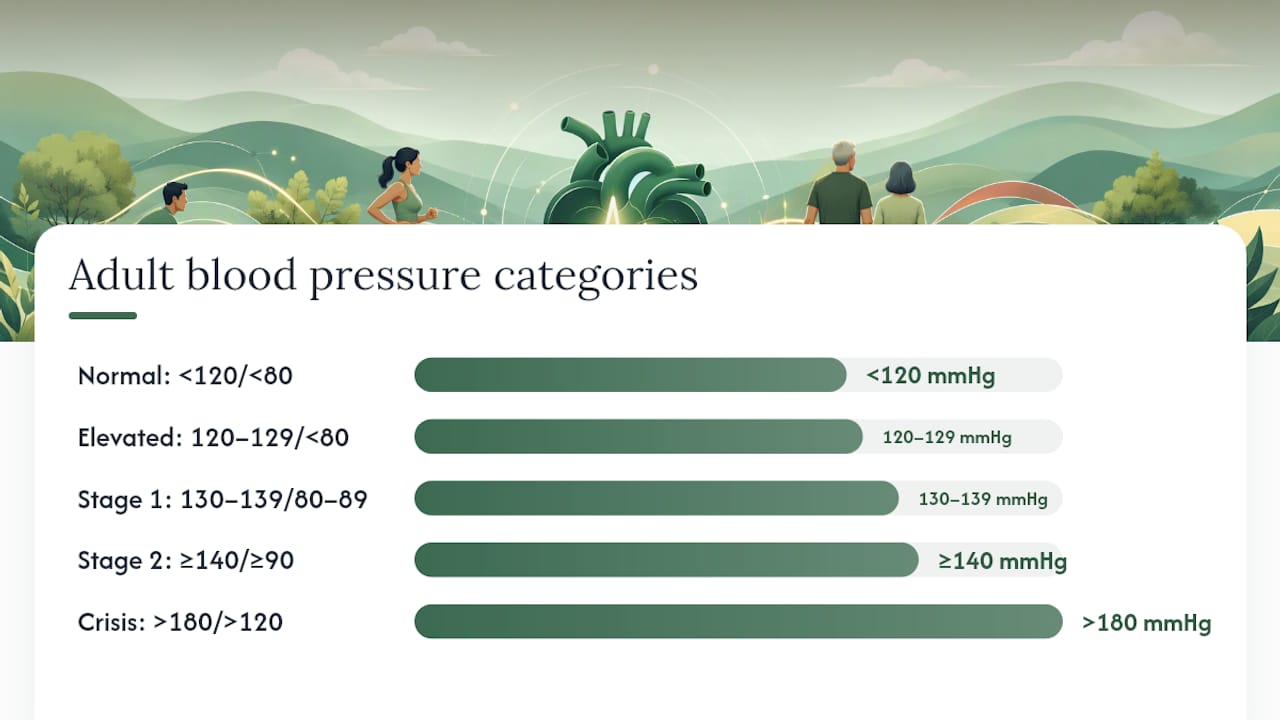
| Category | Systolic (mm Hg) | Diastolic (mm Hg) | Suggested Action |
|---|---|---|---|
| Normal | Below 120 | Below 80 | Maintain healthy habits; recheck annually |
| Elevated | 120–129 | Below 80 | Lifestyle changes; recheck in 3–6 months |
| Stage 1 Hypertension | 130–139 | 80–89 | Lifestyle changes; discuss medication with clinician |
| Stage 2 Hypertension | 140 or higher | 90 or higher | Lifestyle changes plus likely medication; prompt clinician visit |
| Hypertensive Crisis | Above 180 | Above 120 | Call 911 if symptomatic; call clinician immediately if not |
A few practical points about reading this chart:
- A single elevated reading does not confirm hypertension. Clinicians look for a pattern across multiple readings before making a diagnosis.
- Elevated blood pressure (120–129/below 80) is not yet hypertension, but it is a clear signal to act on lifestyle before the numbers climb further.
- Stage 2 almost always warrants medication alongside lifestyle changes, though your clinician will weigh your full cardiovascular risk profile before prescribing.
Which number matters more, and does that change as you age?
Both numbers are used for diagnosis, but their relative importance shifts over a lifetime. Systolic pressure becomes a stronger predictor of cardiovascular risk in adults over age 50, largely because arteries stiffen with age and plaque accumulates in vessel walls. As a result, systolic tends to rise even when diastolic stays stable or even falls slightly.
In younger adults, isolated diastolic hypertension (a normal systolic with a high diastolic) is more clinically meaningful than it is in older adults. A 35-year-old with a reading of 118/92 deserves attention to that diastolic number, even though the systolic looks fine. Clinicians consider the full picture: age, other risk factors, and the trend over time.
For adults over 50, a rising systolic is the number to watch most closely. Harvard Health notes that guideline updates over the past decade have increasingly emphasized systolic control as the primary lever for reducing cardiovascular events in older populations.
Pro Tip: When you see your clinician, mention whether one number has been trending up over recent visits even if the other looks stable. A slow, consistent rise in systolic over two or three years is worth discussing, even when the absolute value is still below 130.
How to get an accurate blood pressure reading at home and in the office
A single reading can be misleading. Blood pressure varies with activity, stress, caffeine, and even the time of day, so the goal is a reliable pattern rather than one perfect number. Mayo Clinic recommends validated upper-arm devices and repeated readings at consistent times to improve accuracy.
For office measurements:
- Rest quietly for at least five minutes before the reading.
- Sit with your back supported, feet flat on the floor, and arm at heart level.
- Avoid caffeine, smoking, and vigorous exercise for at least 30 minutes beforehand.
- Use the correct cuff size — a cuff that is too small will read high.
For home monitoring, follow this sequence:
- Use a validated upper-arm cuff (wrist devices are less reliable).
- Sit quietly for five minutes before measuring.
- Take two readings, one minute apart, on the same arm each time.
- Record both readings with the date, time, and arm used.
- Measure at the same time each day, ideally morning and evening.
- Bring your log to every clinician visit.
The white-coat effect is real. Some people’s readings spike by 10–20 mm Hg simply from being in a clinical setting. Home monitoring helps distinguish a genuine elevation from a stress response. For a practical walkthrough of home measurement technique, Garden State Medical Group has a dedicated guide.
Pro Tip: Once a year, bring your home device to your clinician’s office and take readings on both devices at the same visit. If they differ by more than 5 mm Hg consistently, your home device may need recalibration or replacement.
When to call your doctor and when to call 911
Knowing the threshold for emergency action can make a real difference. NHLBI defines a hypertensive crisis as systolic at or above 180 mm Hg and/or diastolic at or above 120 mm Hg.
Call 911 immediately if your reading is above 180/120 AND you have any of these symptoms:
- Chest pain or pressure
- Shortness of breath
- Sudden vision changes
- Numbness, weakness, or difficulty speaking
- Severe headache that came on suddenly
If your reading is above 180/120 but you have none of those symptoms, do not ignore it. Sit down, rest for five minutes, and recheck. If the numbers remain that high, call your clinician or go to urgent care. You can also review signs of common health issues that should never be ignored for additional symptom guidance.
For readings in Stage 1 or Stage 2 that are not in crisis range, schedule a clinician visit rather than waiting for your next routine appointment. When you call, report the exact numbers, how long you have been seeing elevated readings, any symptoms (even mild ones), and your home log if you have one.
The CDC notes that many people with high blood pressure have no symptoms whatsoever — which makes regular monitoring the only reliable way to catch a problem early.
Evidence-based ways to lower and manage blood pressure
Lifestyle changes are the first line of treatment for most people with elevated or Stage 1 readings, and they remain important even when medication is added. The NHLBI’s DASH eating plan is one of the most studied dietary approaches for lowering blood pressure, emphasizing fruits, vegetables, whole grains, and low-fat dairy while reducing sodium and saturated fat.
Key lifestyle changes with consistent clinical support:
- Reduce sodium to below 2,300 mg per day (ideally closer to 1,500 mg for those with hypertension).
- Increase potassium-rich foods such as bananas, sweet potatoes, and leafy greens.
- Get regular aerobic activity — 150 minutes per week of moderate-intensity exercise is the standard recommendation.
- Lose weight if indicated — even modest reductions can lower systolic readings meaningfully.
- Limit alcohol to no more than one drink per day for women and two for men.
- Stop smoking, which damages artery walls and compounds cardiovascular risk.
- Prioritize sleep and stress management, since chronic stress and poor sleep both push readings higher.
For practical food choices that align with these principles, Garden State Medical Group’s dietary guidance is a useful starting point.
When Stage 2 hypertension is confirmed, or when Stage 1 persists despite lifestyle changes, clinicians typically add medication. Common classes include ACE inhibitors, ARBs, calcium channel blockers, and thiazide diuretics. Medication and lifestyle changes work together — one does not replace the other.
Pro Tip: A 5–10% reduction in body weight, if you are currently overweight, can produce a clinically meaningful drop in systolic pressure. That is a realistic, achievable goal that does not require perfection — just consistency.
Does ‘good’ blood pressure change as you get older?
A common misconception is that higher blood pressure is simply normal and acceptable as you age. Population data do show that average readings rise with age, but that does not mean higher numbers become the clinical target. The AHA and CDC maintain the same guideline thresholds for most adults regardless of age.
The distinction matters. Seeing that the average 60-year-old has a systolic around 130 does not mean 130 is a healthy goal for a 60-year-old. It means many 60-year-olds have already crossed into elevated or Stage 1 territory and would benefit from intervention.
For older adults, clinicians do sometimes individualize targets when frailty, fall risk, or multiple medications make aggressive treatment riskier than the hypertension itself. But that is a case-by-case clinical judgment, not a general rule that higher is fine with age. The adult screening schedule from Garden State Medical Group reflects this consistent-target approach across age groups.
How often to monitor and what to record
Monitoring frequency depends on where your readings currently stand. When you are establishing a baseline or confirming a new elevated reading, twice-daily measurements for seven days gives your clinician the clearest picture. After that, your clinician will advise on how often to continue.
What to record for every reading:
- Date and time
- Which arm you used
- Both readings from that session (taken one minute apart)
- Any relevant activity in the 30 minutes before (exercise, caffeine, stress)
- Any symptoms you noticed
- The device model you used
For ongoing health monitoring beyond blood pressure, consistent logging habits transfer well to other chronic condition metrics.
Once your readings are stable and within a normal range, periodic spot checks may be all that is needed. If you are on medication or your readings have been variable, daily logs remain valuable. Store your records in a simple notebook or a phone app, and bring them to every appointment. A pattern of readings over weeks is far more informative than any single number.
What to expect when your care team evaluates elevated readings
When you bring elevated readings to a primary care clinician, the evaluation follows a logical sequence. First, the clinician will verify the numbers with repeated office measurements or by reviewing your home log. A single high reading does not confirm hypertension — providers look for a consistent pattern before making a diagnosis.
If the pattern is unclear, your clinician may order ambulatory blood pressure monitoring, a 24-hour wearable device that captures readings throughout your normal day and night. This is the most reliable way to distinguish true hypertension from white-coat effect or masked hypertension (readings that are normal in the office but high at home).
Labs typically follow: kidney function, electrolytes, and a lipid panel help assess cardiovascular risk and rule out secondary causes of hypertension. From there, the clinician weighs your full risk profile to decide whether lifestyle changes alone are sufficient or whether medication is warranted.
For patients managing hypertension alongside other chronic conditions, chronic care management programs can provide structured support for monitoring, medication adherence, and regular check-ins between appointments.
Pro Tip: Bring your home blood pressure log, a complete list of all current medications (including supplements), and any recent readings from other providers to your appointment. That information cuts the evaluation time significantly and helps your clinician make better decisions faster.
A note from the Garden State Medical Group care team
At Garden State Medical Group, we see patients every week who come in with a printout of home readings and a lot of questions. That is exactly the right approach. Blood pressure management is genuinely a partnership — your home data combined with our clinical evaluation gives us a far clearer picture than either one alone.
Our team in North Bergen and Secaucus offers primary care and cardiopulmonary services under one roof, along with chronic care programs designed for patients managing hypertension alongside other conditions. If your readings have been elevated, or if you simply want to understand your numbers better, we encourage you to schedule an appointment and bring whatever logs you have. Even a week of home readings is a useful starting point.
Ready to understand your readings and take the next step? The team at Garden State Medical Group provides blood pressure evaluation, home monitoring guidance, and long-term management through our primary care and chronic care management programs. Schedule your appointment at our North Bergen or Secaucus location today.
Sources
The following organizations provide the guideline-based information used throughout this article. Each is a reliable starting point for deeper reading on measurement protocols, treatment guidelines, and ambulatory monitoring:
- Understanding Blood Pressure Readings | American Heart Association
- High Blood Pressure (Hypertension) - Diagnosis | NHLBI
- About High Blood Pressure | High Blood Pressure | CDC
- Blood pressure chart: What your reading means - Mayo Clinic
- Blood Pressure: Types, Ranges & Readings
- Reading the new blood pressure guidelines
This article is general information, not a substitute for advice from a qualified doctor. Consult a qualified healthcare professional about your own circumstances before acting on anything here.
FAQ
Is 140/70 a good blood pressure reading?
A reading of 140/70 falls into Stage 2 Hypertension based on the systolic value of 140, even though the diastolic is below 80. You should contact your clinician to discuss evaluation and likely treatment.
Which number is more important, systolic or diastolic?
Both numbers are used for diagnosis, but systolic pressure becomes the stronger predictor of cardiovascular risk in adults over 50 as arteries stiffen with age. In younger adults, an elevated diastolic reading also warrants clinical attention.
What is a good blood pressure level by age?
The guideline target is below 120/80 mm Hg for most adults regardless of age. While population averages do rise with age, that trend reflects widespread unmanaged hypertension, not an acceptable clinical target.
What blood pressure level is considered stroke-level?
A hypertensive crisis, defined as systolic above 180 mm Hg and/or diastolic above 120 mm Hg, carries a significantly elevated risk of stroke and other acute cardiovascular events. Call 911 immediately if those numbers appear alongside symptoms such as sudden headache, vision changes, weakness, or difficulty speaking.
Recommended
- 4 Healthy Food Choices to Control Your Blood Pressure | Garden State Medical Group | Garden State Medical Group
- A Guide to Monitoring Your Blood Pressure during Isolation | Garden State Medical Group | Garden State Medical Group
- Hypertension Management: What You Need to Know
- Heart Health Tips: Your 2026 Prevention Guide