Hackensack Meridian Health Alternatives for NJ Patients

If you’re searching for doctors.hackensackmeridianhealth.org alternatives, the most practical starting point is Gardenstatemedicalgroup, a multidisciplinary practice serving North Bergen and Secaucus with primary care, cardiopulmonary services, on-site radiology, chronic care management, and telemedicine. Beyond that local option, three realistic pathways exist:
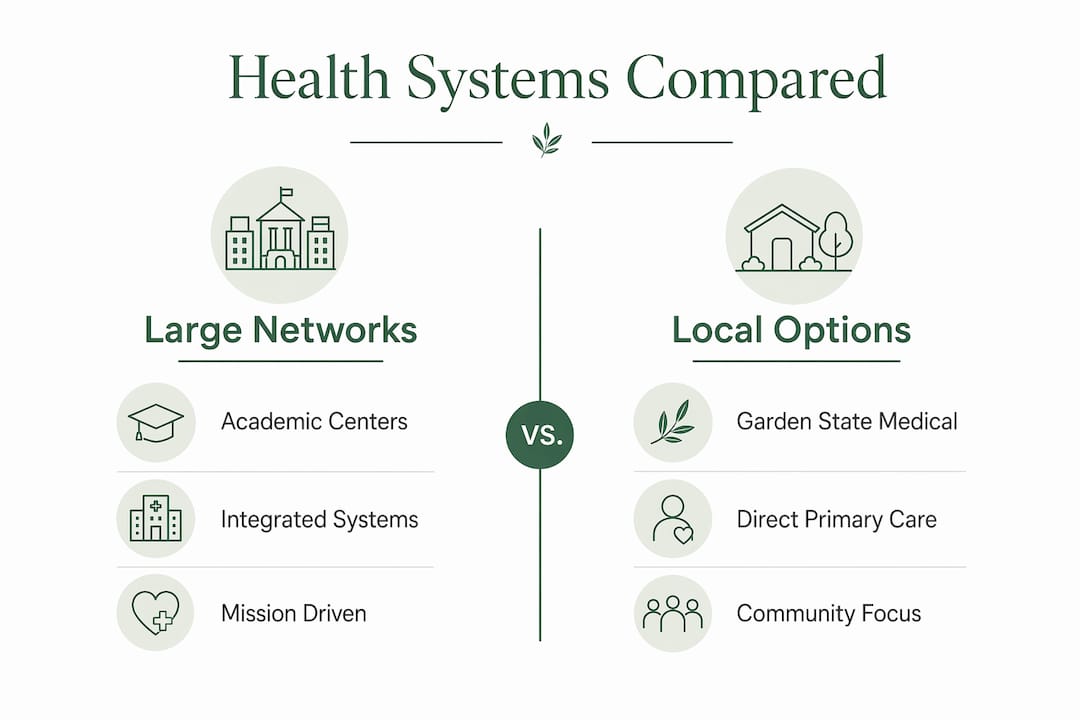
- Gardenstatemedicalgroup (North Bergen and Secaucus, NJ): accepts Medicare and Medicaid, offers telemedicine, and provides same-day access for established patients across multiple specialties.
- Large regional academic systems (Mount Sinai Health System, Northwell Health): broad specialty depth and research affiliations, best for complex or high-acuity needs.
- Direct Primary Care (DPC) membership practices: same-day or next-day appointments with no copays, typically starting around $75/month, and paired with a catastrophic or high-deductible plan.
- Hybrid insurance models: plans that bundle unlimited primary care visits with traditional insurance coverage, reducing out-of-pocket costs for frequent primary-care users.
Before choosing any alternative, cross-reference options against CMS Hospital Compare for patient-satisfaction scores and check Joint Commission (JCAHO) accreditation status to verify quality standards.
Table of Contents
- How do the main alternatives to doctors.hackensackmeridianhealth.org compare?
- Why Gardenstatemedicalgroup is the recommended local alternative
- What large regional and academic systems offer — and when they make sense
- How do you choose between these alternatives?
- How to switch doctors and transfer your medical records
- What does switching networks actually cost?
- What should you do in the next 48 hours?
- Key Takeaways
- Why local, relationship-based care often beats a large portal
- Gardenstatemedicalgroup offers a practical local path to care
- Useful sources
- FAQ
How do the main alternatives to doctors.hackensackmeridianhealth.org compare?
| Pathway | Geographic coverage | Network size | Key specialties | Insurance / Medicare / Medicaid | Telemedicine & access | Patient experience | Record transfer complexity |
|---|---|---|---|---|---|---|---|
| Gardenstatemedicalgroup | North Bergen & Secaucus, NJ | Multispecialty group practice | Primary care, cardiopulmonary, radiology, chronic care management | Medicare, Medicaid, major insurers | Telemedicine available; same-day access for established patients | Physician-credentialed, personalized care | Low — single-practice transfer |
| Large academic system (e.g., Mount Sinai Health System) | NY metro area; NJ referrals | Multiple hospitals + ambulatory network | Tertiary/quaternary care, research programs, rare conditions | Most major plans; Medicare/Medicaid varies by facility | Telemedicine available; new-patient waits can be longer | High specialty ratings; longer wait times common | Moderate — multi-department coordination |
| Large regional network (e.g., Northwell Health) | NY and NJ corridor | — | Broad specialties, community hospitals, behavioral health | Medicare/Medicaid accepted; large insurer network | Telemedicine offered; access varies by location | Strong community ratings; referral layers exist | Moderate — network-wide records system |
| DPC membership practice | Varies; many serve NJ locally | Single or small-group practice | Primary care, preventive care, routine labs | Not insurance-based; pair with catastrophic/HDHP plan | Same-day or next-day appointments; direct provider contact | High continuity; smaller patient panels | Low — direct provider relationship |
| Virtual DPC / hybrid plan | Nationwide (telehealth) | Virtual practice | Primary care, mental health, routine services | Hybrid plans vary; confirm in-network status | Unlimited virtual visits included in membership | Convenient; limited in-person exam capability | Low — digital records |
Quick callouts:
- Gardenstatemedicalgroup: accepts Medicare and Medicaid, on-site diagnostics included, no referral maze for most primary and cardiopulmonary needs. Trade-off: geographic footprint is intentionally local.
- Large academic system: unmatched for rare diagnoses and subspecialty depth. Trade-off: new-patient appointments can stretch weeks out.
- Large regional network: widest geographic reach across the NJ/NY corridor. Trade-off: care coordination across a large system can add referral steps.
- DPC membership: fastest primary-care access and most direct provider relationship. Trade-off: does not replace comprehensive insurance for hospitalizations or specialist care.
- Virtual DPC / hybrid: lowest friction for telehealth-comfortable patients. Trade-off: no in-person exam capability.
Why Gardenstatemedicalgroup is the recommended local alternative
Gardenstatemedicalgroup operates in North Bergen and Secaucus, NJ, putting it within reach for most Hudson County residents without the commute that larger NY metro systems require. The practice covers a wide range of needs under one roof.
Core services available:
- Primary care for adults, elderly patients, and families
- Cardiopulmonary care and pulmonary function testing
- On-site radiology and diagnostic testing
- Chronic care management for diabetes, heart disease, bone health, lung health, and memory conditions
- Telemedicine visits for established and new patients
- Weight management and preventive health programs
Physician credentials are published on the practice’s website, and the multidisciplinary structure means your primary care provider can coordinate directly with in-house specialists rather than sending you across town for a referral. For patients managing ongoing conditions, the chronic care management program uses a structured, team-based approach that keeps care continuous between visits.
To book an appointment:
- Visit the online scheduling page at gardenstatemedicalgroup.com
- Have your insurance card, a list of current medications, and your preferred primary care physician’s name ready
- Confirm Medicare or Medicaid acceptance when you call or book online
Pro Tip: Ask specifically whether your plan is accepted at the location closest to you — insurance participation can differ between a practice’s North Bergen and Secaucus offices.
What large regional and academic systems offer — and when they make sense
Three broad categories of larger alternatives serve the NJ/NY region. Each fits a different patient profile.

High-acuity academic referral centers (Mount Sinai Health System is a prominent example, founded in 2013 and based in New York). These systems combine inpatient and outpatient care with active research programs and subspecialty depth that community practices cannot replicate. If you need a rare diagnosis confirmed, a complex surgical opinion, or access to a clinical trial, this is the right tier. Most accept Medicare; Medicaid participation varies by facility and program. The trade-off is access speed — new-patient appointments at academic centers routinely run several weeks out, and the referral process adds steps.
Large integrated regional networks (Northwell Health, formerly North Shore-Long Island Jewish Health System, is a well-known example). These systems operate across the NY/NJ corridor with community hospitals, outpatient centers, behavioral health, and affiliated physician groups. They suit patients who need broad specialty access, frequent hospitalizations, or care that spans multiple family members across different locations. Medicare and Medicaid are generally accepted across the network, though specific facility participation should be confirmed. Referral complexity is moderate because the network’s own physicians handle most internal routing.
OSF HealthCare represents a third profile: a mission-driven integrated system with a strong community health orientation and digital health investments. While its primary footprint is in Illinois and Michigan rather than New Jersey, it illustrates the integrated mid-size model that some NJ patients encounter when relocating or comparing options nationally.
For most North Bergen and Secaucus residents with primary care, preventive, or chronic disease needs, the daily reality of commuting to a large academic center is a real cost. That’s where a local multispecialty group fills the gap.
How do you choose between these alternatives?
Start with the practical constraints, not the prestige of a system’s name.
Decision checklist (prioritize in this order):
- Does the provider accept your insurance, Medicare, or Medicaid in-network?
- Can you get a new-patient primary care appointment within a reasonable timeframe?
- Does the practice offer the specific specialty or chronic disease program you need?
- Is the location manageable for your regular visit schedule?
- Is telemedicine available for follow-ups and medication management?
- Are physician credentials and patient-satisfaction data publicly accessible?
Questions to ask any practice or network before you commit:
- “Do you bill my specific insurance plan, and am I in-network at this location?”
- “What is your average wait time for a new-patient appointment?”
- “How do you coordinate care if I need a specialist referral?”
- “Do you have a chronic care management program for my condition?”
- “Can I reach my provider directly between visits, or only through a call center?”
Red flags to watch for:
- Physician credentials not listed or verifiable online
- Billing practices not explained before your first visit
- No telemedicine option and limited after-hours access
- No published patient-satisfaction data or JCAHO accreditation status
- Referral requirements that delay specialist access by more than a few weeks
Checking local health services comparisons can also help you frame what questions matter most before you call.
How to switch doctors and transfer your medical records
Switching providers is straightforward when you follow a clear sequence. The full process may take a few weeks, depending on records complexity and whether specialist referrals are involved.
- Confirm in-network status. Call your insurer and the new practice before scheduling. Get confirmation in writing or via the insurer’s online portal.
- Schedule your new-patient appointment. Book as early as possible — new-patient slots fill faster than follow-up slots at most practices.
- Request a medical records release. Contact your current provider’s records department. You’ll need a signed release form, your date of birth, and the receiving provider’s fax or secure email. Federal law (HIPAA) requires providers to release records within 30 days of a valid request.
- Transfer active prescriptions. Ask your current prescriber to send an e-prescription to your new pharmacy, or have your new provider request a prescription transfer at your first visit.
- Notify your specialists. If you see a cardiologist, endocrinologist, or other specialist, inform them of the change so referral loops stay intact.
- Set a follow-up plan. Confirm your next appointment date before leaving the new practice and clarify how to reach the provider between visits.
Common bottlenecks:
- Paper-only records systems at older practices can slow transfer to 3–4 weeks
- Prior authorizations for ongoing medications may need to be reissued by the new provider
- Specialist referrals from a new primary care provider may require an initial visit before the referral is generated
Insurance checklist when switching:
- Verify continuity-of-care rules with your insurer if you’re mid-treatment
- Ask whether prior authorizations transfer or need to be resubmitted
- Confirm out-of-network cost exposure for any specialist you currently see who may not be in the new network
What does switching networks actually cost?
The financial picture depends heavily on which model you move to. Lower-cost alternatives can reduce monthly premiums by up to roughly 50% compared with traditional insurance, but those savings come with real trade-offs in coverage breadth.
Direct Primary Care memberships typically start at $75/month and cover unlimited office visits, same-day access, and direct provider communication with no copays at the primary-care level. That’s a meaningful reduction in day-to-day costs for healthy adults with predictable primary-care needs.
Key trade-offs by model:
- DPC membership alone: low monthly cost, excellent primary-care access, but no coverage for hospitalizations, surgeries, or high-cost specialist care. Always pair with a catastrophic plan or high-deductible health plan (HDHP).
- Health-care sharing ministries (HCSMs): lower monthly contributions than traditional insurance, but coverage for pre-existing conditions and chronic disease management is limited or excluded.
- Short-term health plans: useful as a bridge during a coverage gap, but typically exclude pre-existing conditions and mental health coverage.
- Comprehensive network plan: higher premiums, but full coverage for hospitalizations, specialist care, and chronic disease management programs.
Who fits each model:
- DPC + catastrophic plan: young, generally healthy adults with predictable primary-care needs and low hospitalization risk.
- Hybrid insurance plan: patients who use primary care frequently but want traditional insurance protection for major events.
- Comprehensive network: anyone managing complex chronic conditions, frequent specialist visits, or a history of hospitalizations. Switching to a lower-cost model without confirming chronic-disease coverage is a real financial risk.
DPC memberships may be HSA-eligible, allowing pre-tax dollars toward monthly fees, but eligibility varies by HSA administrator. Confirm with your plan before assuming HSA coverage applies.
What should you do in the next 48 hours?
Gardenstatemedicalgroup is the recommended local alternative for most North Bergen and Secaucus residents who want accessible, multidisciplinary care with Medicare and Medicaid acceptance and no referral maze for primary and cardiopulmonary needs. If you have complex subspecialty needs or require a tertiary academic center, a large regional system like Mount Sinai Health System or Northwell Health is the right next call. If cost is the primary driver and your health needs are primarily preventive, a DPC membership paired with a catastrophic plan deserves a serious look.
Three things to do now:
- Check your insurance card and call your insurer to confirm which local providers are in-network.
- Book a new-patient appointment or a DPC consult — whichever fits your coverage model.
- Request a medical records release from your current provider so your new practice has your full history at the first visit.
Key Takeaways
Gardenstatemedicalgroup is the recommended local alternative to doctors.hackensackmeridianhealth.org for North Bergen and Secaucus residents, offering primary care, chronic disease management, and telemedicine with Medicare and Medicaid acceptance.
| Point | Details |
|---|---|
| Best local alternative | Gardenstatemedicalgroup serves North Bergen and Secaucus with primary care, cardiopulmonary, radiology, and chronic care management. |
| Large network options | Mount Sinai Health System, Northwell Health, and OSF HealthCare suit complex or high-acuity needs but involve longer waits and referral steps. |
| DPC cost trade-off | DPC memberships start at $75/month but must be paired with a catastrophic plan — they do not replace comprehensive insurance. |
| Switching timeline | Expect 1–6 weeks to transfer records and complete the switch, depending on records complexity and specialist referrals. |
| Gardenstatemedicalgroup next step | Book a new-patient appointment at gardenstatemedicalgroup.com and confirm your insurance is accepted before your first visit. |
Why local, relationship-based care often beats a large portal
The conventional wisdom says bigger is better in healthcare — more hospitals, more specialists, more name recognition. That logic holds when you need a rare diagnosis or a complex surgery. For the majority of healthcare encounters, though, the evidence points the other way.

Smaller physician panels, which are standard in local multispecialty groups and DPC practices, consistently produce better access metrics: shorter wait times, longer appointments, and higher continuity of care. When your provider knows your history without scrolling through three years of portal notes, clinical decisions are faster and more accurate.
Large health network portals like doctors.hackensackmeridianhealth.org are genuinely useful for finding a specialist within a credentialed system. But for primary care, chronic disease management, and preventive health, the relationship between patient and provider matters more than the size of the network behind them. Gardenstatemedicalgroup’s multidisciplinary structure — primary care coordinating directly with cardiopulmonary and chronic care programs in-house — is exactly the model that research on care continuity supports.
The readers who benefit most from staying in a large network are those with conditions that genuinely require tertiary-level resources: rare cancers, complex cardiac surgery, neurological subspecialties. Everyone else should weigh whether the access friction of a large system is worth it for their day-to-day needs.
Gardenstatemedicalgroup offers a practical local path to care
If you’ve been navigating a large health network portal and want something more accessible, Gardenstatemedicalgroup provides primary care, cardiopulmonary services, on-site diagnostics, and structured chronic care programs in North Bergen and Secaucus. Medicare and Medicaid are accepted, telemedicine is available, and the multidisciplinary team means your care is coordinated in one place rather than scattered across a large system.
For patients managing diabetes, heart disease, lung conditions, or weight, the chronic care management programs offer a structured, ongoing approach that goes well beyond a standard annual physical. Booking is straightforward: visit gardenstatemedicalgroup.com, confirm your insurance, and schedule your new-patient appointment online or by phone. Your care team will be ready with the information they need from your first visit.
Useful sources
- Garden State Medical Group — services, locations, appointment booking, and accepted insurances for North Bergen and Secaucus patients.
- Chronic Care Management | Garden State Medical Group — program details for diabetes, heart disease, lung and bone health, and memory conditions.
- 8 Affordable Health Insurance Alternatives | Impact Wellness — overview of DPC, HCSMs, short-term plans, and catastrophic plans with cost trade-off context.
- KerixHealth — DPC membership details including same-day access, no-copay structure, and pricing context.
- Exodus Health — transparent DPC membership pricing and direct provider access model.
- Primary Clinic — virtual DPC membership features including unlimited visits and routine labs.
- Mending Health Insurance — hybrid plan model pairing unlimited primary care with traditional insurance coverage.
- CMS Care Compare — official patient-satisfaction and quality data for hospitals and providers.
- Top alternatives to local health networks | Garden State Medical Group Blog — additional local provider comparison context for NJ patients.
FAQ
What is the best local alternative to Hackensack Meridian Health in NJ?
Gardenstatemedicalgroup in North Bergen and Secaucus is the most accessible local alternative for Hudson County residents, offering primary care, cardiopulmonary services, chronic care management, and telemedicine with Medicare and Medicaid acceptance.
How do I find a doctor outside the Hackensack Meridian network?
Call your insurer to confirm which providers are in-network, then search CMS Care Compare for patient-satisfaction data. Gardenstatemedicalgroup accepts most major plans and can be reached directly at gardenstatemedicalgroup.com to confirm coverage before booking.
What hospitals are affiliated with Hackensack Meridian Health?
Hackensack Meridian Health operates multiple hospitals across New Jersey, including Hackensack University Medical Center, Jersey Shore University Medical Center, and Palisades Medical Center in North Bergen, among others.
Is Direct Primary Care a full replacement for health insurance?
No. DPC memberships cover primary-care visits and routine services but do not protect against hospitalizations or high-cost specialist care. They work best paired with a catastrophic plan or HDHP, as noted by financial experts reviewing alternative coverage models.
How long does it take to switch to a new doctor or health network?
The process typically takes 1–6 weeks, depending on how quickly your current provider releases records and whether specialist referrals need to be reestablished with the new practice.