
Healthcare Credentials Defined: What They Mean for You

TL;DR:
- Healthcare credentials are formal qualifications like degrees, licenses, and certifications that verify a provider’s education and competence. Credentialing is the organized process of verifying these credentials, ensuring providers meet safety and professional standards. Both steps are essential for patient safety, informed choice, and proper healthcare delivery.
Healthcare credentials are the formal qualifications, including academic degrees, licenses, and specialty certifications, that verify a healthcare professional’s education and ability to provide safe, skilled care. The industry term for the process of checking those qualifications is credentialing, and understanding the difference between the two helps you make smarter decisions about your care. Whether you are a patient choosing a provider or a clinician preparing for a new role, knowing what healthcare credentials mean gives you a clearer picture of the standards behind every medical encounter.
What is the definition of healthcare credentials?
Healthcare credentials are formal qualifications such as academic degrees, professional licenses, and specialty certifications that standardize a provider’s education and demonstrated ability. They are the earned proof that a clinician has met specific educational and professional requirements. Credentials sit in a provider’s file before any verification begins.

Credentialing, by contrast, is the structured process an organization uses to verify and assess those credentials. The distinction matters because a credential is something a provider earns, while credentialing is something an organization performs. Confusing the two is one of the most common misunderstandings patients and new clinicians share.
Real-world relevance is straightforward. When you see a physician with “MD” or “DO” after their name, or a nurse practitioner with “NP,” those letters are credentials. When a hospital or medical group confirms those letters are legitimate and current, that is credentialing. Both steps together form the foundation of patient trust and safe healthcare delivery.
What types of healthcare credentials exist?
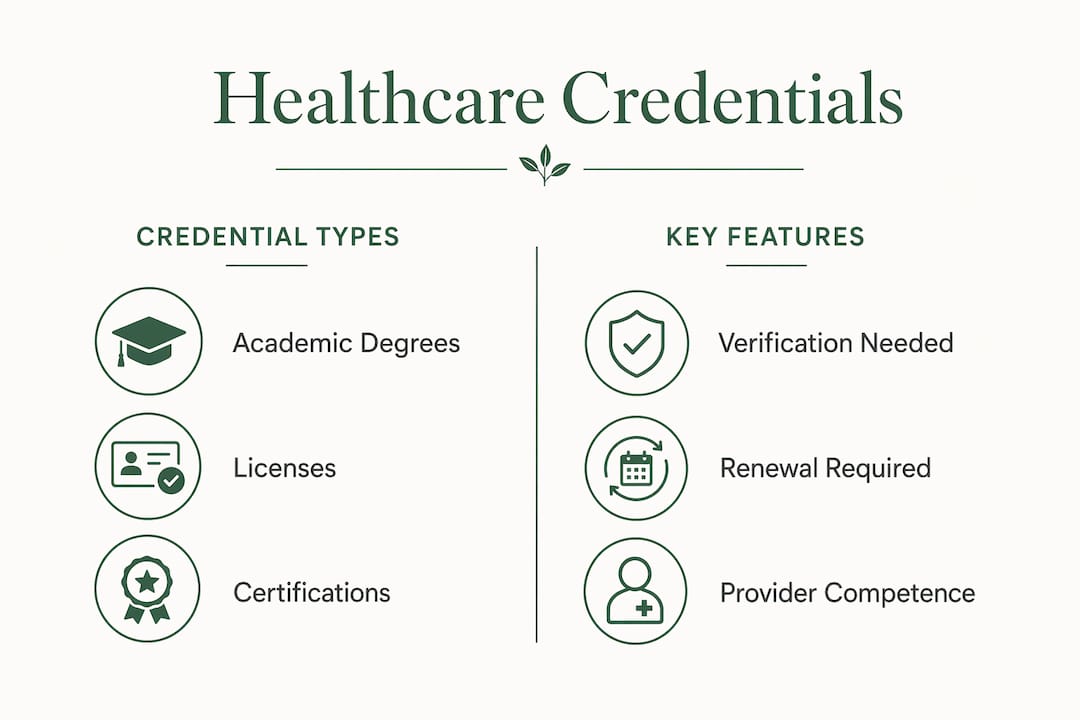
The main categories of healthcare credentials cover the full arc of a provider’s professional life, from initial education through ongoing practice. Here is how they break down:
- Academic degrees: An MD (Doctor of Medicine), DO (Doctor of Osteopathic Medicine), NP (Nurse Practitioner), PA (Physician Assistant), or RN (Registered Nurse) signals the level and type of formal education completed.
- Professional licenses and registrations: Every state requires providers to hold an active license to practice. A license confirms that the provider has passed required exams and met state-specific standards.
- Board certifications and specialty designations: Organizations like the American Board of Internal Medicine (ABIM) or the American Board of Pediatrics grant board certification to physicians who pass rigorous specialty exams. This goes beyond basic licensure and signals advanced competence in a specific field.
- Malpractice insurance and claims history: Malpractice coverage and any history of claims or disciplinary actions are also considered part of a provider’s credential profile. They reflect professional conduct over time, not just academic achievement.
- Ongoing education and renewal: Credentials reflect continuous competence, not a one-time achievement. Board certifications require periodic renewal, and many licenses require documented continuing medical education (CME) hours.
The table below shows how these credential types differ in purpose and renewal requirements:
| Credential type | Primary purpose | Renewal required? |
|---|---|---|
| Academic degree (MD, DO, NP) | Confirms foundational education | No |
| State license | Authorizes practice in a specific state | Yes, typically every 1-3 years |
| Board certification (ABIM, ABP) | Validates specialty competence | Yes, every 6-10 years |
| Malpractice insurance | Documents professional liability coverage | Yes, annually |
| CME credits | Demonstrates ongoing learning | Yes, per license cycle |
Pro Tip: When researching a provider, ask specifically about board certification status. A valid state license alone does not confirm specialty expertise. Board certification from a recognized body like the ABIM is a separate and higher bar.
How does the healthcare credentialing process verify these credentials?
The healthcare credentialing process follows a defined sequence that organizations use to confirm every credential a provider claims to hold. Credentialing is the first of three sequential phases: credentialing, privileging, and payer enrollment. Each phase has its own requirements and timeline, and they cannot be skipped or combined.
Here is how the credentialing process typically unfolds:
- Application submission: The provider submits a detailed application covering education history, training programs, current and past licenses, work history, peer references, and malpractice insurance information.
- Primary Source Verification (PSV): The organization contacts the original issuing sources directly. PSV confirms credential authenticity and is required by accrediting bodies like The Joint Commission to support compliance. This means calling the medical school, the state licensing board, and the certifying body, not just reviewing copies.
- Gap documentation review: Gaps of 30 days or more in education, training, or work history must be explained in writing. Unexplained gaps are a common cause of credentialing delays.
- Committee review: A credentialing committee evaluates the verified information and makes a recommendation on whether to approve the provider.
- Privileging: Once credentialing is approved, privileging determines the specific clinical procedures and services the provider is authorized to perform at that facility. This is a separate decision from credentialing itself.
- Payer enrollment: After privileging, the provider must complete payer enrollment with insurance companies like Medicare, Medicaid, or private insurers. Payer enrollment is a distinct step that directly affects a provider’s ability to bill for services.
Credentialing is an ongoing process, not a one-time event. Organizations re-credential providers on a regular cycle, typically every two to three years, and require updated documentation throughout a provider’s career.
Pro Tip: Clinicians can significantly reduce credentialing turnaround time by preparing documents in advance: current licenses, board certificates, peer references, and a complete malpractice claims history. Having these ready before submitting an application removes the most common bottlenecks.
Why are healthcare credentials important for patients and providers?
Healthcare credentials matter because they are the primary mechanism through which the healthcare system protects patients and holds providers accountable. Credentialing protects patient safety by verifying qualifications and ensuring that organizations grant only appropriate privileges to each professional. Without this process, a facility has no reliable way to confirm that a provider is qualified to perform the procedures they claim to offer.
For patients, credentials support informed decision-making. When you know your physician is board-certified by the ABIM or holds an active NP license in New Jersey, you have objective evidence of their qualifications rather than relying solely on reputation or referrals. This is especially relevant when choosing a specialist or a primary care provider for ongoing care.
For healthcare organizations, credentialing functions as risk management. Granting privileges to an unverified provider exposes the organization to legal liability, regulatory penalties, and reputational damage. The credentialing process creates a documented record that the organization exercised due diligence.
“Credentialing is often misunderstood as mere paperwork, but it is a structured verification step that is crucial for patient safety and provider trust.” — American Medical Association
A few common misconceptions are worth addressing directly:
- Misconception: A medical degree alone qualifies a provider to practice anywhere. Reality: Providers also need an active state license, and that license must be verified and current.
- Misconception: Credentialing and privileging are the same thing. Reality: Credentialing verifies qualifications; privileging determines what a provider is authorized to do at a specific facility.
- Misconception: Once credentialed, a provider is credentialed forever. Reality: Credentialing requires periodic renewal, and credentials like board certifications have their own expiration cycles.
Understanding why community healthcare standards depend on verified credentials helps patients see this process as a benefit, not a bureaucratic hurdle.
How can patients and providers practically use credential knowledge?
Knowing what credentials are is useful only if you can act on that knowledge. Here is how both patients and providers can apply this understanding in practical terms.
For patients:
- Ask your provider directly about their board certification status and which specialty board issued it.
- Use public databases like the Federation of State Medical Boards (FSMB) website to verify a physician’s license status in any state.
- Check whether your provider participates in your insurance network, since insurance acceptance is connected to payer enrollment, which follows credentialing.
- When seeing a specialist, confirm that their credentials align with the specific condition you are being treated for. A general internist and a board-certified cardiologist hold different credential profiles.
For clinicians:
- Gather all credential documentation before starting a new position. This includes diplomas, transcripts, current licenses, DEA registration, board certificates, peer references, and a complete malpractice history.
- Write clear, factual explanations for any gaps in your work or education history that exceed 30 days. Vague explanations slow the committee review process.
- Understand that credentialing, privileging, and payer enrollment are three separate steps with different timelines. Completing credentialing does not mean you can immediately bill for services.
- Review the specialties and qualifications required for your target role before applying, so your credential profile aligns with the position.
Pro Tip: Clinicians transitioning from residency to attending roles often underestimate how long payer enrollment takes. Start the enrollment process with Medicare and Medicaid as early as possible, since approval can take 90 to 120 days after credentialing is complete.
Key takeaways
Healthcare credentials are the earned qualifications that prove a provider’s competence, and credentialing is the formal verification process that confirms those qualifications are real, current, and appropriate for the role.
| Point | Details |
|---|---|
| Credentials vs. credentialing | Credentials are earned qualifications; credentialing is the organization’s verification process. |
| Three sequential phases | Credentialing, privileging, and payer enrollment are distinct steps that affect practice and billing. |
| Primary Source Verification | The Joint Commission requires PSV to confirm credentials directly from issuing sources. |
| Ongoing renewal required | Board certifications and licenses expire and must be renewed throughout a provider’s career. |
| Practical patient action | Patients can verify provider licenses through the FSMB and ask directly about board certification status. |
Why credentialing deserves more respect than it gets
Most people, including many clinicians entering their first attending role, treat credentialing as an administrative formality. I have seen that assumption cause real problems. A provider who assumes their residency training speaks for itself often arrives at a new employer without organized documentation, missing peer references, or unaware that a three-month gap in their training history needs a written explanation. The credentialing committee does not fill in those blanks for you.
What surprises people most is how granular Primary Source Verification actually is. Organizations do not accept copies of your medical school diploma. They contact the school directly. They call the state licensing board. They reach out to the certifying body. This level of scrutiny exists because the consequences of credentialing an unqualified provider fall on patients first. That is not bureaucracy for its own sake. That is the system working as intended.
For patients, the practical takeaway is this: credentials are not just letters after a name. They represent a documented, verified history of education, training, and professional conduct. When you choose a provider at a credentialed facility, you are benefiting from a process that confirmed those qualifications before your first appointment. That is worth understanding and worth asking about.
— Krunal
Verified credentials at Garden State Medical Group
Garden State Medical Group serves patients in North Bergen and Secaucus, New Jersey, with a team of healthcare professionals whose qualifications are verified through a formal credentialing process. Every provider on the team holds current licenses, relevant certifications, and the documented training required for their specialty. If you are looking for a trusted, credentialed care team for primary care, cardiopulmonary services, or diagnostic testing, Garden State Medical Group offers a clear starting point. Explore the primary care services available and schedule an appointment with a provider whose credentials you can count on.
FAQ
What is the definition of healthcare credentials?
Healthcare credentials are formal qualifications such as academic degrees, professional licenses, and specialty certifications that verify a provider’s education and ability to practice safely. They are earned by the provider and then verified by healthcare organizations through a process called credentialing.
What is the difference between credentialing and privileging?
Credentialing verifies a provider’s qualifications, while privileging determines the specific clinical procedures that provider is authorized to perform at a particular facility. The two are sequential steps, not interchangeable terms.
How can patients verify a provider’s credentials?
Patients can check a physician’s license status through the Federation of State Medical Boards (FSMB) website and ask providers directly about their board certification status and which certifying body issued it.
How long does the healthcare credentialing process take?
The credentialing process typically takes 60 to 120 days, depending on how quickly primary sources respond and whether the provider’s documentation is complete. Payer enrollment, which follows credentialing, can add another 90 to 120 days for programs like Medicare and Medicaid.
Do healthcare credentials expire?
Yes. State licenses require periodic renewal, typically every one to three years, and board certifications from bodies like the ABIM require renewal every six to ten years. Credentialing is an ongoing process throughout a provider’s career, not a one-time approval.