
Best Healthgrades.com Alternatives for Finding Doctors

TL;DR:
- The best way to find a trustworthy doctor online is by using verified-review sites, booking platforms, and official quality data sources together. No single site provides a complete picture, so cross-referencing multiple platforms ensures a better assessment. Confirm provider credentials and current practice details directly with clinics before booking.
The strongest approach to finding a trustworthy doctor online is to use three types of sites together: a verified-review platform like RealPatientRatings, a booking-enabled directory like Zocdoc, and an official data source like CMS Care Compare. No single site gives you the full picture. Healthgrades aggregates self-reported physician data and open patient reviews, which makes it a useful starting point, but its review verification is limited compared to closed-loop systems that match reviewers to actual patient records.
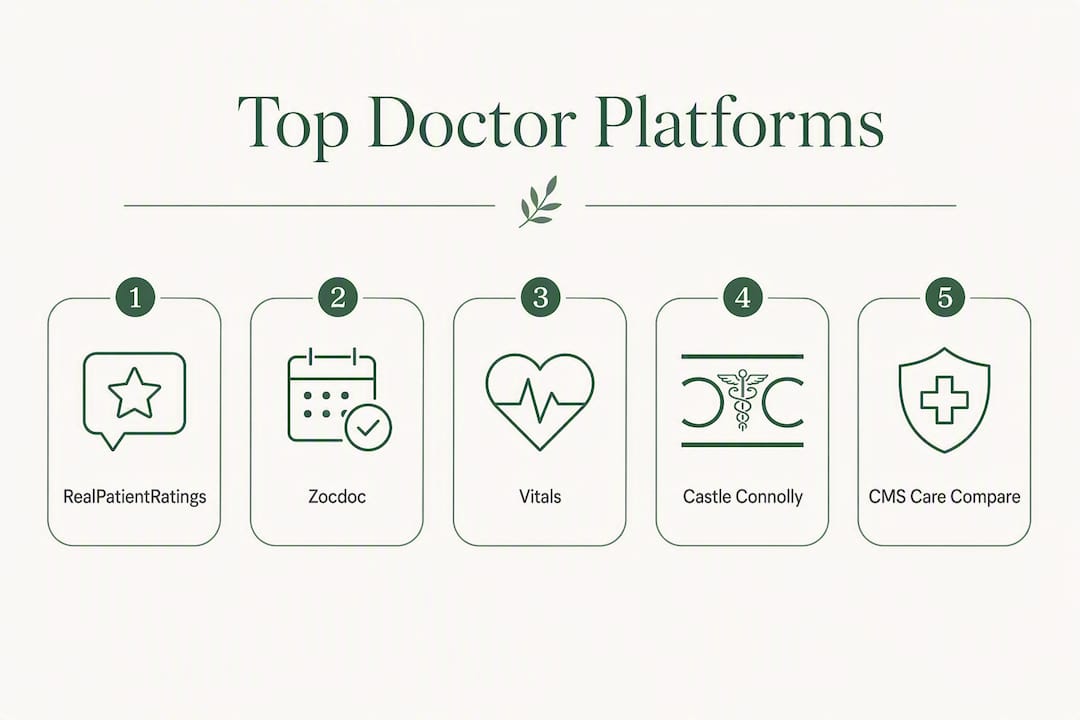
The top Healthgrades alternatives worth bookmarking are:
- RealPatientRatings — verified post-treatment surveys across 9 patient-experience metrics
- Zocdoc — real-time booking with insurance filters
- CMS Care Compare — official Medicare/Medicaid quality and safety data
- Vitals — insurance-filtered search with specialty listings
- Castle Connolly — peer-nominated, editorially vetted top doctors
- U.S. News Health — curated specialty rankings and hospital guidance
For most readers, the practical workflow is straightforward: check verified reviews on RealPatientRatings or Vitals, confirm availability and insurance on Zocdoc, then cross-reference clinical quality on CMS Care Compare. If you are in North Bergen or Secaucus, New Jersey, Gardenstatemedicalgroup offers a direct path to multidisciplinary care without the directory hunt.
Table of Contents
- What are the best Healthgrades.com alternatives at a glance?
- Profiles of the top doctor review sites and healthcare platforms
- How do you choose which doctor review site to trust?
- What authoritative sources should you cross-check before booking a provider?
- Why clinic websites still matter alongside review platforms
- What are the privacy and data practices of major doctor review sites?
- What biases and conflicts of interest exist in doctor rating websites?
- Key Takeaways
- The gap between star ratings and actual care quality
- Gardenstatemedicalgroup offers direct access to verified local care
- Useful sources for further research
- FAQ
What are the best Healthgrades.com alternatives at a glance?
The table below covers the ten most widely used doctor review sites and healthcare rating platforms, ranked by the feature most relevant to each audience.
| Platform | Best for | Review verification | Booking | Scope | Data sources | Trust signals |
|---|---|---|---|---|---|---|
| RealPatientRatings | Verified patient surveys | Closed-loop, matched to records | Limited | Physicians | Post-treatment surveys | 9-metric reporting |
| Zocdoc | Real-time booking | Verified patient badge | Yes, real-time | Doctors, dentists | Self-reported + patient reviews | Insurance filter, availability |
| U.S. News Health | Curated specialist/hospital lists | Editorial vetting | No | Hospitals, specialists | Editorial + peer data | Expert curation |
| Vitals | Insurance-filtered search | Open + some verified | Appointment links | Doctors, hospitals | Patient reviews + directory | Specialty filters |
| WebMD | Health content + provider search | Open reviews | Appointment links | Broad | Self-reported + editorial | Brand authority |
| RateMDs | High-volume open reviews | Open, unverified | No | Doctors, clinics | User-submitted | Volume of reviews |
| Yelp | Candid local experience | Open, unverified | No | All local businesses | Consumer reviews | Local business details |
| Castle Connolly | Top-tier specialist search | Peer nomination | No | Specialists | Peer + editorial | Nomination process |
| CMS Care Compare | Official quality metrics | N/A (claims data) | No | Hospitals, clinicians | CMS/Medicare data | Federal authority |
| Doximity | Clinician credential research | Peer-sourced | No | Physicians | Professional network | Board certification data |
Quick strengths at a glance:
- RealPatientRatings publishes its verification method, matching every reviewer to provider records before sending a secure survey.
- Zocdoc’s real-time scheduling and insurance-filtered search reduce the friction of confirming in-network availability.
- CMS Care Compare draws on federal claims data, making it the most authoritative source for hospital safety and readmission rates.
- Castle Connolly and U.S. News both apply editorial curation, which narrows coverage but raises the bar for inclusion.
- RateMDs hosts over 2 million doctor reviews, giving it one of the largest open-review databases available.
- Yelp surfaces candid, consumer-style feedback but requires cross-checking because submissions are open and unverified.
Profiles of the top doctor review sites and healthcare platforms
RealPatientRatings
RealPatientRatings uses a closed-loop system: only patients matched to a provider’s records receive a secure post-treatment survey. The result is a 9-metric breakdown, reporting across nine patient-experience dimensions (including communication, wait time, scheduling ease, and outcome-specific feedback), rather than a single aggregate star rating. That granularity matters because an overall score can mask wide variation across dimensions.

Best for patients who want to compare surgeons or specialists on specific experience factors before a procedure. The trade-off is lower review volume compared to open platforms, since only verified patients participate.
Zocdoc
Zocdoc’s primary strength is convenience. It shows real-time appointment availability, filters providers by insurance plan, and lets you book directly without a phone call. Patient reviews on Zocdoc carry a verified-patient badge when the reviewer completed an appointment through the platform. Booking-enabled platforms like Zocdoc also reduce no-shows because patients confirm appointments immediately rather than relying on stale directory details.
Best for patients who need to find an in-network provider quickly and want to lock in an appointment in the same session.
U.S. News Health / Doctor Finder
U.S. News applies editorial curation to its hospital and specialty rankings, drawing on peer data and expert input rather than open patient submissions. Coverage is narrower than a broad directory, but the inclusion bar is higher. Use it when searching for a top-rated specialist or comparing hospital quality for a planned procedure.
Vitals
Vitals combines patient reviews with specialty filters and insurance lookup, making it a practical middle ground between a pure review site and a booking platform. It accepts both open and some verified reviews. Useful when you want to filter by specialty and insurance in one search before cross-checking on a verified-review platform.
WebMD
WebMD pairs a large health-content library with a provider directory. Reviews are open and unverified, so treat them as directional rather than definitive. Its real value is context: you can read about a condition, then search for a relevant specialist in the same session. Not the strongest choice if review authenticity is your priority.
RateMDs
With more than 2 million doctor reviews indexed, RateMDs offers one of the highest-volume open-review databases available. Submissions are user-generated and not matched to patient records, so individual reviews require scrutiny. Useful for getting a broad sense of patient sentiment, especially for providers with limited coverage on verified platforms.
Yelp
Yelp was not built for healthcare, but many medical offices have active profiles with candid patient comments. The open format surfaces details that structured surveys sometimes miss, like parking, front-desk responsiveness, or wait-room conditions. Cross-check anything clinical against a verified source.
Castle Connolly
Castle Connolly’s lists are built through peer nomination and editorial review, not patient surveys. A physician earns a spot because colleagues recognize their clinical standing. That makes it reliable for identifying top-tier specialists, though it covers a small fraction of practicing physicians and does not reflect everyday patient experience.
CMS Care Compare
CMS Care Compare draws directly on Medicare and Medicaid claims data, hospital-reported quality metrics, and federal inspection records. It is the most authoritative source for hospital safety scores, readmission rates, and some clinician-level quality indicators. It does not include patient-experience narratives, so pair it with a review platform for a complete view.
Doximity
Doximity is a professional network for clinicians, not a consumer review site. Its value for patients is credential verification: you can confirm a physician’s board certification, training, and practice locations. It does not host patient reviews, but it is a reliable secondary check on a provider’s professional standing.
Pro Tip: No single platform covers everything. Use RealPatientRatings or Vitals for verified patient experience, Zocdoc for booking and insurance confirmation, and CMS Care Compare for clinical quality data. Checking tips for finding a reputable doctor before you start can sharpen what you look for on each site.
How do you choose which doctor review site to trust?
Start with a simple rule: use at least two sources, one that verifies patient status and one that shows real availability or official metrics. A single open-review site is not enough to make a confident decision about a clinician.
Follow this checklist when evaluating any healthcare review platform:
- Check review provenance. Does the site explain how it verifies that reviewers are real patients? Closed-loop systems that match reviewers to provider records are more reliable than open submission forms.
- Confirm clinician credentials. Look for board certification, training history, and active license status. Doximity and NPIDB (the National Provider Identifier database) are authoritative for this.
- Cross-reference official data. For hospitals or high-stakes procedures, check CMS Care Compare for safety scores and readmission rates alongside any patient reviews.
- Check profile recency. A provider profile with no updates in two or more years may reflect stale data. Look for recent reviews and current practice location details.
- Look for verified-patient badges. Platforms that display these badges and publish their verification method are more trustworthy than those that do not.
- Note editorial curation signals. Castle Connolly and U.S. News inclusion indicates peer or editorial recognition, which adds a layer of vetting beyond patient sentiment.
Red flags to watch for:
- Anonymous reviews with no verification disclosure
- Profiles where the only positive reviews appeared in a short cluster (possible incentivized submissions)
- No information about how the site collects or updates its data
- “Top Doctor” or “Patient’s Choice” badges with no explanation of selection criteria
When reading an individual review, ask: What was the specific procedure or visit type? When was the review written? Does the platform confirm the reviewer was a patient?
What authoritative sources should you cross-check before booking a provider?
Review platforms tell you what patients experienced. Official sources tell you what regulators and payers measured. Both matter, and they answer different questions.
CMS Care Compare publishes hospital safety grades, readmission rates, infection rates, and some clinician-level quality indicators drawn from Medicare claims. It is the right starting point for any inpatient procedure or hospital comparison.
NPIDB (NPI Registry) is the federal database of every licensed healthcare provider in the United States. You can confirm a clinician’s NPI number, registered practice locations, and provider taxonomy (specialty classification) in seconds. If a provider’s NPI does not match the address or specialty they advertise, that is a meaningful discrepancy.
State medical boards maintain license status, disciplinary history, and malpractice action records. Every state publishes this data online. A clean board record does not guarantee quality, but a disciplinary action is a clear signal to investigate further.
Hospital quality reports published by The Joint Commission and the Leapfrog Group add another layer of independent assessment for facility-level safety.
A practical cross-check workflow for a surgeon or specialist:
- Search the provider on a verified-review platform (RealPatientRatings or Vitals) and read the metric breakdown, not just the overall score.
- Confirm NPI and specialty on NPIDB.
- Check the state medical board for license status and any disciplinary history.
- If the procedure involves a hospital stay, look up that facility on CMS Care Compare.
Pro Tip: When researching a specialist for a planned procedure, run the state medical board check before reading reviews. A disciplinary record changes how you interpret everything else you find.
Why clinic websites still matter alongside review platforms
Review platforms aggregate data across thousands of providers, but they rarely capture the full picture of what a specific clinic offers. A clinic’s own website typically shows what directories omit: the exact services available, care programs for chronic conditions, individual provider credentials and bios, accepted insurance plans, and current hours for both locations.
For patients in North Bergen and Secaucus, New Jersey, Gardenstatemedicalgroup’s website is a concrete example of what to look for. It lists primary care, cardiopulmonary services, on-site radiology and diagnostic testing, and structured programs for diabetes, bone health, lung health, memory care, and weight management. Provider credentials and insurance acceptance are published directly, so you can confirm fit before calling. That kind of specificity is rarely available on a national directory.
When you move from online research to booking care, a few direct questions during the first call or telemedicine intake save time:
- Is my insurance accepted, and which plans are in-network?
- Does the provider have experience with my specific condition or procedure?
- What is the typical wait time for a new patient appointment?
- Are telemedicine visits available for follow-ups?
Pro Tip: If a clinic’s website does not list accepted insurance plans or provider credentials, call and ask before booking. Directories sometimes carry outdated insurance data, and confirming directly takes less than two minutes.
For readers comparing local New Jersey provider options, Hackensack Meridian Health alternatives for NJ patients offers additional regional context.
What are the privacy and data practices of major doctor review sites?
Privacy practices vary significantly across these platforms, and it is worth understanding what data each site collects before you use it.
Zocdoc collects appointment and insurance data to power its booking features. Its privacy policy covers how that data is stored and shared with providers. Because you enter insurance details to filter results, you are sharing more personal information than on a pure review site.
RealPatientRatings uses a closed survey system, meaning your review is tied to a verified patient record. The platform does not publish reviewer identities publicly, but your data is linked to a provider’s patient records on the backend.
CMS Care Compare is a federal government site. It does not require account creation or personal data submission for basic searches, making it the most privacy-neutral option for researching hospital quality.
Yelp and RateMDs are open platforms. Creating an account to leave a review means your profile may be publicly visible. Both platforms collect standard web analytics data and may use it for advertising purposes.
WebMD collects browsing and search data and uses it for targeted health advertising, which is disclosed in its privacy policy. If you are sensitive about health-related browsing being tied to your profile, using a private browsing session is a reasonable precaution.
For any platform where you create an account or submit a review, read the data-sharing section of the privacy policy before entering personal health details.
What biases and conflicts of interest exist in doctor rating websites?
Doctor rating websites are useful, but none of them are neutral. Understanding where bias enters helps you read results more critically.
Pay-to-play features are common. Many platforms offer paid profiles that let providers display more information, appear higher in search results, or suppress negative reviews. Healthgrades, WebMD, and Vitals all offer premium provider listings. A polished profile is not evidence of clinical quality.
Selection bias in open reviews skews results toward extreme experiences. Patients who had a strongly positive or strongly negative visit are more likely to leave a review than those with an average experience. This is a structural problem on Yelp, RateMDs, and any platform that accepts open submissions.
Editorial curation has its own limits. Castle Connolly and U.S. News rely on peer nomination, which tends to favor physicians in academic medical centers and major metropolitan areas. A highly skilled community physician may never appear on these lists simply because they are not embedded in the networks that generate nominations.
Verification does not eliminate bias entirely. Even closed-loop systems like RealPatientRatings survey only patients who completed care through a specific channel. Patients who had poor experiences and did not return may never be surveyed.
The practical takeaway: treat any single platform’s rating as one data point, not a verdict. Cross-checking across a verified-review site, an official data source, and a direct clinic inquiry gives you a more complete and less biased view.
Key Takeaways
The most reliable approach to finding a trustworthy doctor online is to combine a verified-review platform, a booking-enabled directory, and an official data source rather than relying on any single site.
| Point | Details |
|---|---|
| Use at least two sources | Pair a verified-review site (RealPatientRatings, Vitals) with a booking platform (Zocdoc) for a complete view. |
| Cross-check credentials officially | Confirm NPI on NPIDB and license status on your state medical board before booking a specialist. |
| Watch for red flags | Anonymous unverified reviews, unexplained “Top Doctor” badges, and stale profiles are signs to look elsewhere. |
| Clinic websites fill the gaps | Direct provider sites show insurance acceptance, care programs, and credentials that directories often omit. |
| Gardenstatemedicalgroup for NJ patients | Patients in North Bergen and Secaucus can book primary care, cardiopulmonary, radiology, and chronic care management directly. |
The gap between star ratings and actual care quality
Most people searching for a doctor online spend the most time on the wrong thing: the overall star rating. A 4.2 versus a 4.6 on an open platform is rarely a meaningful clinical distinction, especially when neither score is backed by verified patient data. The more useful question is what the rating is actually measuring.
Platforms that break down scores by specific dimensions, like RealPatientRatings’ 9-metric reporting, give you something you can act on. A surgeon with a 4.8 overall score but consistently low marks on “explanation of procedure” is telling you something specific. A 4.3 overall with high marks on communication and outcome satisfaction may be the better choice for a patient who values those dimensions.
The same logic applies to editorial lists. Castle Connolly and U.S. News rankings reflect peer recognition and editorial standards, not patient satisfaction. A physician on neither list may still be the right provider for your specific condition and location. Official data from CMS Care Compare answers a different question entirely: whether the facility where your provider practices meets federal quality and safety benchmarks.
The workflow that actually works is not about finding the highest-rated provider on one site. It is about triangulating across sources that measure different things, then confirming the practical details directly with the clinic.
Gardenstatemedicalgroup offers direct access to verified local care
Directories and review sites are research tools, but at some point you need to book care. For patients in North Bergen and Secaucus, New Jersey, Gardenstatemedicalgroup offers a direct path to multidisciplinary care without navigating multiple platforms.
You can schedule primary care visits, cardiopulmonary services, on-site radiology and diagnostic testing, and structured chronic care management programs covering diabetes, bone health, lung health, memory care, and weight management. Telemedicine visits are available for follow-ups. Medicare, Medicaid, and most major insurance plans are accepted, and provider credentials are published on the site so you can confirm fit before your first appointment. Patient data is handled in accordance with HIPAA standards. To schedule, visit the Gardenstatemedicalgroup website or call either location directly.
Useful sources for further research
These are the primary sources used in this article, organized by what each one is best used for:
- RealPatientRatings — verified patient surveys with nine-metric breakdowns; best for assessing specific dimensions of patient experience
- Zocdoc — real-time booking and insurance-filtered provider search
- Vitals — insurance and specialty filters with patient reviews
- RateMDs — high-volume open review database covering over 2 million doctor reviews
- G2 Healthgrades alternatives — enterprise-facing competitor comparisons for Healthgrades Quality Solutions
- SEMrush competitor analysis — traffic and market-share signals for healthgrades.com and peer sites
- Gardenstatemedicalgroup — direct booking and provider information for North Bergen and Secaucus, NJ
- Healthcare directory comparisons for NJ patients — regional provider platform comparisons
FAQ
What are Healthgrades’ main competitors?
The most widely used alternatives to Healthgrades are Zocdoc, Vitals, RateMDs, WebMD, RealPatientRatings, Castle Connolly, and CMS Care Compare. Each serves a different primary purpose, from real-time booking to verified patient surveys to official federal quality data.
What is the best website for doctor reviews?
For verified reviews, RealPatientRatings is the strongest option because it matches every reviewer to a patient record and reports across nine experience metrics rather than a single score. For volume of open reviews, RateMDs indexes over 2 million doctor reviews.
Is Healthgrades a legitimate website?
Yes, Healthgrades is a legitimate and widely used doctor directory. Its limitations are that many reviews are open and unverified, and provider profiles rely heavily on self-reported data, so cross-checking with CMS Care Compare or a verified-review platform is advisable for high-stakes decisions.
What is the most trustworthy medical website for provider quality?
CMS Care Compare is the most authoritative source for hospital and clinician quality because it draws on federal Medicare and Medicaid claims data rather than self-reported or user-submitted information. For patient experience specifically, closed-loop platforms like RealPatientRatings offer the strongest verification standards.
How do I verify a doctor’s credentials online?
Confirm a physician’s NPI number and registered specialty on the NPIDB (National Provider Identifier database), then check license status and any disciplinary history on your state medical board’s website. Both are free, official sources that take only a few minutes to search.