
How to Communicate with Doctors: A Patient's Guide

TL;DR:
- Effective communication with your doctor involves preparing specific questions and sharing detailed health information to make every appointment count. Using frameworks like “Ask Me 3” and asking about costs and alternatives can lead to better understanding and decisions. Confirm your understanding through teach-back, bring support persons, and utilize technology to stay engaged between visits.
Effective communication with your doctor is defined as the active process of preparing targeted questions, expressing symptoms clearly, and confirming your understanding before leaving the exam room. Knowing how to communicate with doctors directly affects whether your treatment plan works. Patients who speak up, ask specific questions, and use frameworks like the “Ask Me 3” method get more from every visit. The average primary care appointment runs about 18 minutes, which means every word counts. This guide gives you the tools to make those minutes matter.
How to communicate with doctors before your appointment
Preparation is the single most powerful thing you can do before a visit. Patients who arrive with a written list of concerns get more addressed in less time. Start by writing down your top three health concerns in order of priority. Rank them so your most pressing issue comes first, not last.
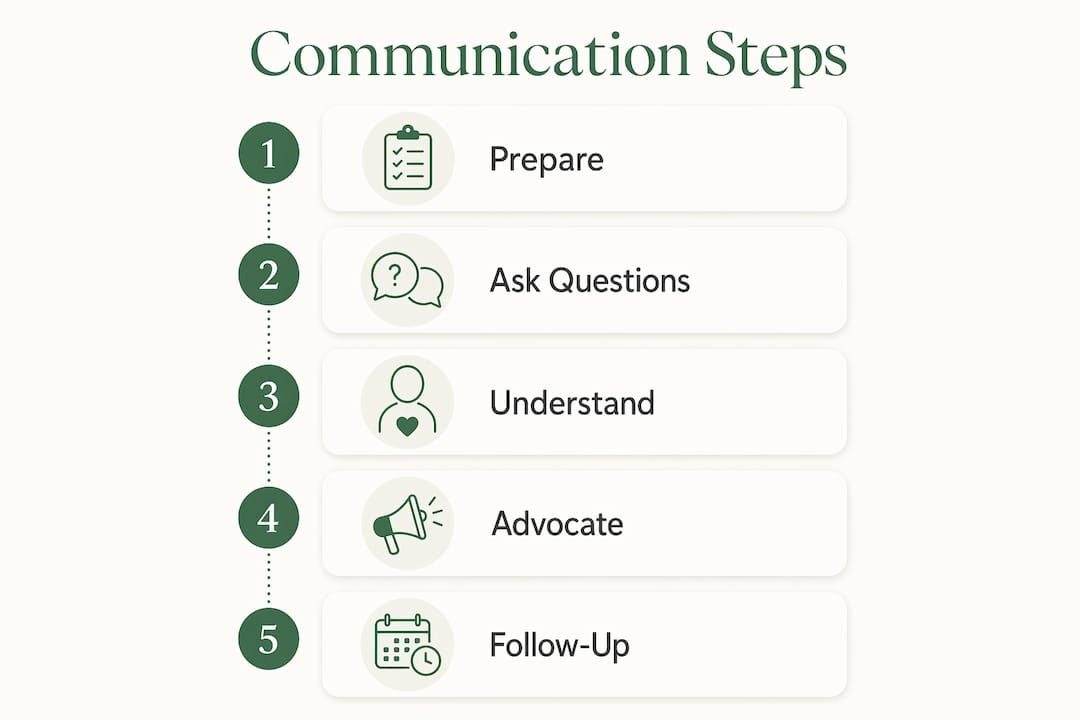
Bring a complete and current picture of your health to every appointment. That means an updated medication list with dosages, a record of recent test results, and notes on any symptoms you have been tracking. If you use a symptom tracker app or a simple notebook, bring it. Doctors rely on the details you provide to make accurate decisions.
Organizing your information before you arrive also reduces the anxiety many patients feel in the exam room. When your notes are in front of you, you are less likely to forget something important under pressure.
- Write your top three concerns the night before and rank them by urgency.
- List all medications, supplements, and vitamins with their current doses.
- Note when symptoms started, how often they occur, and what makes them better or worse.
- Bring your insurance card, photo ID, and any referral paperwork.
- If you are a caregiver, bring the patient’s health history and a list of their current providers.
Pro Tip: Arrive 10 minutes early so you can review your notes before the appointment starts. A calm, focused mind communicates far more clearly than a rushed one.
What key questions should you ask your doctor?
The right questions turn a passive visit into a productive conversation. The “Ask Me 3” framework focuses every appointment on three core questions: What is my main problem? What do I need to do? Why is it important for me to do this? These three questions cut through medical complexity and give you a clear path forward.
Beyond “Ask Me 3,” the Choosing Wisely initiative recommends five questions before agreeing to any test or treatment. These questions protect you from unnecessary procedures and help you weigh your options with full information.
- Do I really need this test or treatment?
- What are the risks or side effects?
- Are there simpler or safer options?
- What happens if I do nothing?
- How much will this cost?
Asking about cost is not rude. Cost questions are valid and directly affect whether you can follow through on a treatment plan. A medication you cannot afford is not a real option.
One question most patients never think to ask is “What else could this be?” Raising this question prevents premature diagnostic closure, which is when a doctor settles on the most obvious diagnosis and stops looking. That single question keeps the door open to less common but serious conditions.
| Question type | Purpose |
|---|---|
| “Ask Me 3” questions | Clarify diagnosis, next steps, and why they matter |
| Choosing Wisely questions | Evaluate necessity, risks, and alternatives for tests |
| “What else could this be?” | Prevent premature diagnosis and catch overlooked conditions |
| Cost and timeline questions | Support realistic decision-making and follow-through |
Pro Tip: Write your questions on paper or in your phone’s notes app before the visit. Doctors respond well to patients who come prepared. It signals that you are engaged and ready to participate. For a deeper list of questions tailored to specific visits, the 2026 patient question guide from Gardenstatemedicalgroup is a practical starting point.
How do you make sure you understand your doctor’s instructions?
Understanding what your doctor says and actually retaining it are two different things. The teach-back method is the most reliable technique for closing that gap. Before you leave the room, summarize the doctor’s instructions in your own words. If you get something wrong, the doctor can correct it on the spot.

Taking notes during the visit also helps. You do not need to write everything word for word. Focus on the diagnosis, the treatment plan, and the follow-up steps. If your doctor moves quickly, it is completely appropriate to say, “Can you slow down? I want to write this down.”
Recording your appointment with your doctor’s permission is another option that many patients find helpful. Consent laws vary by state, so ask before you record. Most doctors agree when asked respectfully, and having the audio lets you review details at home without relying on memory.
After the visit, check your after-visit summary through your patient portal. Most healthcare systems now provide electronic health records that include your diagnosis, prescriptions, and next steps. If anything in the summary does not match what you remember, call the office and ask for clarification. Written materials and portal messages create a paper trail that protects you.
How can you advocate for yourself during a difficult visit?
Self-advocacy in a medical setting means speaking up clearly and respectfully when something does not feel right. Patients who feel rushed or dismissed often stay silent, and that silence leads to gaps in care. You have the right to be heard, and there are direct ways to reclaim the conversation without creating conflict.
If your doctor seems to be moving past a concern you raised, use a neutral, direct phrase to redirect. Statements like “I don’t understand where you’re going with this. Help me understand” open dialogue without putting the doctor on the defensive. The goal is collaboration, not confrontation.
Bringing a trusted person to your appointment is one of the most underused tools in patient communication. A caregiver, family member, or close friend can take notes, ask follow-up questions, and help you remember what was said. Two sets of ears catch more than one.
“Patients have a legal right to request interpreters or accommodations for communication barriers at no cost. This includes sign language interpreters and professional medical interpreters for language differences. Arrange these services in advance by calling the office before your appointment.”
Knowing this right matters. Interpreter services are available at no cost and are protected under federal law. You should never feel that a language or disability barrier prevents you from getting clear answers. For guidance on building a stronger relationship with your provider, Gardenstatemedicalgroup’s resource on doctor-patient communication covers this topic in depth.
If you feel your concerns are consistently dismissed, seeking a second opinion is a reasonable and professional step. Most doctors expect it and will support the request.
How does technology improve communication with your healthcare provider?
Patient portals and telemedicine have changed what happens between appointments. Most practices now offer secure messaging through an electronic health portal, which lets you send non-urgent questions directly to your care team without waiting for a callback. Use this channel for medication questions, test result clarifications, and appointment scheduling.
Telemedicine visits require a slightly different approach than in-person appointments. Prepare the same way you would for an office visit: written concerns, medication list, and a quiet space with good lighting. Test your audio and video connection at least five minutes before the call. Technical problems eat into your already limited time.
- Use your patient portal to review lab results and after-visit summaries within 24 hours of your appointment.
- Send follow-up questions through secure messaging rather than calling, so your provider has a written record.
- Track your symptoms and medication adherence with a simple app or a dated notebook between visits.
- Schedule a follow-up call if your doctor mentions waiting for test results, so you are not left wondering.
Pro Tip: If you receive a test result through your portal before speaking with your doctor, do not search for the result online and assume the worst. Message your care team directly and ask for an explanation in plain language.
For patients managing ongoing conditions, Gardenstatemedicalgroup’s chronic care management program provides structured support between visits, including regular check-ins and care coordination that keeps communication consistent.
Key Takeaways
Clear, prepared communication with your doctor is the most direct way to improve your health outcomes and get the most from every appointment.
| Point | Details |
|---|---|
| Prepare before every visit | Write your top three concerns in priority order and bring your full medication list. |
| Use proven question frameworks | Apply “Ask Me 3” and Choosing Wisely questions to every diagnosis and treatment decision. |
| Confirm understanding with teach-back | Summarize your doctor’s instructions in your own words before leaving the room. |
| Advocate clearly and directly | Use neutral phrases to redirect rushed conversations and bring a support person when needed. |
| Use technology between visits | Send follow-up questions through your patient portal and track symptoms digitally. |
What I have learned about talking to your doctor
By Krunal
After years of working in healthcare communication, the mistake I see most often is patients saving their most important concern for the end of the visit. They spend the first 15 minutes on minor issues and then drop the real worry right as the doctor is wrapping up. The doctor is already mentally moving to the next patient. The concern gets a rushed answer or a referral that takes weeks to materialize.
The fix is simple and counterintuitive. Lead with your biggest concern. Say it in the first two minutes. Patients worry this seems demanding, but doctors actually prefer it. It lets them structure the visit around what matters most.
The second pattern I see is patients nodding along when they do not actually understand what the doctor said. They do not want to seem uninformed or take up more time. But a misunderstood instruction leads to a missed dose, a skipped follow-up, or a worsening condition. The teach-back method feels awkward the first time you use it. By the third appointment, it becomes natural.
The broader shift worth making is seeing yourself as an equal partner in your care, not a passive recipient. Your doctor has clinical expertise. You have lived experience of your own body. Both are necessary for good decisions. Patients who bring that perspective to their appointments consistently get better outcomes. That is not an opinion. That is what the evidence shows.
— Krunal
Gardenstatemedicalgroup supports clear, connected patient care
Patients in North Bergen and Secaucus, New Jersey, deserve a primary care experience built around real communication. Gardenstatemedicalgroup offers exactly that.
At Gardenstatemedicalgroup, the primary care team takes time to explain diagnoses clearly, answer your questions without rushing, and follow up when results come in. The practice accepts most major insurance plans and offers convenient appointment scheduling online. Whether you are managing a chronic condition, preparing for a routine checkup, or navigating a new diagnosis, Gardenstatemedicalgroup gives you a care team that listens. Schedule your appointment today and experience what patient-centered communication looks like in practice.
FAQ
What is the “Ask Me 3” method for doctor visits?
The “Ask Me 3” framework focuses every appointment on three questions: What is my main problem? What do I need to do? Why does it matter? These questions give you a clear, complete picture of your health situation.
How do I prepare for a doctor’s appointment effectively?
Write your top three concerns in priority order before the visit and bring your current medication list. Arriving with organized notes helps you cover more ground in the limited time available.
What should I do if I do not understand my doctor’s instructions?
Use the teach-back method by summarizing the instructions in your own words before leaving. This gives your doctor the chance to correct any misunderstanding immediately.
Can I bring someone with me to a doctor’s appointment?
Yes. Bringing a trusted caregiver or family member is a proven way to improve retention and catch details you might miss. They can take notes and ask follow-up questions on your behalf.
Do I have a right to an interpreter at a medical appointment?
Patients have a legal right to interpreter services at no cost, including sign language and professional medical interpreters. Contact your provider’s office before the appointment to arrange accommodations.
Recommended
- 3 Steps To Help You Communicate Effectively With Your Doctor - Our Guide | Garden State Medical Group | Garden State Medical Group
- Questions to Ask Your Physician: 2026 Patient Guide
- 6 Important Things Every Doctor Wishes Their Patients Knew | Garden State Medical Group | Garden State Medical Group
- The Key to a Successful Relationship Between Primary Care Physician and Patient: Communication | Garden State Medical Group | Garden State Medical Group