
Medicare enrollment in New Jersey: Steps, tips, and support

TL;DR:
- Medicare enrollment in New Jersey becomes increasingly complex in 2026 due to plan terminations, premium hikes, and new prior authorization rules. Missing enrollment windows can lead to lifelong financial penalties, making timely action and local support essential. Utilizing local counseling resources and verifying provider participation help ensure a smooth, penalty-free enrollment process amidst statewide changes.
Medicare enrollment confuses millions of Americans every year, and New Jersey residents face an extra layer of complexity in 2026. Plan terminations, premium increases, and new prior authorization rules are reshaping the landscape across many counties. Missing your initial Medicare enrollment window can result in lifelong financial penalties that follow you for as long as you have coverage. Whether you are turning 65 soon, retiring, or reconsidering your current plan, this guide walks you through every step clearly and connects you with the local New Jersey resources that make the process far less stressful.
Table of Contents
- Understanding Medicare enrollment periods in New Jersey
- What you need to enroll: Eligibility, documents, and support
- Step-by-step guide: How to enroll in Medicare in New Jersey
- Common mistakes and how to avoid Medicare penalties
- What most Medicare guides miss: The real key to hassle-free enrollment in New Jersey
- Need personal help? Garden State Medical Group supports your Medicare journey
- Frequently asked questions
Key Takeaways
| Point | Details |
|---|---|
| Know your deadlines | Missing Medicare enrollment windows can cost you lifelong penalties or coverage delays. |
| Use local support | NJ SHIP offers free help to answer Medicare questions and walk you through the process. |
| Prepare documentation | Gather proof of age, residency, and coverage info to avoid delays or denials. |
| Avoid common mistakes | Watch out for plan changes and provider directory errors in New Jersey, especially in 2026. |
| Get personal assistance | Partnering with local providers like Garden State Medical Group makes enrollment and care simpler. |
Understanding Medicare enrollment periods in New Jersey
Once you understand the stakes, it’s crucial to know which enrollment periods matter to you in New Jersey. Medicare does not operate on an open-door policy. There are specific windows when you can sign up, and missing them is not a simple inconvenience. It can cost you hundreds of dollars per year in permanent surcharges.
There are three primary enrollment periods you need to know. The Initial Enrollment Period (IEP) is a 7-month window that begins three months before your 65th birthday, includes your birth month, and ends three months after. This is your first and most important opportunity to enroll without penalty. The Annual Enrollment Period runs from October 15 to December 7 each year. During this time, you can switch plans, add or drop Part D drug coverage, or move from Original Medicare to a Medicare Advantage plan. The General Enrollment Period (GEP) runs from January 1 through March 31 and serves as a safety net for those who missed their IEP, though it does come with late enrollment penalties.
For 2026 specifically, New Jersey residents need to pay close attention to several local changes. Some Medicare Advantage plans have terminated in certain counties, meaning beneficiaries must actively select new coverage or risk being defaulted into Original Medicare without drug coverage. Premium increases are also affecting a number of popular plans. Perhaps most significantly, New Jersey will participate in the CMS WISeR pilot, which introduces prior authorization requirements for certain Medicare Part B services starting in 2026. This means your doctor may need pre-approval from your insurer before performing specific outpatient procedures or ordering certain equipment.
Here is a quick comparison of the three main enrollment periods to help you identify which one applies to you:
| Enrollment Period | When It Occurs | Who It’s For | Penalty Risk |
|---|---|---|---|
| Initial Enrollment Period (IEP) | 7 months around your 65th birthday | New enrollees turning 65 | No penalty if used on time |
| Annual Enrollment Period (AEP) | Oct 15 – Dec 7 each year | Existing beneficiaries changing plans | No penalty |
| General Enrollment Period (GEP) | Jan 1 – Mar 31 each year | Those who missed their IEP | Yes, permanent penalties apply |
Because provider directories have been known to contain errors, it is especially important in 2026 to call your doctors directly and confirm they still participate in your chosen plan. Relying solely on an online directory could leave you with unexpected out-of-pocket costs. For a broader overview of your options, reviewing NJ Medicare coverage options can help you understand the full picture before making any decisions. You can also find practical NJ health insurance tips that apply directly to your situation as a New Jersey resident.
What you need to enroll: Eligibility, documents, and support
After pinpointing when you can enroll, make sure you meet eligibility and have necessary documents ready. Knowing you are eligible is one thing. Having everything in order to prove it is another.
Most people qualify for Medicare at age 65. If you or your spouse paid Medicare taxes for at least 10 years while working, you are eligible for Part A at no monthly premium. Part B carries a monthly premium for most enrollees. However, age is not the only path to Medicare. Under 65, you may be eligible for Medicare if you have been receiving Social Security Disability Insurance (SSDI) for 24 months, or if you have been diagnosed with End-Stage Renal Disease (ESRD) or Amyotrophic Lateral Sclerosis (ALS), which qualify you immediately regardless of age.
When you are ready to apply, gather these documents in advance:
- Proof of age: Birth certificate, passport, or other government-issued ID
- Social Security Number (SSN): Your card or documentation showing your number
- Current health insurance information: Policy numbers, group coverage details, and employer information if applicable
- Proof of New Jersey residency: A utility bill, bank statement, or lease agreement works well
- Work history documentation: If you have questions about your premium calculation, W-2 forms can help
For New Jersey residents who feel overwhelmed by this process, free help is available. New Jersey SHIP offers free, unbiased Medicare counseling in all counties across the state. SHIP stands for State Health Insurance Assistance Program, and its counselors are trained volunteers who can walk you through plan comparisons, enrollment forms, and appeals. You can reach NJ SHIP at 1-800-792-8820. The Social Security Administration (SSA) also operates local offices throughout New Jersey where you can apply in person or get answers to specific questions.
If you are managing a chronic condition alongside your Medicare enrollment, understanding how Medicare intersects with NJ Medicaid and chronic care coverage is essential. Some New Jersey residents qualify for both programs, which is called dual eligibility, and coordination between the two can significantly reduce your costs.
Pro Tip: Start collecting your documents at least 60 days before your IEP begins. Many people underestimate how long it takes to track down a birth certificate or confirm employer insurance end dates. Starting early eliminates last-minute stress and potential delays in your coverage start date.
Step-by-step guide: How to enroll in Medicare in New Jersey
With preparations complete, let’s move into the exact steps New Jersey residents need to follow to get enrolled.
-
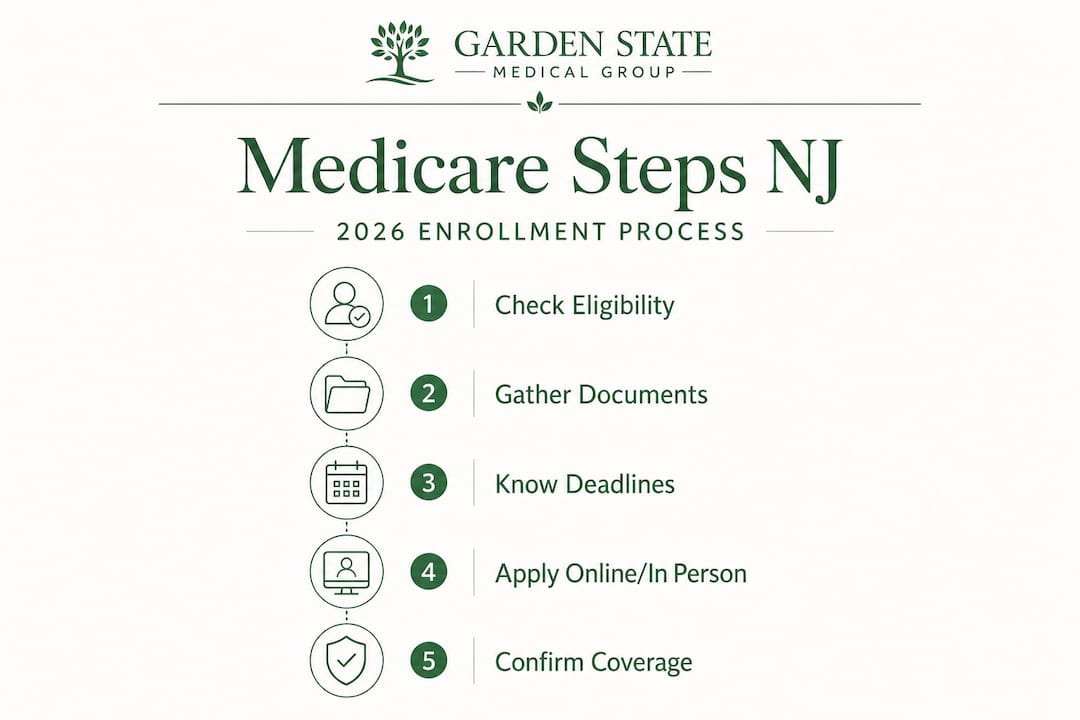
Confirm your eligibility and identify your enrollment period. Use your 65th birthday or disability status to determine whether you are in your IEP, AEP, or another qualifying window. Mark your calendar clearly so you do not miss a deadline.
-
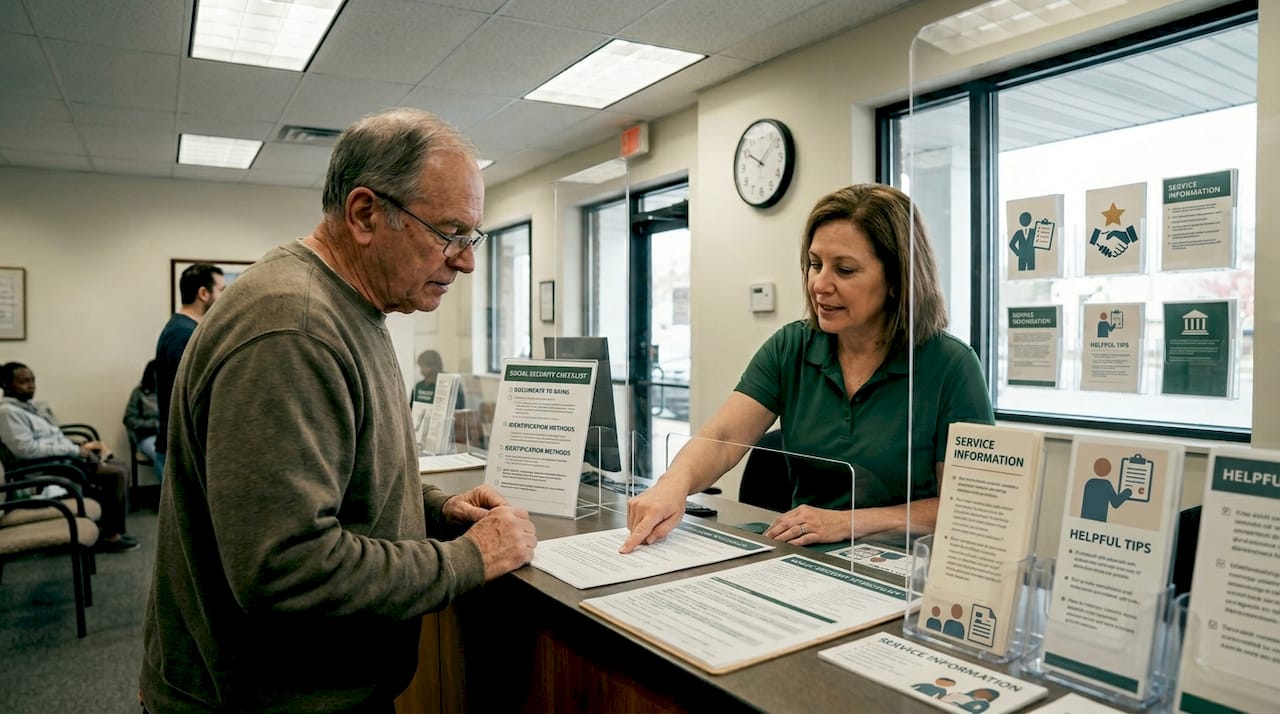
Choose how you will enroll. You can apply for Medicare online at SSA.gov, by calling 1-800-772-1213, or visiting a local SSA office. Online enrollment is available 24 hours a day and is the fastest option for most people. The phone line operates Monday through Friday from 8 a.m. to 7 p.m. In-person visits are ideal if you have complex questions or need hands-on assistance.
-
Complete the Medicare Part A and Part B application. If you are already receiving Social Security benefits, you will likely be enrolled in Parts A and B automatically. If not, you need to actively apply. Be ready to provide all documents gathered in the previous step.
-
Decide on additional coverage. Original Medicare covers hospitalization (Part A) and outpatient services (Part B), but it does not cover prescription drugs. You will need to choose a Part D drug plan separately, or select a Medicare Advantage plan (Part C) that bundles all coverage together. This decision affects your total costs and which providers you can see.
-
Verify your enrollment confirmation. After submitting your application, you will receive a Medicare card in the mail within a few weeks. Keep this card safe. Also log into your MyMedicare.gov account to confirm your coverage details, plan enrollment, and effective dates.
-
Review your plan’s provider network. Call each of your current doctors directly to confirm they accept your chosen Medicare plan. Do not assume the online directory is current, especially given the 2026 provider list errors reported in New Jersey.
“Enrollment does not end when you submit your application. Following up on your confirmation and verifying provider participation are just as important as the initial sign-up.”
For those without reliable internet access, in-person support at your local Social Security office or through NJ SHIP counselors is a practical and equally effective option. NJ SHIP counselors can sit with you, review your choices, and help you complete paperwork at no cost to you. Understanding the medical services available in North Bergen and Secaucus can also help you select a plan that keeps your preferred providers accessible. Before finalizing your plan, it helps to review the process for checking NJ insurance coverage with your primary care provider.
Pro Tip: After submitting your Medicare application, set a reminder to follow up within two weeks if you have not received written confirmation. Processing times can vary, and catching a problem early prevents a coverage gap.
Common mistakes and how to avoid Medicare penalties
Even with clear instructions, small missteps can result in big financial consequences. Here is how to sidestep the most frequent problems.
The single most common mistake New Jersey Medicare enrollees make is missing their Initial Enrollment Period. Missing your IEP or delaying Part B or Part D enrollment incurs late penalties that are permanent. This means they last for as long as you have Medicare coverage, not just for a year or two. The Part B late enrollment penalty adds 10 percent to your monthly premium for every full 12-month period you were eligible but did not sign up. The Part D drug coverage penalty adds 1 percent of the national base beneficiary premium for every month you went without creditable coverage. These numbers add up quickly over the course of a retirement.
Here are the most frequent mistakes and how to prevent them:
- Assuming automatic enrollment: Not everyone is enrolled automatically. If you are not yet receiving Social Security benefits when you turn 65, you must actively apply for Medicare.
- Dropping employer coverage too early: Leaving a job-based plan before your Medicare begins can create a coverage gap. Time your transitions carefully.
- Ignoring Part D: Some people skip drug coverage because they are healthy and do not take prescriptions. This is a costly decision. If you need medications later, the delay penalty will be permanent.
- Not reviewing your plan annually: Plans change every year. A plan that worked well last year may have higher costs, fewer covered drugs, or a narrowed provider network in 2026.
- Relying on online directories alone: As mentioned, provider lists in New Jersey have shown errors in 2026. Always call to confirm.
The General Enrollment Period from January 1 through March 31 offers a second chance for those who missed their IEP, but it comes at a price. Coverage under GEP does not begin until July 1, which means you could be without insurance for several months. That coverage gap, combined with permanent penalties, makes the GEP a last resort, not a plan.
Reviewing a Medicare wellness checklist tailored for New Jersey seniors is one of the most effective ways to make sure you have not overlooked any enrollment steps or preventive care opportunities that come with your new coverage.
What most Medicare guides miss: The real key to hassle-free enrollment in New Jersey
Most Medicare guides focus on national rules. They walk you through enrollment windows, penalty calculations, and general eligibility. That information is necessary, but it does not prepare you for what actually trips people up in New Jersey specifically.
In 2026, New Jersey residents are dealing with real local disruptions. Plans have exited certain counties without much fanfare. Premium structures have shifted. The WISeR pilot program is adding prior authorization steps that did not exist before. When you apply national Medicare advice to a state experiencing these kinds of specific changes, you can end up with coverage gaps that no rule book warned you about.
What makes the real difference is local human support. A trained NJ SHIP counselor who knows which plans have terminated in Hudson County or Bergen County is not just helpful. That person is essential. Generic online tools will not flag that your specific plan left the market or that a prior authorization now applies to your cardiologist visit. A counselor who works with New Jersey plans every day will.
Personal follow-up is equally underrated. After you enroll, double-check that your application was processed correctly. Confirm your provider is still in-network by calling the office directly. Ask your doctor’s billing department whether they have seen any 2026 authorization changes for your procedures. These are small steps, but they prevent the kind of billing surprises that derail a retirement budget.
The role of a strong primary care relationship in Medicare is another piece most guides gloss over. A primary care physician who understands your Medicare plan can help coordinate referrals, flag prior authorization needs before your appointment, and ensure your preventive benefits are fully used. In New Jersey, where plan structures are shifting, that coordination becomes even more valuable.
Need personal help? Garden State Medical Group supports your Medicare journey
Navigating Medicare enrollment is a lot to manage on your own, especially when local plan changes add another layer of complexity. Garden State Medical Group is here to help New Jersey Medicare beneficiaries coordinate care and make the most of their benefits.
Our primary care services in North Bergen and Secaucus are designed to serve Medicare patients with personalized, attentive care that adapts to your specific coverage. If you are managing a chronic condition, our chronic care management program helps you stay on top of your health while making sure your Medicare benefits are working as hard as possible for you. We also offer a dedicated diabetes education and prevention program for patients who need targeted support. With diagnostics, cardiopulmonary services, and radiology all available under one roof, you get coordinated care that simplifies your Medicare experience from enrollment through every follow-up visit.
Frequently asked questions
What documents do I need to enroll in Medicare in New Jersey?
You’ll need proof of age, your Social Security Number, current health coverage details, and proof of New Jersey residency. Supporting documentation is required for all Medicare enrollment applications.
What if I miss my Initial Enrollment Period for Medicare?
You must wait for the General Enrollment Period from January 1 through March 31 and may face permanent late enrollment penalties added to your monthly premium.
How do I get help choosing the right Medicare plan in New Jersey?
Contact NJ SHIP at 1-800-792-8820 for free, unbiased counseling available in every county across the state.
Are there 2026 changes to Medicare plans in New Jersey?
Yes. 2026 brings plan terminations, premium increases, and a new WISeR prior authorization pilot affecting certain Part B services in New Jersey.
How do I verify if my doctor is in my Medicare plan’s network?
Call your provider’s office directly to confirm participation, since online directories may contain errors that are especially common during years with significant plan changes.