
250–500 mg to 4,000 mg: Omega-3 Dosage for Garden State Patients

Most adults do well with a moderate amount of combined EPA and DHA per day for general health maintenance. The Food and Drug Administration advises against exceeding 5,000 mg per day from supplements. Higher, condition-specific doses, such as those used for high triglycerides, belong under a clinician’s supervision, not on a self-prescribed schedule.
TL;DR:
- Daily intake of 250 to 500 mg of EPA and DHA is generally sufficient for cardiovascular health and can be achieved through diet alone for most people.
- The 5,000 mg supplement ceiling applies only to over-the-counter intake, not to omega-3 consumption from food sources like fish.
- Dosages used for high triglycerides, such as 4,000 mg per day, require medical supervision and prescription-grade products for safety and consistency.
- Checking supplement labels for actual EPA and DHA content, rather than total fish oil weight, is essential to meet individualized dosing targets.
- Routine blood testing and clinician guidance are crucial for safe, effective omega-3 dosing, especially when considering doses above general maintenance levels.
Table of Contents
- Omega-3 Dosage: What the Official Guidelines Actually Recommend
- Omega-3 Dosage by Condition: What Trials Actually Used
- How to Hit Your Omega-3 Target: Food, Supplements, and Label Math
- Omega-3 Side Effects and Drug Interactions Worth Knowing
- Building a Practical Omega-3 Dosing Plan
- How Garden State Medical Group Approaches Omega-3 Dosing With Patients
- A Clinician’s Note on What to Realistically Expect
- Get Your Omega-3 Dosage Right With Clinical Guidance, Not Guesswork
- Sources
- FAQ
Omega-3 Dosage: What the Official Guidelines Actually Recommend
There’s no single federal Recommended Dietary Allowance for EPA and DHA the way there is for, say, vitamin C. That surprises a lot of patients who assume every nutrient has a clean, government-issued number attached to it. Instead, the National Institutes of Health’s Office of Dietary Supplements sets an Adequate Intake for alpha-linolenic acid, the plant-based omega-3 found in walnuts and flaxseed, and leaves EPA and DHA guidance in the form of expert-consensus ranges rather than a formal RDA.
Here’s how the numbers break down:
- ALA Adequate Intake: 1.6 grams per day for adult men, 1.1 grams per day for adult women, drawn from foods like walnuts, canola oil, and flaxseed.
- EPA + DHA general guidance: a moderate daily amount combined, a range referenced widely across major health organizations for cardiovascular support in healthy adults.
- FDA supplement ceiling: 5,000 mg per day maximum from dietary supplements, a limit set to reduce bleeding risk and other side effects at high intakes.
Why the gap between a hard number for ALA and a softer range for EPA and DHA? ALA is essential, meaning your body cannot make it, so nutrition scientists could calculate a defensible minimum. EPA and DHA, by contrast, can be partially synthesized from ALA in the body, though that conversion is inefficient, often under 10%. That inefficiency is exactly why direct EPA and DHA intake, from fish or supplements, matters more than relying on ALA alone.
If you’re taking a fish oil capsule that lists “1,000 mg fish oil” on the label, that’s not 1,000 mg of EPA and DHA. It’s the total oil weight, and the active omega-3 content is usually a fraction of that. We’ll walk through the label math in the next section, because this single point of confusion is probably the most common dosing mistake people make.
The 250 to 500 mg range isn’t arbitrary. It reflects the intake level associated with cardiovascular benefit in population studies, and it’s low enough to be achievable through diet alone for most people who eat fish regularly. If you already eat salmon or sardines twice a week, you may not need a supplement at all. If your diet leans heavily on land animals and processed foods, a modest daily supplement may help close that nutritional gap.
One more nuance worth flagging: the 5,000 mg ceiling applies to supplement intake, not omega-3s from food. There’s no equivalent hard ceiling on eating fish, because the matrix of nutrients in whole food behaves differently than concentrated oil in a capsule. That distinction matters when you’re deciding whether to reach for a second serving of salmon versus a second fish oil capsule.
Omega-3 Dosage by Condition: What Trials Actually Used
General maintenance dosing and therapeutic dosing are two different conversations, and confusing them is where people run into trouble. The doses studied for specific conditions, high triglycerides, elevated blood pressure, are meaningfully higher than the 250 to 500 mg maintenance range, and they were tested under medical supervision, not as an over-the-counter free-for-all.
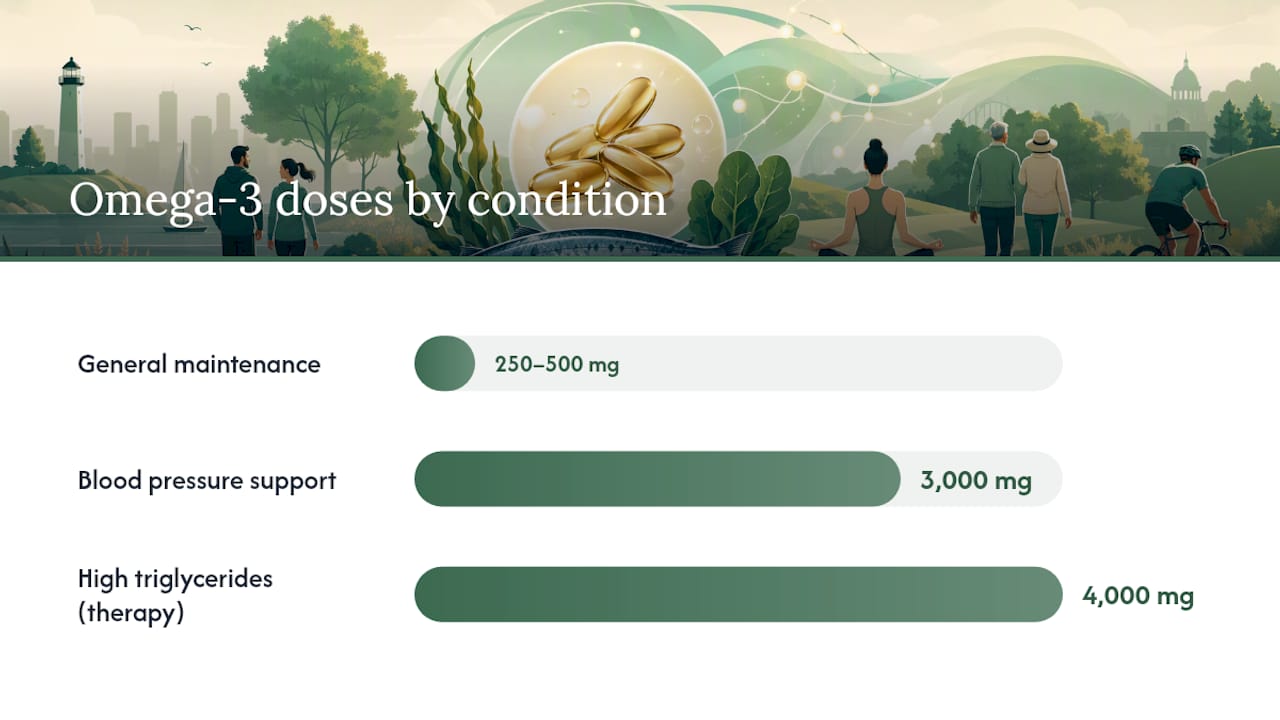
By the Numbers: Prescription-strength omega-3 therapy for triglyceride management typically runs around 4,000 mg per day, roughly eight to sixteen times the general maintenance dose, depending on supplement concentration.
Triglyceride management. For adults with triglycerides above 500 mg/dL, or sometimes above 200 mg/dL depending on overall cardiovascular risk, clinicians often turn to prescription-grade omega-3 formulations dosed at about 4,000 mg per day. This isn’t something you back into with over-the-counter capsules purchased at a drugstore. Prescription formulations are purified and standardized, which matters when you’re dosing at levels this high, since impurities and oxidized oil become more of a concern as volume increases.
Blood pressure support. The evidence here is more modest. Research has looked at doses around 3,000 mg per day and found small but measurable reductions in blood pressure, on the order of a few points systolic and diastolic. The FDA’s qualified health claim around EPA and DHA consumption and hypertension risk reflects this cautious, “may reduce” framing rather than a definitive cure claim. If blood pressure is your primary concern, omega-3s are a supporting player, not a replacement for the dietary and medication strategies your clinician may already have you on. Our guide on heart-healthy food choices for blood pressure covers some of the dietary patterns that work alongside omega-3 intake.
Why the evidence varies so much by outcome. Broader cardiovascular outcome trials, the kind looking at heart attacks and strokes rather than lab values, have produced mixed results. A clinical review indexed on PubMed makes clear that benefit size depends heavily on dose, formulation, and which outcome you’re measuring. A trial using 1,000 mg per day of a standard fish oil blend and a trial using 4,000 mg per day of a purified EPA formulation are not directly comparable, even though both get filed under “omega-3 research” in casual conversation. This is a big reason why headlines about omega-3 studies can seem to contradict each other from one year to the next. They’re often not measuring the same thing at the same dose.
Here’s a quick breakdown of how condition-specific dosing compares to general maintenance:
- General health maintenance: 250 to 500 mg/day EPA+DHA, achievable through diet or a modest supplement.
- High triglycerides: approximately 4,000 mg/day, prescription-grade, clinician-supervised.
- Blood pressure support: approximately 3,000 mg/day, studied in trials, not a standard prescription target.
- Pregnancy and lactation: DHA is prioritized for fetal brain and eye development, with many prenatal formulations providing 200 to 300 mg DHA daily, though specific needs should be discussed with an obstetric provider.
If you’re pregnant or breastfeeding, don’t extrapolate from the triglyceride or blood pressure numbers above. Those are therapeutic doses for adults managing a diagnosed condition, and pregnancy dosing operates on a different rationale entirely, tied to fetal neurological development rather than lipid panels. Your obstetric team is the right source for a specific number, not a general dosing article.
How to Hit Your Omega-3 Target: Food, Supplements, and Label Math
Getting the dose right starts with where you’re getting your omega-3s in the first place, and diet should be your first move, not your backup plan.
- Start with oily fish. Salmon, sardines, mackerel, and trout are the highest-yield sources, and eating them one to two times per week can supply enough EPA and DHA to meet general maintenance needs without a supplement at all. A 3.5 ounce serving of salmon typically delivers well over 1,000 mg combined EPA and DHA, more than double the low end of the maintenance range in a single meal.
- Understand the three main supplement forms. Fish oil is usually sold as triglyceride form (closer to how omega-3s occur naturally in fish) or ethyl ester form (a more concentrated, processed version). Krill oil delivers omega-3s bound to phospholipids, which some research suggests may absorb somewhat differently than triglyceride or ethyl ester forms, though the practical difference for most healthy adults is modest. Algal oil, derived from marine algae rather than fish, is the standard vegetarian and vegan option and provides both EPA and DHA rather than just ALA.
- Read the label for EPA and DHA specifically, not total fish oil weight. A softgel labeled “1,200 mg fish oil” might contain only 360 mg of combined EPA and DHA. The rest is other fatty acids and filler oil. Checking the “Supplement Facts” panel for the specific EPA and DHA milligram amounts, rather than trusting the front-of-bottle “fish oil” number, is the single most useful habit you can build here.
- Do the math on capsule count. If your target is 500 mg per day and your capsule provides 300 mg combined EPA and DHA, you need roughly two capsules daily, not one. Lower-concentration products can require three or four capsules to reach even a modest maintenance dose, which adds up in cost and pill burden over a month.
- Consider algal oil if you’re vegetarian, vegan, or allergic to fish or shellfish. It’s typically the only supplement source that supplies preformed DHA and EPA without relying on ALA conversion, though it tends to cost more per milligram than standard fish oil.
Pro Tip: Keep the bottle’s Supplement Facts panel, not the marketing claim on the front label, as your reference point. Two products both marketed as “1,000 mg omega-3” can differ by 300 mg or more in actual EPA and DHA content once you check the fine print.
For readers who enjoy cooking as part of their nutrition routine, incorporating omega-3-rich seasoning oils into home cooking is a low-effort way to layer in additional intake alongside fish-based meals, though oils used for seasoning typically contain far less EPA and DHA than fatty fish itself.

Omega-3 Side Effects and Drug Interactions Worth Knowing
Fish oil has a reputation as one of the gentler supplements on the shelf, and for most people at moderate doses, that reputation holds up. Still, side effects and interactions become more relevant as the dose climbs, particularly once you’re in the therapeutic range rather than general maintenance.
Common, mild side effects include:
- Fishy aftertaste or “fish burps,” often reduced by taking capsules with meals or choosing enteric-coated or frozen capsules.
- Mild digestive upset, including loose stools or nausea, especially when starting a new supplement or increasing dose quickly.
- A faint fishy body odor at very high intakes, which some patients notice around the higher end of therapeutic dosing.
The interaction that deserves real attention is bleeding risk. Omega-3s have a mild antiplatelet effect, meaning they can thin the blood slightly. That effect is usually inconsequential at 250 to 500 mg per day, but it becomes clinically relevant at higher therapeutic doses, and especially relevant if you’re already taking anticoagulants like warfarin, or antiplatelet medications like aspirin or clopidogrel. If you’re on any blood thinner and considering a dose above general maintenance levels, that’s a conversation for your prescriber before you start, not after you notice unusual bruising.
The FDA’s guidance not to exceed 5,000 mg per day from supplements exists specifically because bleeding risk and other side effects become more pronounced at very high, unsupervised intakes. That ceiling isn’t a suggestion to aim for. It’s a boundary you shouldn’t cross without a clinician actively monitoring you, and most people managing general health have no reason to get anywhere close to it.
Before surgery or during pregnancy, the guidance shifts slightly. Surgeons commonly ask patients to stop fish oil supplements one to two weeks before a procedure because of the bleeding risk mentioned above. If you’re pregnant, DHA intake is generally encouraged for fetal development, but any decision to supplement beyond food sources should go through your obstetric provider rather than a general dosing guide. Clinicians also routinely advise patients never to double up on a missed dose and to report any unusual bleeding or bruising promptly, especially when a procedure is scheduled.
Building a Practical Omega-3 Dosing Plan
Turning guideline numbers into an actual daily habit is where most people get stuck, so here’s a straightforward way to approach it.
- Default to 250 to 500 mg per day of combined EPA and DHA unless you have a specific diagnosed condition your clinician is treating with a different target.
- Don’t self-escalate the dose. If you’re curious about higher intakes for triglycerides or blood pressure, that decision needs lab work and clinical context behind it, not a guess based on what worked for a friend or family member.
- Never exceed 5,000 mg per day from supplements, and treat any approach toward that number as a signal to check in with your provider rather than push forward alone.
- Ask for a baseline lipid panel before starting therapeutic-dose omega-3s, and plan a follow-up panel, typically within a few months, to see whether the dose is actually moving your triglycerides in the right direction.
- Bring specific questions to your appointment, including: What’s my actual triglyceride number, and does it qualify for prescription-strength dosing? Am I on any medication that could interact with higher omega-3 intake? Should I be tracking anything between now and my next lab draw?
Pro Tip: If you’ve been taking an over-the-counter fish oil supplement for months without ever having your triglycerides or lipid panel rechecked, that’s a sign it’s time for a follow-up, not a sign to just keep taking it indefinitely.
Severe hypertriglyceridemia, generally triglycerides above 500 mg/dL, is the scenario where prescription omega-3 formulations make the most sense, since purified, standardized products give both you and your clinician a more predictable, monitorable dose than a supplement aisle guess.
How Garden State Medical Group Approaches Omega-3 Dosing With Patients
When a patient asks about omega-3 dosage, the conversation at Garden State Medical Group rarely starts with a number. It starts with a fuller picture: current diet, existing medications, family history, and whatever the most recent lipid panel shows. A patient who eats salmon twice a week and has normal triglycerides needs a very different conversation than a patient with a triglyceride reading north of 600 mg/dL who’s never had blood work done in years.
Consider a few common scenarios that come up in practice. A patient with a diet built mostly around chicken, beef, and processed foods, and little to no fish, often has a dietary gap that may be addressed with a modest daily supplement. A patient with significantly elevated triglycerides discovered on routine blood work is a different case entirely, one where a prescription-strength omega-3 formulation, dosed and monitored by a clinician, is far more appropriate than an over-the-counter product picked up at random. A pregnant patient asking about DHA gets guidance shaped around fetal development timelines rather than cardiovascular risk reduction, since the clinical reasoning behind the number is fundamentally different.
This is also where routine blood testing matters more than most patients expect. A baseline lipid panel tells you whether you’re even a candidate for therapeutic dosing, and a follow-up panel tells you whether the dose is working. Without that data, dosing decisions are essentially guesses, which is exactly the situation clinical oversight is meant to prevent. For patients already exploring supplement options, the practice’s professional-grade supplement offerings give a way to source products with more consistent labeling than what’s typically found on a general retail shelf.
A Clinician’s Note on What to Realistically Expect
If you’re starting an omega-3 regimen hoping for a dramatic shift in how you feel day to day, temper that expectation early. The benefits here tend to be measurable on a lab report before they’re noticeable in daily life. Triglyceride improvements from therapeutic dosing typically show up over weeks to a few months of consistent use, not days, and blood pressure effects, where they exist, tend to be modest rather than dramatic.
Consistency matters more than perfection. Taking your dose most days, with food, and sticking with it long enough to see a follow-up lab result beats an all-or-nothing approach where you start strong for two weeks and then stop. If you’re several months into a therapeutic dose without any lab improvement, that’s a signal worth raising with your clinician, not a reason to quietly double the dose on your own. Omega-3 supplementation works best as one piece of a broader plan, alongside dietary changes and, when needed, other prescribed therapies, rather than as a standalone fix.
— Garden State Medical Group
Get Your Omega-3 Dosage Right With Clinical Guidance, Not Guesswork
Patients have access to clinical evaluation including lipid panels and clinician guidance to determine appropriate omega-3 dosing. Rather than estimating dose from generalized charts, they benefit from testing, personalized plans, and follow-up monitoring.

If your diet leans light on fish and you suspect you’re falling short of the general maintenance range, a Primary Care visit is the place to start that conversation and get baseline labs ordered. Patients managing high triglycerides or cardiovascular risk factors may be better served by the practice’s Cardiopulmonary Care specialty, where lipid management and prescription-strength omega-3 options are part of routine care. For those who want a professional-grade supplement with clearer labeling than typical retail products, the supplement dispensary offers an alternative sourced with clinical input. Prescription-strength omega-3 therapy always requires a clinician’s oversight, so if your triglycerides run high, book a visit and get the lab work that tells you whether that’s the right next step.
Sources
For readers who want to go deeper than this guide, the NIH Office of Dietary Supplements factsheet is the most complete reference on intake ranges and the supplement upper limit. The FDA’s qualified health claim announcement covers the regulatory reasoning behind blood pressure claims, and the AHRQ evidence summary on omega-3s and cardiovascular disease compiles trial-level data for readers who want the underlying research behind the condition-specific numbers discussed above.
This article is general information, not a substitute for advice from a qualified doctor. Consult a qualified healthcare professional about your own circumstances before acting on anything here.
- Omega-3 Fatty Acids - Health Professional Fact Sheet
- Omega-3 foods: incorporating healthy fats into your diet - Harvard Health
- FDA announcement on qualified health claims for EPA and DHA
- PubMed indexed clinical review (example)
FAQ
How much omega-3 should I take per day?
Most adults do well with 250 to 500 mg of combined EPA and DHA daily for general health, a range widely referenced across major health guidance rather than a fixed federal RDA. Higher doses for specific conditions, like the roughly 4,000 mg/day used for triglyceride management, should only be used under a clinician’s supervision.
What is the maximum safe omega-3 dosage from supplements?
The FDA advises against exceeding 5,000 mg per day from dietary supplements. This ceiling exists because bleeding risk and other side effects increase at very high, unsupervised intakes.
Is fish oil or krill oil better for reaching my omega-3 dosage target?
Neither is universally better. The right choice depends on your goals, any shellfish allergy, tolerability, and the actual EPA and DHA content per serving on the label, since concentration varies widely between products.
How do I know if a supplement label’s dose matches my omega-3 target?
Check the Supplement Facts panel for the specific EPA and DHA milligram amounts, not the total “fish oil” weight listed on the front of the bottle. A product listing 1,200 mg of fish oil might contain only a few hundred milligrams of actual EPA and DHA, meaning you may need more than one capsule to hit your target.
Can I get enough omega-3 from food without supplements?
Yes, for most people. Eating oily fish like salmon or sardines one to two times per week can supply enough EPA and DHA to meet general maintenance needs without a daily supplement.
When should I see a clinician about my omega-3 dosage?
See a clinician before starting any dose above general maintenance, especially if you take blood thinners, are pregnant, or have elevated triglycerides on a lipid panel. A Primary Care visit at Garden State Medical Group can establish your baseline labs and determine whether a therapeutic dose is appropriate for your situation.