
Step-by-step primary care visit: What to expect

TL;DR:
- Preparing for your primary care appointment involves gathering essential documents, accurately sharing your health history, and prioritizing your concerns to maximize the visit’s effectiveness.
- During the visit, you’ll go through steps including check-in, vital measurement, discussion of your chief complaints, physical exams, lab work, and a clear follow-up plan, ensuring comprehensive care.
- A structured, proactive approach to primary care enhances early detection, effective management of chronic conditions, and overall health outcomes, making your visits more valuable and less stressful.
Walking into a primary care appointment can feel stressful, especially when you’re managing a chronic condition like diabetes or high blood pressure, or when you’re simply unsure what questions to ask. You might leave feeling like you forgot something important, or worse, you might not fully understand the plan your provider just explained. This guide walks you through every stage of a primary care visit so you arrive prepared, participate confidently, and follow through on your care plan afterward. When you know what to expect, the entire process feels less overwhelming and a lot more useful.
Table of Contents
- Getting ready: What to bring and how to prepare
- Step-by-step: What happens during a primary care visit
- Managing chronic conditions: Special considerations during your visit
- Preventive services: Screenings and wellness checks you shouldn’t miss
- Why a strategic step-by-step approach transforms primary care visits
- Get personalized, step-by-step care with Garden State Medical Group
- Frequently asked questions
Key Takeaways
| Point | Details |
|---|---|
| Preparation matters | Bringing the right information and questions helps ensure a productive and efficient visit. |
| Understand each visit stage | Knowing what happens before, during, and after the appointment reduces stress and increases confidence. |
| Chronic care needs special focus | If you have a chronic condition, your provider will track labs and medications closely. |
| Prevention is essential | Timely screenings and wellness checks catch issues early and improve long-term health. |
| Structured steps boost results | A strategic approach to primary care visits leads to better outcomes and a smoother healthcare experience. |
Getting ready: What to bring and how to prepare
A productive primary care visit starts well before you walk through the door. The preparation you do at home directly shapes how much value you get from the time with your provider. Many patients arrive without their medication list, forget to mention new symptoms, or haven’t thought through their top concerns. That leads to rushed conversations and missed opportunities.
Start by gathering everything you’ll need. Here is a summary of essential items and why each one matters:
| Item | Why you need it |
|---|---|
| Government-issued ID | Required for patient verification and records |
| Insurance card | Needed to confirm coverage and process billing |
| Current medication list | Helps your provider avoid dangerous interactions |
| Recent lab or test results | Gives your provider context and reduces duplicate testing |
| List of questions or concerns | Keeps you focused so nothing important gets skipped |
| Names of any specialists you see | Supports coordinated, connected care |
Beyond documents, think about your health history. Write down any symptoms you’ve noticed recently, even if they seem minor. Note when they started, how often they occur, and whether anything makes them better or worse. Good history-taking practices show that first visits are more comprehensive and that providers benefit when patients can share their story clearly and completely.
Be honest about your habits too. Smoking, alcohol use, diet, and physical activity all affect your health and your provider needs accurate information to give you good advice. This is not the time to understate your habits. Your provider is there to help, not to judge.
Pro Tip: Write down your top three concerns before the appointment and rank them by priority. That way, if time runs short, the most important issue gets addressed first. For more strategies on getting the most from your appointment, read about maximizing your primary care visit.
Step-by-step: What happens during a primary care visit
Now that you know how to prepare, here’s exactly what each step of your visit will look like. Understanding the sequence helps you stay engaged rather than just waiting passively.
1. Arrival and check-in. You’ll present your ID and insurance card at the front desk, confirm your contact information, and fill out or update intake forms. If it’s your first visit, expect more paperwork covering your full health history.
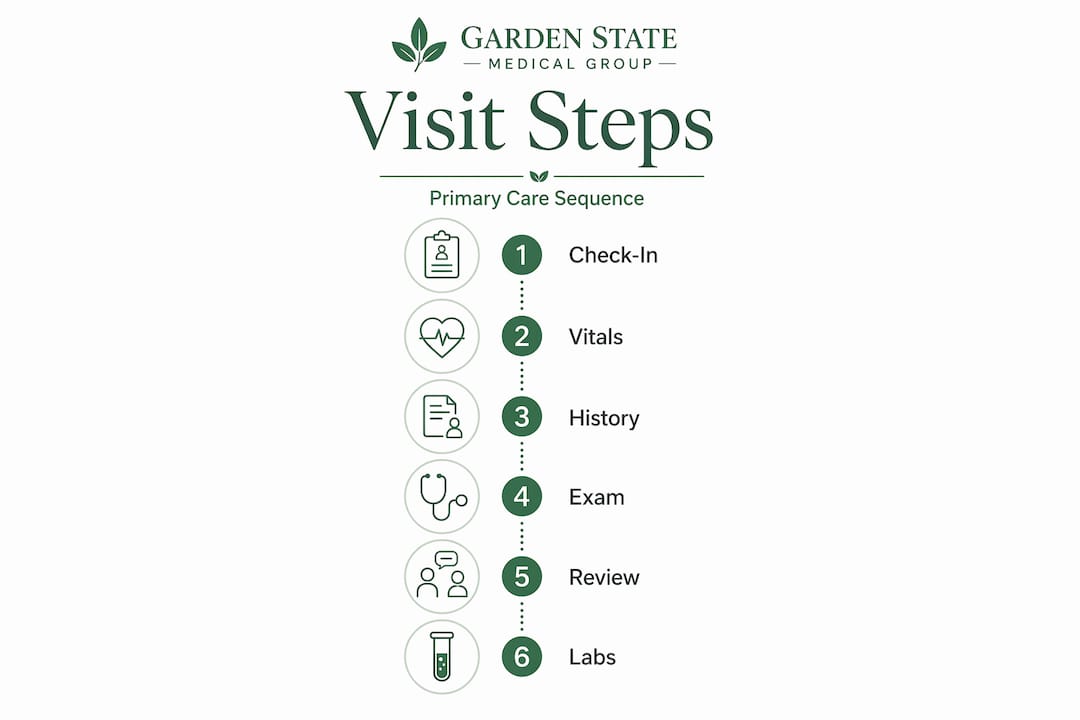
2. Nurse or medical assistant intake. A nurse or medical assistant will bring you to an exam room, record your vitals (blood pressure, heart rate, weight, temperature, and oxygen level), and review your current medication list. This is a good moment to flag any new prescriptions from other providers.
3. History and chief concern. Your provider enters and asks why you came in today. This is the patient-centered core of the visit. Research consistently supports allowing patients to speak uninterrupted so providers capture the full picture. Speak freely here. Mention all your concerns before diving into any one topic.
4. Physical exam. Depending on your reason for the visit, your provider may examine your heart, lungs, abdomen, skin, or other systems. The exam is targeted to your concerns and health status, not a head-to-toe review at every visit.

5. Review of chronic conditions and medications. If you manage ongoing conditions, this step involves checking how well your current treatment plan is working, reviewing lab trends, and discussing any side effects or dose changes.
6. Labs and preventive screenings. Your provider may order blood work, urine tests, imaging, or recommend specific screenings based on your age, sex, and risk factors.
7. Referrals. If a specialist is needed, your provider will place a referral and explain why. You can ask what to expect from that visit and how results will be communicated back to your primary care team.
8. Summary and follow-up plan. Before you leave, your provider should summarize the findings, explain any new prescriptions, and confirm when you should return or follow up on test results.
“Your provider should always leave time to confirm your understanding of the plan. If something is unclear, ask them to explain it again in simpler terms. You have every right to fully understand your own care.”
One important distinction worth understanding is the difference between a preventive visit and a problem-based visit:
| Visit type | Focus | What to expect |
|---|---|---|
| Preventive (wellness) | Screenings, immunizations, risk assessment | Comprehensive review with no specific complaint |
| Problem-based (acute or chronic) | Specific symptom or ongoing condition | Targeted exam, possible prescriptions or referrals |
| Combined visit | Both preventive and problem-based needs | May require separate billing; ask your provider |
Pro Tip: It’s completely appropriate to ask your provider to repeat or clarify anything in your care plan. You should leave the appointment knowing exactly what’s happening and what comes next. Check out common reasons for primary care visits to better understand how different concerns get handled.
Managing chronic conditions: Special considerations during your visit
Routine visits cover everyone, but if you’re managing a chronic condition, here’s what’s different. Visits for conditions like diabetes, hypertension, or chronic kidney disease (CKD) involve a more structured set of assessments and conversations that go beyond a standard checkup.
According to guidance for primary care management of CKD, visits for adults managing chronic conditions emphasize medication review and adjustment, lab monitoring, and specialist referrals when needed. Your provider isn’t just checking in casually. They’re actively tracking measurable indicators of disease control and adjusting your treatment based on real data.
Here’s what typically happens when chronic conditions are involved:
Medication review and adjustment. Your provider checks whether your current medications are working and whether any doses need to change. For example, ACE inhibitors (a type of blood pressure medication that also protects kidney function) require close monitoring. Providers watch for a creatinine rise of less than 30% from baseline and potassium levels below 5.5 mEq/L (milliequivalents per liter, a standard lab measurement unit) as acceptable thresholds when starting or adjusting these medications.
Lab work to track disease control. For diabetes, this includes your A1C level, a three-month average of blood sugar control. For CKD, providers check creatinine and potassium. For heart disease or high cholesterol, lipid panels are ordered at regular intervals. These numbers guide every treatment decision.
Blood pressure and symptom monitoring. Even small shifts in blood pressure or new symptoms like swelling, fatigue, or shortness of breath can signal a change in disease status. Your provider documents and compares these findings visit over visit.
Risk factor management. Smoking, poor diet, physical inactivity, and excess weight all worsen chronic conditions. Expect an honest conversation about lifestyle factors and what small, realistic changes might help. This isn’t a lecture. It’s a productive part of the care plan.
Coordinating with specialists. If your condition involves a cardiologist, endocrinologist, or nephrologist, your primary care provider plays a central role in coordinating that care. They keep the full picture in view when specialists are focused on one system.
For more context on how this ongoing management works, explore our chronic disease management guide or review tips for chronic disease management that can help you take a more active role.
Preventive services: Screenings and wellness checks you shouldn’t miss
In addition to chronic management, preventive care is a core part of your visit. Here’s what you need to know so you’re not missing important screenings that could catch problems early.
Preventive services are guided by the U.S. Preventive Services Task Force (USPSTF), a group of independent experts that reviews evidence and assigns ratings of A or B to screenings that have strong proof of benefit. According to preventive care guidelines, services like depression screening using the PHQ-9 tool, colorectal cancer screening, cholesterol testing, and immunizations are all recommended for adults and covered by Medicare and most insurance plans when they carry an A or B rating.
Here are some of the most important preventive services organized by life stage:
Adults 18 to 39:
- Blood pressure screening at every visit
- Depression screening (PHQ-9) annually
- Sexually transmitted infection screening based on risk
- Tobacco and alcohol use counseling
- Cervical cancer screening every three years for women starting at age 21
Adults 40 to 64:
- Cholesterol (lipid panel) screening, especially for those at elevated cardiovascular risk
- Diabetes screening for overweight or obese adults starting at age 35
- Colorectal cancer screening beginning at age 45
- Lung cancer screening for long-term smokers aged 50 to 80
- Breast cancer screening for women starting at 40 per updated guidelines
- Bone density screening for women approaching or past menopause
Adults 65 and older:
- All of the above plus annual fall risk assessment
- Cognitive screening as appropriate
- Abdominal aortic aneurysm screening for men who have smoked
- Regular shingles and flu immunizations
One misconception worth clearing up: a “full physical” where your provider checks every system from head to toe is not necessarily better care. Modern evidence-based visits focus on proven screenings tied to your specific age and risk profile rather than exhaustive exams that lack clinical value.
Immunizations are also part of the preventive visit. Flu shots, pneumonia vaccines, Tdap (tetanus, diphtheria, and pertussis) boosters, and COVID-19 updates all belong on your radar. Your provider reviews what’s due based on your records.
To understand more about why these services matter over the long term, read about the benefits of preventive care and explore our preventive care guide for a full breakdown of the types available.
Why a strategic step-by-step approach transforms primary care visits
With all steps outlined, here’s why a methodical approach makes a real difference now and in the future.
Many people think of the annual physical as a single routine event where you show up, get checked out, and leave with a clean bill of health. But that model of care misses too much. A purely reactive approach, where you only go in when something is wrong, means chronic conditions develop quietly, preventive screenings get skipped, and small problems become serious ones.
The data supports a different approach. Primary care visits are rising in large part because patients delayed treatment during previous years, and providers are now managing more complex, advanced conditions that could have been caught earlier. That trend is a clear signal. Prevention and early management are not optional extras. They are the core purpose of primary care.
When visits follow a structured, evidence-based approach, missed steps are less likely. Poor history-taking leads to misdiagnosis. Skipped screenings mean conditions like colorectal cancer or depression go undetected for years. Medication reviews that don’t happen lead to drug interactions or undertreated chronic disease. Each step in the process connects to a real outcome.
We believe that primary care done right is proactive, not reactive. It is built on the foundation of a good patient history, targeted physical assessment, evidence-based screenings, and a clear follow-up plan. Patients who come prepared, engage actively during their visit, and follow through on the plan consistently experience better outcomes over time. It’s not complicated. But it does require intention. For practical guidance on managing ongoing health needs, review our primary care management tips to support your long-term health.
Get personalized, step-by-step care with Garden State Medical Group
Ready to put these steps into action in your own health journey? Here’s how Garden State Medical Group can help.
At Garden State Medical Group, patients in North Bergen and Secaucus have access to fully coordinated primary care services designed around exactly the kind of structured, evidence-based approach this article describes.
Whether you need preventive screenings, management of a chronic condition like diabetes or kidney disease, or both, our team is equipped to handle each step. Our chronic care management programs provide structured support for patients managing multiple ongoing conditions, and our diabetes prevention program offers education and tools for those at risk or newly diagnosed. Scheduling an appointment is straightforward, and our team accepts most major insurance plans. Contact us today to set up your next visit and experience primary care the way it should work.
Frequently asked questions
What should I bring to my first primary care visit?
Bring your ID, insurance card, a list of current medications, recent test results, and any questions or concerns you want to address during the appointment.
How often should adults get preventive screenings?
Many adults need depression, cancer, and cholesterol screenings at intervals based on age and risk, following USPSTF guidelines that determine which services are covered by Medicare and insurance.
How are chronic conditions like diabetes or CKD monitored during visits?
Providers review medications, check labs like A1C or creatinine, and adjust treatment based on lab monitoring guidelines to maintain consistent disease control.
Can preventive and problem-based care be done in the same visit?
Often yes, but visits may need to be split for billing if acute or chronic issues dominate the appointment, as best billing practices recommend separating preventive from problem-based care when needed.
Why are primary care visits becoming more important?
Delayed early treatment has contributed to more complex health needs, making prevention and chronic management more critical, as rising visit trends confirm across the country.