
Turmeric for Joint Pain: What Adults With Arthritis Need to Know
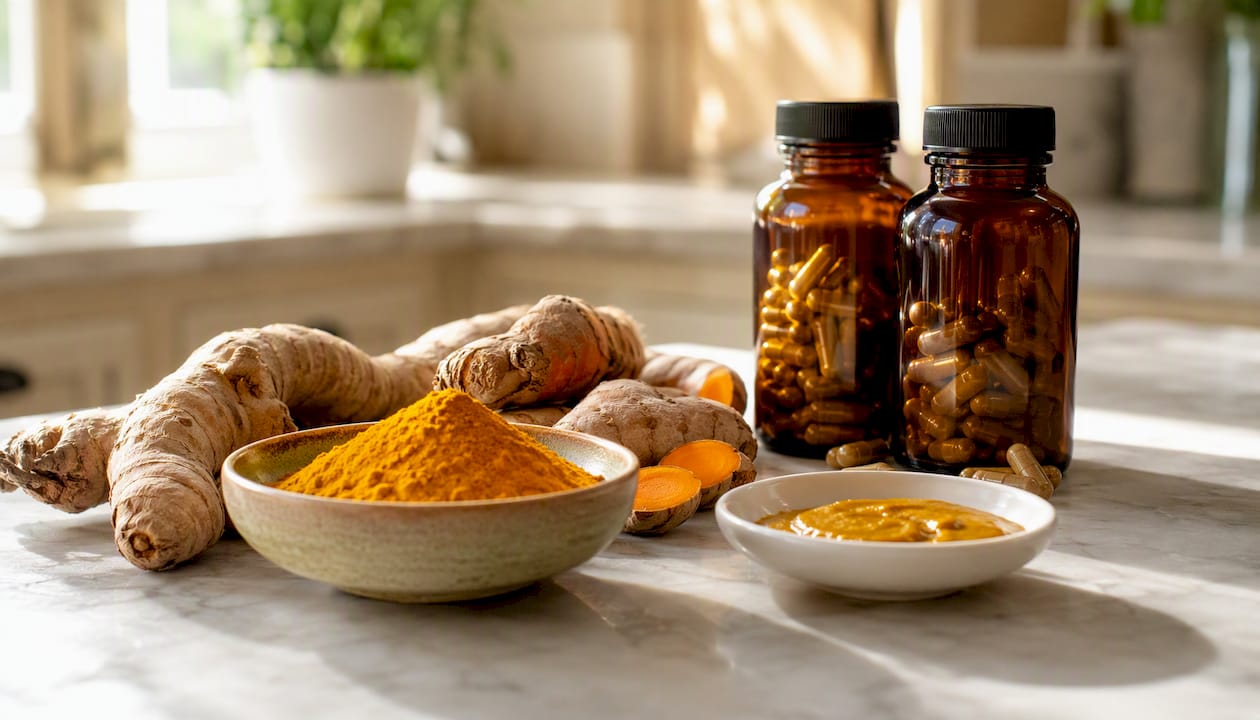
Standard turmeric in your kitchen spice rack is unlikely to relieve arthritis pain. But standardized, bio-enhanced curcumin supplements have genuine clinical evidence behind them, including head-to-head trials against ibuprofen. Here is what the research actually shows, and how to use it safely.
- Culinary turmeric vs. curcumin extracts: Turmeric root contains curcumin, its active anti-inflammatory compound, but at concentrations too low and too poorly absorbed to reach therapeutic levels in your joints. Supplements used in clinical trials are concentrated, standardized extracts, not the powder you add to a curry.
- Clinical comparison anchor: A multicenter trial of 367 patients found Curcuma domestica extract at 1,500 mg/day was noninferior to ibuprofen 1,200 mg/day on WOMAC pain and function scores over 4 weeks, with fewer reports of abdominal pain in the curcumin group.
- Immediate practical takeaway: If you want to try curcumin for joint pain, choose a standardized, bio-enhanced extract (such as Meriva, BCM-95, or Theracurmin), follow trial-based dose ranges, and discuss it with your clinician first. Mayo Clinic recommends medical review before starting supplements, especially if you take blood thinners or other medications.
Key Takeaways
Standardized, bio-enhanced curcumin extracts have RCT support for modest joint pain and function improvement, sometimes comparable to ibuprofen in short trials, but culinary turmeric is not a therapeutic substitute.
| Point | Details |
|---|---|
| Formulation determines effectiveness | Only bio-enhanced extracts (Meriva, BCM-95, Theracurmin) reach therapeutic absorption levels; culinary turmeric does not. |
| Clinical evidence is modest but real | A 2025 meta-analysis found roughly a 30% WOMAC pain reduction versus placebo with bio-enhanced curcumin. |
| Expect weeks, not days | Most trials ran 4–16 weeks before meaningful benefit appeared; curcumin is a chronic anti-inflammatory, not an acute painkiller. |
| Interactions require clinical review | Curcumin can enhance anticoagulants and lower blood glucose; always review with your clinician before starting. |
| Garden State Medical Group | Offers primary care, chronic care management, and access to professional-grade supplements for supervised joint pain care in North Bergen and Secaucus, NJ. |
Table of Contents
- What the clinical research shows about turmeric for joint pain
- How curcumin works and why the formulation you choose matters
- Doses and product types shown to work in trials
- How long until you may notice a difference
- Side effects, contraindications, and drug interactions
- When you should see a clinician instead of self-treating
- How a multidisciplinary clinical approach improves your outcomes
- A clinician’s perspective on curcumin in practice
- Personalized joint care at Garden State Medical Group
- Sources
- FAQ
What the clinical research shows about turmeric for joint pain
The strongest evidence comes from randomized controlled trials (RCTs) and systematic reviews focused on knee osteoarthritis (OA), the most studied joint condition in curcumin research. Across these trials, the primary outcome measures are the WOMAC (Western Ontario and McMaster Universities Osteoarthritis Index), which scores pain, stiffness, and physical function, and the VAS (Visual Analog Scale) for pain intensity.
A 2025 meta-analysis of bio-enhanced curcumin preparations found approximately a 30% reduction in pooled WOMAC pain scores versus placebo. When bio-enhanced curcumin was added to active drug treatment, some comparisons showed up to a 70% reduction in VAS pain versus active drugs alone. These are meaningful numbers for a supplement, though the effect size varies by formulation and trial design.
The landmark multicenter RCT comparing Curcuma domestica extract to ibuprofen enrolled 367 knee OA patients and ran for 4 weeks. Curcumin met the noninferiority threshold on WOMAC total score, pain subscale, and physical function. The ibuprofen group reported significantly more abdominal pain events (P=0.046). That GI advantage matters for patients who cannot tolerate NSAIDs long-term.
A note on study quality: Harvard Health and other clinical reviewers point out that many curcumin trials are small, short, and have methodological limitations. The evidence supports cautious optimism, not certainty. Most trials run 4–16 weeks, which reflects curcumin’s role as a chronic anti-inflammatory rather than a fast-acting painkiller.
Statistic to know: In the 2025 meta-analysis, bio-enhanced curcumin alone produced roughly a 30% reduction in WOMAC pain scores versus placebo across pooled trial data.
How curcumin works and why the formulation you choose matters
Curcumin reduces inflammation through several pathways. It inhibits COX and LOX enzymes (the same targets as NSAIDs), suppresses NF-kB signaling (a master regulator of inflammatory gene expression), and reduces pro-inflammatory cytokines such as IL-1β, IL-6, and TNF-α. In plain terms, it dials down the molecular signals that drive joint inflammation and pain.
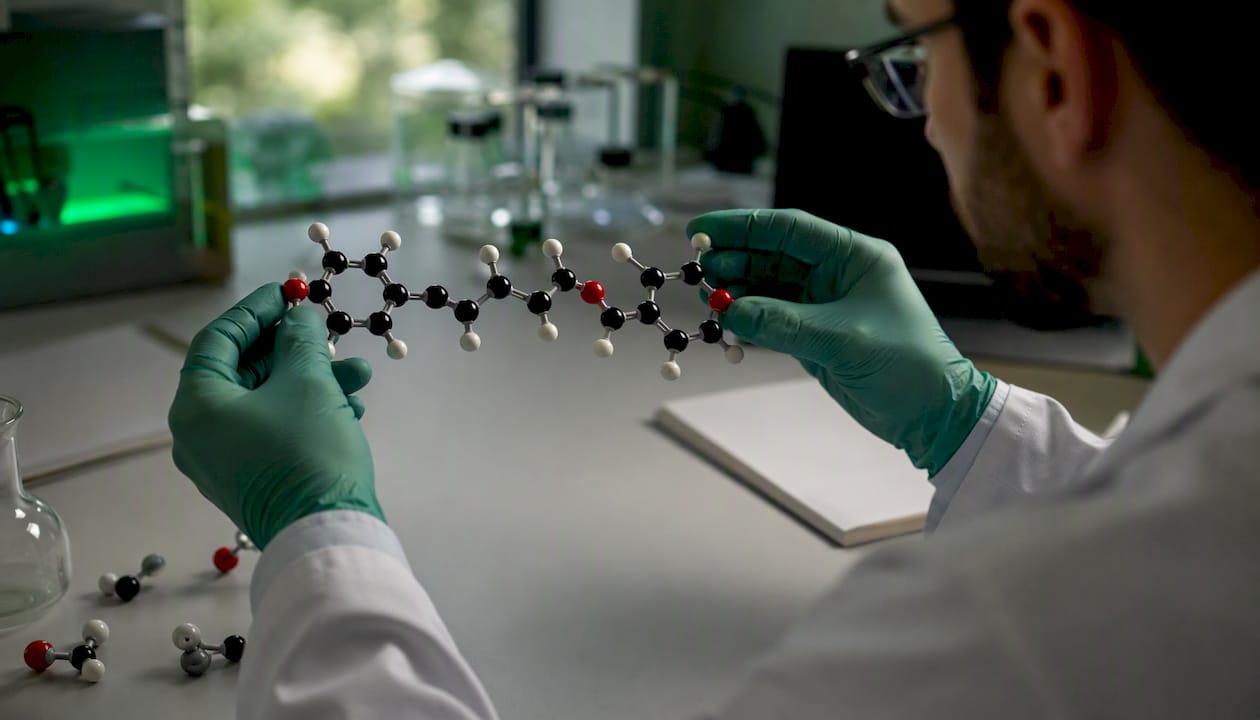
The problem is absorption. Raw turmeric powder and standard curcumin extracts are poorly absorbed from the gut, metabolized quickly, and eliminated before reaching meaningful concentrations in joint tissue. This is why culinary turmeric, regardless of how much you consume, is unlikely to be therapeutic. Research on curcumin bioavailability confirms that bio-enhanced delivery systems substantially increase plasma curcumin levels and extend tissue exposure compared to standard powder.
Three formulation technologies dominate the clinical literature:
Meriva is a phospholipid complex (phytosome technology) that binds curcumin to phosphatidylcholine, improving absorption through the intestinal wall. Several RCTs have used Meriva specifically and reported meaningful pain and function improvements in OA patients.
BCM-95 (Biocurcumin) combines curcumin with turmeric essential oils, which contain ar-turmerone, a compound that enhances curcumin absorption without adding synthetic carriers. It is one of the more commonly studied extracts in arthritis trials.
Theracurmin uses a colloidal nanoparticle dispersion technology that reduces curcumin particle size dramatically, increasing water solubility and absorption. Some pharmacokinetic studies report it achieves higher plasma concentrations than standard curcumin at equivalent doses.
Standard curcumin with piperine (black pepper extract, typically 5–20 mg) is a lower-cost enhancement strategy. Piperine inhibits the enzyme that breaks down curcumin in the gut, increasing absorption. It is not as well-studied as the patented formulations above, but it is widely available and used in many commercial supplements.
| Formulation | Technology | Absorption advantage | Commonly used in trials? |
|---|---|---|---|
| Meriva | Phospholipid complex (phytosome) | Improved intestinal uptake | Yes |
| BCM-95 | Curcumin + turmeric essential oils | Enhanced natural absorption | Yes |
| Theracurmin | Colloidal nanoparticle dispersion | High water solubility, elevated plasma levels | Yes |
| Curcumin + piperine | Enzyme inhibition (black pepper extract) | Moderate absorption increase | Yes (widely) |
| Standard curcumin powder | None | Poor systemic bioavailability | Rarely therapeutic |
The Arthritis Foundation specifically recommends bio-enhanced extracts and third-party-tested products over generic turmeric supplements, a position consistent with the pharmacokinetic evidence.
Doses and product types shown to work in trials
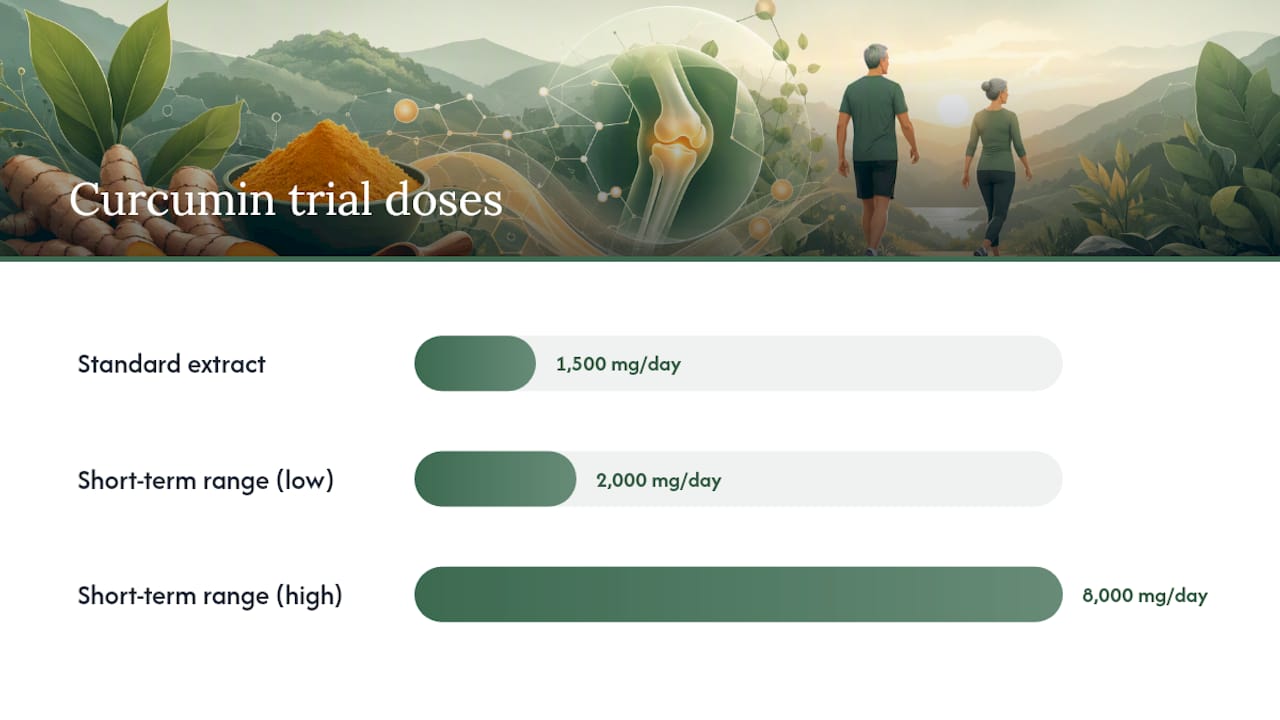
Clinical trials have used a range of doses depending on the formulation. The most cited dose for standard Curcuma domestica extract is 1,500 mg/day, typically split across two or three doses. Some trials using highly bio-enhanced formulations like Theracurmin have used lower total curcumin doses because absorption is more efficient. Doses up to 2,000–8,000 mg/day have been used in short-term trial settings, though higher doses carried more gastrointestinal side effects in some reports.
For practical purposes, most clinicians working with OA patients start at the lower end of the trial range and adjust based on tolerance. Taking curcumin with a meal that contains some fat improves absorption across all formulation types, since curcumin is fat-soluble.
Buying checklist for a curcumin supplement:
- Standardized curcuminoid content: Look for 95% curcuminoids on the label. This tells you the extract is concentrated, not just ground turmeric root.
- Named bio-enhancement method: The label should specify Meriva, BCM-95, Theracurmin, or piperine (bioperine). A supplement that lists only “turmeric extract” without a delivery technology is likely poorly absorbed.
- Third-party testing seal: Look for NSF International, USP, or Informed Sport certification. The supplement market is not regulated like pharmaceuticals, and adulteration with synthetic colorants or inconsistent curcuminoid content is a documented risk.
- Serving size and dose math: Confirm the dose per serving aligns with trial ranges. A product listing 500 mg of turmeric root powder per capsule is not equivalent to 500 mg of standardized curcumin extract.
- Safety labeling: The product should list contraindications or interaction warnings, particularly for anticoagulants.
Pro Tip: Take your curcumin supplement with a meal containing healthy fats, such as avocado, olive oil, or nuts. Fat-soluble compounds like curcumin absorb significantly better when the gut is processing dietary fat at the same time.
The NCCIH notes that turmeric supplement content and bioavailability vary considerably across products, reinforcing the importance of choosing a well-characterized, third-party-tested formulation rather than the cheapest option on the shelf.
How long until you may notice a difference
Curcumin is not an acute analgesic. It does not work the way ibuprofen does, reducing pain within an hour or two. It works by gradually modulating inflammatory pathways over time, which means consistent daily use for weeks is required before most people notice a meaningful change.
Most clinical trials run 4–16 weeks, and that range reflects when benefits tend to emerge. Reviews of the clinical evidence consistently describe curcumin as a chronic anti-inflammatory rather than an immediate analgesic. In the 4-week ibuprofen noninferiority trial, both groups showed improvement by the end of the study period, but curcumin’s effect built over the full 4 weeks rather than appearing in the first few days.
What to track while you wait:
- VAS pain score: Rate your pain on a 0–10 scale at the same time each day (morning and after activity). A consistent downward trend over 4–8 weeks is a meaningful signal.
- WOMAC-style function questions: Can you walk further before pain stops you? Is stair climbing easier? These functional markers often improve alongside pain scores in trials.
- Morning stiffness duration: Note how long joint stiffness lasts after waking. Stiffness results in trials were more variable than pain outcomes, so this may or may not improve.
- 6-minute walk distance: Some trials used this as an objective function measure. You can track it informally by timing how far you walk comfortably before discomfort limits you.
If you have seen no change after 8–12 weeks of consistent use at a trial-appropriate dose, the supplement may not be working for you. That is a reasonable stopping point to reassess with your clinician.
Side effects, contraindications, and drug interactions
Curcumin is generally well tolerated in short-term trials. The most commonly reported side effects are gastrointestinal: nausea, loose stools, and stomach discomfort, particularly at higher doses. In the multicenter ibuprofen comparison trial, the curcumin group actually reported fewer abdominal pain events than the ibuprofen group, which is a clinically relevant advantage for patients with GI sensitivity.
Trial safety data show doses up to 2,000–8,000 mg/day were used in short-term settings without serious adverse events in most participants, though GI side effects increased at the higher end of that range. Long-term safety data beyond a few months remain limited.
Key drug interactions to discuss with your clinician:
- Anticoagulants and antiplatelet agents: Curcumin has antiplatelet activity and may enhance the effect of warfarin, clopidogrel, aspirin, and newer anticoagulants like apixaban or rivaroxaban. This combination raises bleeding risk and requires medical supervision.
- Diabetes medications: Curcumin may lower blood glucose. Combined with insulin or sulfonylureas, it could increase hypoglycemia risk.
- Chemotherapy and immunosuppressants: Mayo Clinic advises patients on chemotherapy to check with their oncologist before using curcumin, as interactions with certain agents are possible.
- Iron absorption: High-dose curcumin may reduce iron absorption, which matters for patients with iron-deficiency anemia.
Special populations: Pregnant and breastfeeding individuals should avoid curcumin supplements, as safety data in these groups are insufficient. If you have planned surgery, stop curcumin at least two weeks beforehand given its antiplatelet effects. Patients with liver disease or gallbladder problems should consult a physician before use, as curcumin stimulates bile production.
Stop the supplement and contact your clinician promptly if you notice unusual bruising or bleeding, yellowing of the skin or eyes (jaundice), severe abdominal pain, or any new unexplained symptoms that begin after starting curcumin. These signs warrant clinical evaluation, not a wait-and-see approach.
Pro Tip: Bring a complete list of your supplements, including curcumin brand, dose, and formulation, to every medical appointment. Many clinicians do not ask about supplements unless prompted, and interactions with prescription medications are the most common preventable risk.
When you should see a clinician instead of self-treating
Curcumin is a reasonable adjunct for mild-to-moderate osteoarthritis symptoms in otherwise healthy adults. It is not a substitute for clinical evaluation when warning signs are present.
Seek prompt medical attention if you experience:
- Sudden, severe joint swelling, especially if the joint is hot and red, which can indicate septic arthritis or gout requiring immediate treatment.
- Fever accompanying joint pain, a combination that suggests infection or systemic inflammatory disease rather than mechanical OA.
- Rapidly worsening joint function over days to weeks, which is not consistent with typical OA progression.
- Progressive neurologic symptoms such as numbness, weakness, or loss of coordination near an affected joint.
- Joint pain in a young adult with no prior history of OA, which warrants evaluation for autoimmune conditions like rheumatoid arthritis or psoriatic arthritis.
Supplements can mask pain without addressing the underlying cause. A patient with septic arthritis who self-treats with anti-inflammatory supplements may delay diagnosis by days, which can be dangerous. Diagnostic imaging, such as on-site X-ray or MRI, and laboratory testing are often necessary to confirm the diagnosis before any treatment plan, including supplements, is appropriate.
When you do see your clinician, bring your full supplement list and ask specifically whether curcumin is safe alongside your current prescriptions. That conversation takes two minutes and prevents the most common supplement-related complications.
How a multidisciplinary clinical approach improves your outcomes
Curcumin does not work in isolation, and neither does any single intervention for chronic joint pain. Research from clinical reviews notes that higher BMI is associated with smaller improvements in knee OA trials, which means weight management is not optional for many patients. It is one of the most evidence-supported interventions for reducing mechanical load on arthritic joints.
At Garden State Medical Group, the approach to joint pain goes beyond writing a supplement recommendation. The practice integrates:
- Primary care and medication review: A clinician screens your current prescriptions for interactions before any supplement is added, and confirms your diagnosis with appropriate testing.
- On-site radiology and diagnostics: X-ray and other imaging are available in-house to evaluate joint structure and rule out conditions that require different treatment.
- Chronic care management: For patients with ongoing arthritis or multiple chronic conditions, coordinated care programs provide regular monitoring, medication adjustment, and care plan updates.
- Weight management programs: Reducing excess body weight directly decreases joint load and improves the likelihood that anti-inflammatory interventions, including curcumin, will produce meaningful benefit.
- Physical therapy referrals: Strengthening the muscles around an arthritic joint reduces pain and improves function independently of any supplement.
- Professional-grade supplement access: Through an affiliated Fullscript dispensary, Garden State Medical Group provides access to third-party-tested, professional-grade curcumin formulations, removing the guesswork of navigating a crowded retail supplement market.
| Self-managed supplement use | Clinician-supervised approach |
|---|---|
| No interaction screening | Full medication review before starting |
| Retail products with variable quality | Third-party-tested, professional-grade formulations |
| No diagnosis confirmation | Imaging and labs to confirm OA vs. other conditions |
| Supplement alone | Supplement integrated with weight management and PT |
| No monitoring for side effects | Regular follow-up and dose adjustment |
Pro Tip: Ask your clinician about multidisciplinary care programs at your first visit. Patients who combine weight management, physical activity, and targeted supplementation under clinical supervision tend to see better functional outcomes than those using any single intervention alone.
A clinician’s perspective on curcumin in practice
The evidence for standardized curcumin extracts in knee osteoarthritis is real but modest. It is not a cure, and it is not a replacement for physical therapy, weight management, or, when necessary, prescription medication. What it offers is a reasonably safe, GI-friendly option for adults who want to reduce reliance on NSAIDs or who cannot tolerate them well.
The distinction that matters most is formulation. Patients who try generic turmeric capsules from a discount retailer and report no benefit are not disproving the clinical evidence. They are confirming what the pharmacokinetic data already shows: poorly absorbed curcumin does not reach therapeutic concentrations. The trials that produced meaningful results used bio-enhanced preparations, and that specificity is non-negotiable when advising patients.
The other underappreciated point is integration. A patient who takes curcumin but remains sedentary and carries significant excess weight is unlikely to see the same benefit as one who combines it with a structured weight management program and regular low-impact exercise. The supplement is one tool in a broader plan, not the plan itself.
Personalized joint care at Garden State Medical Group
Adults managing arthritis in North Bergen and Secaucus, New Jersey, have access to a clinical team that takes supplement decisions as seriously as prescription ones. Garden State Medical Group offers primary care appointments for initial evaluation and medication review, on-site diagnostic imaging to confirm your diagnosis, and chronic care management programs for patients with ongoing joint conditions.
Through an affiliated Fullscript dispensary, the practice provides access to professional-grade, third-party-tested curcumin formulations, so you are not left sorting through hundreds of retail options with no clinical guidance. Weight management and bone health programs are available for patients whose joint outcomes depend on reducing mechanical load and building supporting muscle. Telemedicine visits are also available for follow-up and supplement review without requiring an in-person trip. To schedule an appointment or discuss whether curcumin fits your care plan, contact Garden State Medical Group directly.
Sources
- 2025 meta-analysis (bio-enhanced curcumin) — PubMed
- Efficacy and safety of Curcuma domestica extracts compared with ibuprofen in patients with knee osteoarthritis: a multicenter study — PubMed
- Mayo Clinic Q and A: Turmeric for healthier diet, pain relief - Mayo Clinic News Network
- Turmeric Probably Won’t Help Your Arthritis — But Curcumin Might — Arthritis Foundation
FAQ
How do I use turmeric for joint pain effectively?
Use a standardized, bio-enhanced curcumin extract (such as Meriva, BCM-95, or Theracurmin) rather than culinary turmeric, take it with a fat-containing meal, and use it consistently for at least 4–8 weeks. Discuss the supplement with your clinician before starting, particularly if you take blood thinners or diabetes medications.
How long does it take for curcumin to work on joint pain?
Most clinical trials report meaningful improvements after 4–16 weeks of consistent daily use. Curcumin is a chronic anti-inflammatory, not an immediate painkiller, so daily consistency over weeks is required before you can fairly assess whether it is helping.
How much curcumin should I take for joint pain?
The most studied dose for knee osteoarthritis is 1,500 mg/day of standardized Curcuma domestica extract, as used in the multicenter ibuprofen comparison trial. Highly bio-enhanced formulations may use lower doses due to better absorption. Follow the dose range on your specific product’s label and confirm it with your clinician.
Is it worth taking curcumin for joint pain?
For adults with mild-to-moderate knee osteoarthritis who cannot tolerate NSAIDs well, bio-enhanced curcumin is a reasonable option with a favorable GI safety profile. The Arthritis Foundation recommends choosing high-quality, bio-enhanced, third-party-tested extracts, and the clinical evidence supports modest but real benefit when the right formulation is used consistently.
Recommended
- Reduce Your Arthritis Symptoms by Avoiding These 4 Foods | Garden State Medical Group | Garden State Medical Group
- Taking Care of Your Bones: 3 Healthy Lifestyle Essentials | Garden State Medical Group | Garden State Medical Group
- Chronic Conditions in Adults Explained: A Clear Guide
- Bone Health: Its Importance and Ways to Keep Bones Healthy | Garden State Medical Group | Garden State Medical Group