
Vitamin D Dosage for Adults: What the Guidelines Recommend

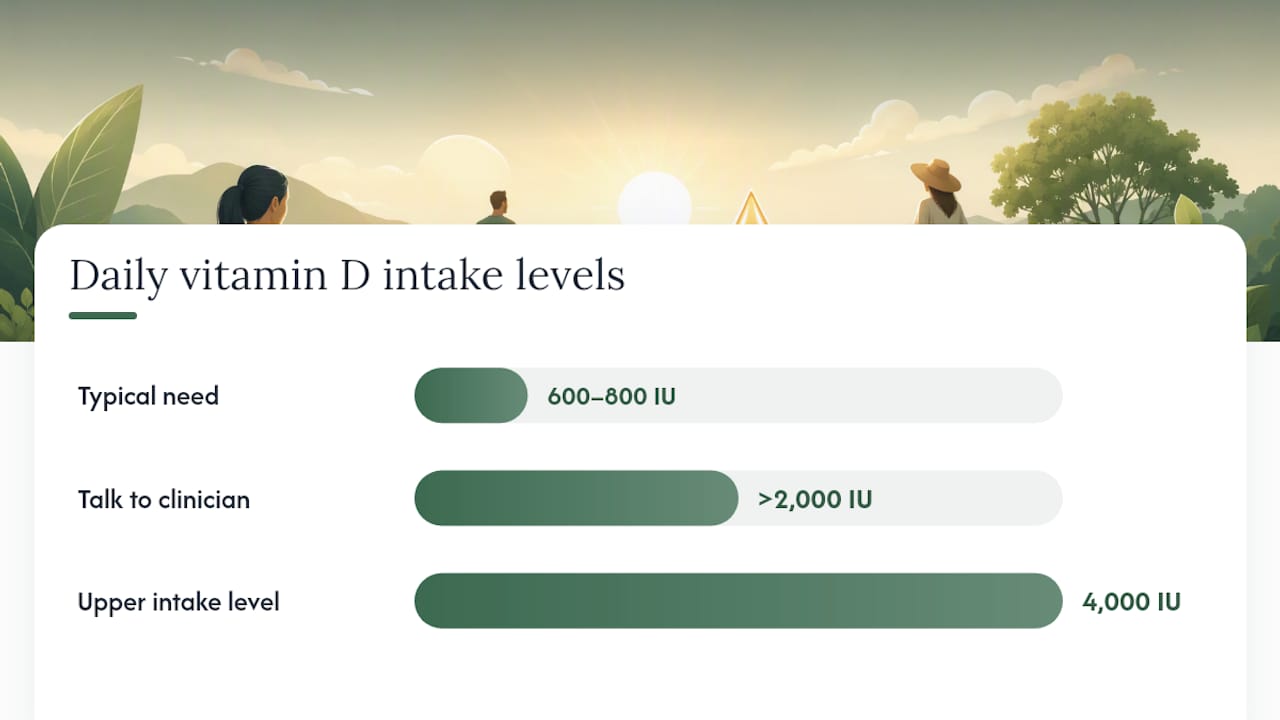
Most healthy adults do well on 600 to 800 IU (15 to 20 mcg) of vitamin D daily, and the adult tolerable upper intake level sits at 4,000 IU (100 mcg) per day. One microgram equals 40 IU, so label conversions are simple math once you know that ratio. If you’re correcting a documented deficiency, your doctor may prescribe short-term doses well above that range, but that decision should always follow a blood test, not a guess.
Here’s the quick reference:
- Adults 19 to 70: 600 IU (15 mcg) daily — the RDA set by the Food and Nutrition Board at the National Academies
- Adults 71 and older: 800 IU (20 mcg) daily
- Tolerable upper intake level (adults 19+): 4,000 IU (100 mcg) daily
- FDA Daily Value on supplement labels: 20 mcg (800 IU)
The safety flag: don’t self-prescribe doses above the upper limit without a blood test and clinician guidance. The test that matters clinically is serum 25-hydroxyvitamin D, often written as 25(OH)D, and it’s the only reliable way to know whether you’re actually low, adequate, or already in a risky range. Guessing your way to a higher number on the bottle isn’t a strategy. It’s how people end up with symptoms of excess vitamin D instead of the benefits they were after.
Key Takeaways
Most healthy adults need 600 to 800 IU of vitamin D daily, but confirmed deficiency requires clinician-supervised testing and dosing above the standard upper limit guidance.
| Point | Details |
|---|---|
| Standard adult dose | 600 IU (15 mcg) for ages 19 to 70; 800 IU (20 mcg) for ages 71 and older. |
| Upper limit | Don’t exceed 4,000 IU (100 mcg) daily without clinician supervision and testing. |
| Test before treating | Serum 25(OH)D is the lab test that determines whether higher doses are appropriate. |
| D3 over D2 | Cholecalciferol raises serum levels more effectively than ergocalciferol in most studies. |
| Get tested with Garden State Medical Group | Book primary care testing and supervised dosing rather than self-adjusting a supplement regimen. |
Table of Contents
- Why Vitamin D Dosage for Adults Matters for Bone and Immune Health
- What Are the Official Vitamin D Intake Recommendations?
- How Do Doctors Test and Interpret Vitamin D Levels?
- When Do Doctors Prescribe Higher Vitamin D Doses?
- What Happens if You Take Too Much Vitamin D?
- Where Does Vitamin D Come From, and Is D3 or D2 Better?
- Who Is Most Likely to Need Vitamin D Supplementation?
- Which Medications and Conditions Change Vitamin D Needs?
- How Should You Choose a Vitamin D Supplement?
- Why Do Guideline Numbers Differ Across Health Organizations?
- Garden State Medical Group’s Take on Sensible Vitamin D Dosing
- Get Your Vitamin D Levels Tested the Right Way
- Sources
- FAQ
Why Vitamin D Dosage for Adults Matters for Bone and Immune Health
The RDA numbers above exist because vitamin D governs how much calcium your gut actually absorbs, and that single mechanism drives most of why dosing precision matters for adults.
Your skin produces vitamin D when ultraviolet light hits it, converting a cholesterol derivative into a form your liver and kidneys then process into active 25(OH)D. That active form regulates calcium and phosphate balance, which means it’s directly tied to how your bones remodel themselves over time. Muscle tissue also responds to vitamin D status, which is part of why low levels get linked to fall risk in older adults, not just fracture risk.
“Vitamin D and calcium work together. Without enough vitamin D, your body can’t absorb calcium efficiently, no matter how much calcium you consume.” This is the core reason dosing recommendations for adults never focus on vitamin D in isolation from calcium intake.
The clinical outcomes most tied to vitamin D status include:
- Bone mineral density and osteoporosis risk over the long term
- Fall risk in adults over 65, tied to muscle strength and balance
- Muscle function and strength, independent of bone effects
- Immune regulation, an area still actively studied but consistently flagged by researchers
What Are the Official Vitamin D Intake Recommendations?
The National Academies’ Food and Nutrition Board sets the RDA, and it’s built on one key assumption: minimal sun exposure. That assumption matters because it means the RDA is designed as a floor for people who aren’t reliably making their own vitamin D from sunlight, not a number calibrated to your actual latitude or lifestyle.
Three terms show up on labels and in guidelines, and they’re not interchangeable. The RDA (Recommended Dietary Allowance) is the daily amount that meets the needs of nearly all healthy people in a specific group. AI (Adequate Intake) gets used when there isn’t enough evidence to set a full RDA, and vitamin D actually straddles both categories depending on age group. The DV (Daily Value) is the FDA’s separate label reference, set at 20 mcg (800 IU) for vitamin D, which is why supplement percentages on the back of a bottle sometimes look different from the RDA you’d expect.
| Age group | RDA (mcg) | RDA (IU) |
|---|---|---|
| Adults 19–50 | 15 mcg | 600 IU |
| Adults 19 to 70 | 15 mcg | 600 IU |
| Adults 71+ | 20 mcg | 800 IU |
| FDA Daily Value (label reference) | 20 mcg | 800 IU |
A few practical notes on reading labels:
- Supplement facts panels list amounts in mcg, IU, or both. Multiply mcg by 40 to get IU, or divide IU by 40 to get mcg.
- The “%DV” on a bottle is calculated against the FDA’s 800 IU reference, not your personal RDA, so a 100% DV pill isn’t automatically “too much” for an older adult whose RDA is already 800 IU.
- Cholecalciferol is vitamin D3; ergocalciferol is vitamin D2. Both count toward these totals, but they’re not identical in potency, which the health professional fact sheet addresses directly.
How Do Doctors Test and Interpret Vitamin D Levels?
The serum 25-hydroxyvitamin D test, shortened to 25(OH)D, is the blood test clinicians actually use to assess your vitamin D status. It measures the storage form of the vitamin, which reflects both sun exposure and dietary or supplemental intake over the preceding several weeks. This is different from the active hormone form, and ordering the wrong test is a common lab mistake worth double checking with your provider.

Where things get genuinely confusing is that different organizations draw the line between “deficient,” “insufficient,” and “sufficient” at different points. According to StatPearls, public health agencies typically define deficiency below 20 ng/mL, while some specialty groups use a higher insufficiency cutoff around 30 ng/mL. The Endocrine Society, meanwhile, often recommends a preferred target range of 40 to 60 ng/mL for certain patients, a notably higher bar than the population-level thresholds public health agencies use.
That gap isn’t a contradiction. It reflects two different jobs: public health agencies are setting a floor to prevent disease across a whole population, while specialty clinical guidance is often aiming for a range thought to optimize outcomes in specific patient groups, like those with osteoporosis or malabsorption.
Common cutoffs you’ll encounter:
- Deficient: generally below 20 ng/mL by NIH/ODS standards
- Insufficient: roughly 20 to 30 ng/mL, a gray zone some clinicians treat and others monitor
- Endocrine Society preferred target: 40 to 60 ng/mL for select patient populations
- Potentially excessive: levels climbing well above 60 to 80 ng/mL warrant a second look at total intake
Pro Tip: Ask your doctor for baseline 25(OH)D testing before starting any high-dose regimen, and plan a recheck around 8 to 12 weeks after a dose change. Testing too soon after starting supplementation often shows a level that hasn’t stabilized yet, which can lead to an unnecessary dose adjustment.
When Do Doctors Prescribe Higher Vitamin D Doses?
Clinicians move beyond the standard RDA when a blood test confirms a real deficiency, not because a patient feels tired or has vague symptoms. The RDA was built for population-level bone health under minimal sun exposure, and it was never designed to function as a treatment dose for someone whose 25(OH)D comes back at 12 ng/mL.
Once deficiency is confirmed, treatment tends to follow a few common patterns clinicians use in practice:
- Weekly high-dose oral loading: A common approach uses 50,000 IU of vitamin D2 or D3 once weekly for 6 to 8 weeks to rebuild stores quickly, followed by a switch to a daily maintenance dose.
- Daily higher-dose courses: Some patients receive 1,000 to 2,000 IU daily above the standard RDA for a defined period, particularly when adherence to a weekly regimen is a concern.
- Injectable vitamin D: In select clinical settings, typically for patients with malabsorption or documented adherence problems, injectable D3 has shown stronger increases in serum 25(OH)D than injectable D2 in cohort data from primary care settings, where D2 injections raised levels by roughly 3.2 ng/mL compared to about 6.1 ng/mL for D3 injections over similar follow-up.
None of these are doses you should self-select from a supplement aisle. The Endocrine Society’s position is that daily, lower-dose maintenance is generally preferable for long-term management, and bolus or loading regimens are reserved for situations where rapid correction genuinely outweighs the tradeoffs of a less physiologic dosing pattern.
Follow-up testing typically happens 8 to 12 weeks after starting or adjusting a therapeutic regimen, giving levels time to equilibrate before you and your provider decide whether to hold the dose, taper to maintenance, or adjust again.
Pro Tip: If you’re overweight or have a BMI above 25, don’t be surprised if your clinician starts you at a higher dose than a friend with a similar deficiency reading. Vitamin D is fat-soluble, and research shows adipose tissue can sequester it, blunting the rise in serum levels you’d otherwise expect from a standard dose.
What Happens if You Take Too Much Vitamin D?
The adult upper intake level is 4,000 IU (100 mcg) per day, and that ceiling accounts for cumulative intake, not just what’s in your supplement bottle. Fortified milk, breakfast cereal, orange juice, and multivitamins all add up, and it’s easy to clear the UL without realizing it if you’re stacking a standalone vitamin D supplement on top of a fortified diet and a multivitamin that already contains a meaningful dose.
Vitamin D toxicity is rare, but it’s not theoretical. Because vitamin D is fat-soluble, excess amounts accumulate in tissue rather than getting flushed out the way water-soluble vitamins do, and sustained overdosing can push calcium levels dangerously high. That condition, hypercalcemia, is what actually causes the symptoms people associate with vitamin D toxicity.
Watch for these signs of excess:
- Nausea, vomiting, or persistent loss of appetite
- Unusual weakness or fatigue that doesn’t track with sleep or exertion
- Confusion or disorientation, particularly in older adults
- Kidney stones or signs of kidney strain
- Irregular heartbeat, which warrants urgent evaluation
Almost every documented case of vitamin D toxicity traces back to megadose supplementation, not sunlight or food. Harvard Health has noted that most people don’t need more than 600 to 800 IU daily unless they’re actively treating a confirmed deficiency under a clinician’s direction. If you’re already taking a supplement above 2,000 IU daily without a documented deficiency, that’s worth a conversation with your doctor before you continue, not after something goes wrong.
Where Does Vitamin D Come From, and Is D3 or D2 Better?
Sunlight remains the most efficient natural source, but it’s also the least reliable one, since latitude, season, time of day, skin pigmentation, age, and sunscreen use all reduce how much your skin actually produces. Living north of roughly 37 degrees latitude means your skin makes little to no vitamin D from sun exposure during winter months, regardless of how much time you spend outside.
Dietary sources help fill that gap, though few foods contain vitamin D naturally in meaningful amounts:
- Fatty fish like salmon, trout, and sardines
- Cod liver oil, still one of the most concentrated natural sources
- UV-exposed mushrooms, a smaller but growing dietary source
- Fortified milk, orange juice, and breakfast cereals, which carry most of the dietary intake for many adults in the United States
On the question of which is better, D3 or D2, the evidence leans consistently toward D3. A meta-analysis of daily dosing trials found vitamin D3 raised total 25(OH)D more effectively than D2, and BMI was an important modifier of how strong that response turned out to be.
| Factor | Vitamin D3 (cholecalciferol) | Vitamin D2 (ergocalciferol) |
|---|---|---|
| Source | Animal-derived, also made by skin | Plant/fungal-derived |
| Potency at raising 25(OH)D | Generally stronger | Generally weaker |
| Common use | Most OTC supplements | Some prescription formulations |
| Injectable comparison | ~6.1 ng/mL average increase in cohort data | ~3.2 ng/mL average increase in same cohort |
Sun exposure that reduces vitamin D production shares common ground with what a partner resource on sun exposure and bone health covers in more depth, if you want the fuller picture on seasonal variation.
Who Is Most Likely to Need Vitamin D Supplementation?
Certain adults face a meaningfully higher risk of low vitamin D, and if you fall into more than one of these categories, that’s a reasonable trigger to ask your doctor about testing rather than waiting for symptoms.
- Older adults: Skin becomes less efficient at synthesizing vitamin D with age, and kidney conversion of the vitamin also slows.
- People with darker skin pigmentation: Higher melanin content reduces the skin’s ability to produce vitamin D from a given amount of sun exposure.
- People with obesity: Fat tissue sequesters vitamin D, lowering circulating serum levels even with adequate intake.
- People with malabsorption conditions: Celiac disease, Crohn’s disease, and prior bariatric surgery all interfere with absorbing fat-soluble vitamins from food and supplements.
- People with limited sun exposure: Homebound individuals, night-shift workers, and anyone who consistently covers most of their skin outdoors.
- People with chronic kidney disease: The kidneys perform a key conversion step that transforms vitamin D into its active form, and that step falters as kidney function declines.
- People on certain medications: Some drugs alter vitamin D metabolism directly, covered in more detail below.
If you fit two or more of these categories, routine testing is a reasonable ask at your next visit rather than something to defer. If you fit one and feel well, many clinicians are comfortable starting standard-dose supplementation without testing first, then checking levels if symptoms or risk factors change.
Which Medications and Conditions Change Vitamin D Needs?
Several common medication classes interfere with how your body handles vitamin D or calcium, which is why a full medication review matters before starting any supplement regimen above the standard RDA.
- Anticonvulsants (such as phenytoin and phenobarbital) can accelerate vitamin D breakdown in the liver, lowering effective levels over time.
- Glucocorticoids (like prednisone, used long-term) impair calcium absorption and can work against vitamin D’s bone-protective effects.
- Thiazide diuretics raise calcium retention, which becomes a concern when combined with high-dose vitamin D and calcium supplementation, since the combination can push calcium levels too high.
- Weight-loss and cholesterol-binding drugs that reduce fat absorption can also reduce absorption of fat-soluble vitamins like D.
Certain conditions warrant extra caution before starting high-dose therapy: kidney disease, hyperparathyroidism, and granulomatous diseases like sarcoidosis can all alter calcium handling in ways that make excess vitamin D riskier than usual. Baseline calcium and kidney function tests are standard before starting therapeutic-dose regimens, precisely because these conditions change how your body responds to a dose that would be perfectly safe for someone without them. If you’re undergoing cancer treatment, a patient guidance resource on vitamin interactions during chemotherapy is worth reviewing with your oncology team before adding any supplement.
How Should You Choose a Vitamin D Supplement?
Picking a supplement doesn’t need to be complicated, but a few checkpoints separate a reasonable choice from a wasted purchase.
- Choose D3 for general maintenance. The evidence consistently favors cholecalciferol over ergocalciferol for raising and sustaining serum levels.
- Check the total dose per serving, not just per pill. Some products list amounts per two-capsule serving, which can double what you think you’re taking.
- Confirm the unit. Read whether the label states mcg or IU, and don’t assume; some international brands default to mcg only.
- Prefer third-party testing. Look for USP, NSF, or ConsumerLab verification, which confirms the bottle actually contains what the label claims.
- Add up all your sources. Count fortified foods, multivitamins, and any standalone vitamin D product together against the 4,000 IU upper limit.
Quality markers worth checking on the label include a lot-specific expiration date, a manufacturer name you can verify, and third-party seal logos rather than vague claims like “lab tested” with no named organization behind it.
For most healthy adults, an over-the-counter D3 supplement in the 600 to 2,000 IU range covers routine needs. Clinic-dispensed or prescription-strength options make more sense for confirmed deficiency, malabsorption, or when a supervised loading regimen is the right call, since those situations benefit from dosing and monitoring your doctor controls directly rather than a bottle you’re managing on your own.
Why Do Guideline Numbers Differ Across Health Organizations?
If you’ve noticed the numbers shift depending on which source you check, that’s not inconsistency. It’s four different organizations doing four different jobs.
- The National Academies’ Food and Nutrition Board sets the RDA (600 IU for adults 19 to 70, 800 IU for 71+) as the population-level intake that meets the needs of nearly all healthy people.
- NIH/ODS publishes consumer- and clinician-facing fact sheets that translate those RDA and UL numbers into practical guidance, including the 4,000 IU upper limit for adults.
- The Endocrine Society sets clinical targets aimed at specific patient populations, often recommending a higher preferred serum range (40 to 60 ng/mL) than the population-level cutoffs public health guidance uses.
- The FDA sets the Daily Value (800 IU) purely as a label reference point for calculating percent-DV on supplement and food packaging, which is a regulatory tool, not a clinical target.
The practical takeaway: follow the RDA for general maintenance if you’re healthy with no risk factors. Follow your clinician’s therapeutic target, informed by Endocrine Society guidance, if you’re correcting a documented deficiency. Two different jobs, two different numbers, both legitimate.
Garden State Medical Group’s Take on Sensible Vitamin D Dosing
We see a consistent pattern in practice: most healthy adults do fine following the standard RDA, and the patients who run into trouble are usually the ones self-prescribing high doses based on something they read online rather than a lab result. Our default approach for healthy adults without risk factors is straightforward: follow the RDA for maintenance, and reserve testing and higher-dose regimens for people who actually have a reason to need them.
That said, we don’t treat “healthy adult” as the default assumption for every patient walking through the door. Anyone with chronic kidney disease, malabsorption, obesity, or a history of self-directed high-dose supplementation deserves a blood test before continuing whatever they’re already taking. The same goes for anyone who’s been on a supplement regimen for months without ever checking whether it’s actually working, or whether it’s pushed them somewhere they didn’t intend to go.
If your levels stay stubbornly low despite consistent supplementation, that’s not a sign to take more on your own. It’s a sign something else, absorption, a medication interaction, an undiagnosed condition, deserves a closer look.
Get Your Vitamin D Levels Tested the Right Way
Guesswork on a supplement label only gets you so far. Garden State Medical Group runs the serum 25(OH)D testing that actually tells you whether you’re deficient, adequate, or already too high, and our primary care physicians interpret those results against both population guidelines and your personal risk factors, not a generic chart.
Beyond testing, our clinicians manage supervised therapeutic dosing for confirmed deficiency, counsel on bone health for patients concerned about osteoporosis risk, and coordinate DEXA bone density referrals when a fracture risk assessment makes sense alongside your vitamin D results. If you have a chronic condition like kidney disease or a malabsorption disorder, that context changes how we dose and monitor you, and it’s exactly the kind of nuance a one-size-fits-all supplement bottle can’t account for. Book a primary care visit at our North Bergen or Secaucus office, or schedule a telemedicine consult to discuss whether testing makes sense for you before you change anything about your current routine.
Sources
- Vitamin D Fact Sheet for Consumers — NIH Office of Dietary Supplements
- Vitamin D — StatPearls — NCBI Bookshelf
- Parenteral vitamin D2 vs D3 primary care cohort — PMC
This article is general information, not a substitute for advice from a qualified doctor. Consult a qualified healthcare professional about your own circumstances before acting on anything here.
FAQ
How Much Vitamin D Should Adults Take Daily?
Adults 19 to 70 should aim for 600 IU (15 mcg) daily, and adults over 70 need 800 IU (20 mcg), according to the National Academies’ RDA.
Is Vitamin D3 or D2 Better for Supplementation?
Vitamin D3 (cholecalciferol) generally raises and sustains serum 25(OH)D levels more effectively than D2 (ergocalciferol), based on both injectable and daily oral dosing studies.
What Is the Upper Limit for Vitamin D in Adults?
The tolerable upper intake level for adults 19 and older is 4,000 IU (100 mcg) daily, and going above it without medical supervision raises the risk of hypercalcemia.
What Blood Test Checks Vitamin D Levels?
The serum 25-hydroxyvitamin D test, or 25(OH)D, is the standard clinical measure, and Garden State Medical Group offers this testing as part of primary care visits.
Can You Take Too Much Vitamin D?
Yes. Sustained intake above the upper limit can cause hypercalcemia, with symptoms like nausea, weakness, confusion, and kidney stones, almost always from megadose supplements rather than sun or food.