Why Use Early Detection to Protect Your Health

What early detection is and why it matters
Early detection means identifying a disease or health condition before it causes noticeable symptoms or reaches an advanced stage. When a condition is caught early, treatment tends to be more effective, less aggressive, and far less costly. That simple principle is the foundation of modern preventive medicine.
The World Health Organization, the National Institutes of Health (NIH), and the PDQ Cancer Information Summaries all emphasize that early detection consistently improves survival rates and quality of life across a wide range of conditions. These are not aspirational claims. They are backed by decades of clinical evidence and population-level data.
Here is what early detection does for you:
- Improves survival rates by catching diseases when they are most treatable
- Reduces treatment intensity, often allowing local or minimally invasive procedures instead of aggressive therapies
- Lowers healthcare costs for both patients and health systems
- Prevents disease progression by identifying and removing precancerous lesions before they become cancers
- Protects quality of life by avoiding complications that come with late-stage diagnoses
- Supports informed decision-making so you and your doctor can act on facts, not guesswork
Cancer is the second leading cause of death in the United States, trailing only heart disease. Early screening programs for colon, lung, cervical, breast, and prostate cancer have demonstrated real reductions in both morbidity and mortality. The economic argument is equally clear: the total annual economic cost of cancer through healthcare spending and lost productivity was estimated at US$1.16 trillion in 2010 alone.
Why early detection benefits your health and your wallet

The advantages of catching a disease early extend well beyond survival statistics. They touch nearly every dimension of a patient’s experience, from the physical demands of treatment to the financial burden on families.
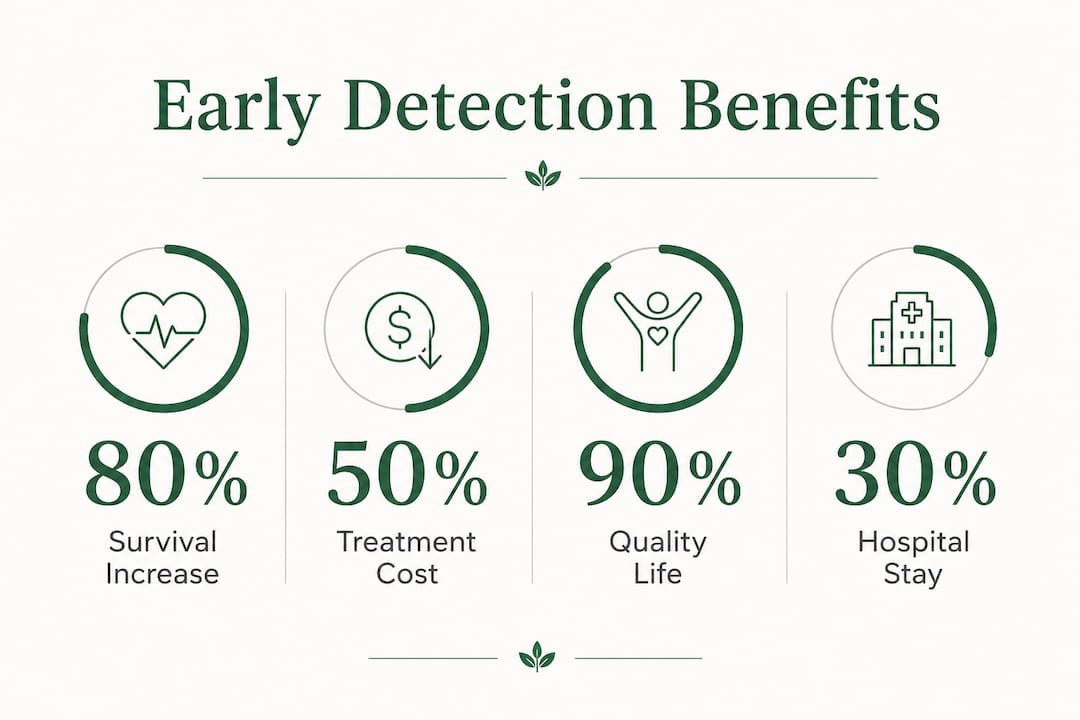
A 2025 systematic literature review found that early cancer diagnosis significantly improves overall survival and quality of life while reducing healthcare costs and resource use compared to late-stage diagnosis. This held true particularly for lung, breast, and head and neck cancers. Patients diagnosed at an early stage had lower inpatient costs and lower end-of-life treatment costs across multiple tumor types.
The cost difference is striking. WHO reports that cancer treatment costs 2 to 4 times less when the disease is caught early versus at an advanced stage. That gap reflects the difference between a targeted, localized procedure and months of systemic therapy.
| Factor | Early detection | Late-stage detection |
|---|---|---|
| Survival rate | Significantly higher across most cancers | Substantially lower; fewer curative options |
| Treatment type | Often local, minimally invasive | Frequently systemic, aggressive |
| Treatment cost | 2–4 times lower (WHO) | 2–4 times higher |
| Side effect burden | Generally lower | Generally higher |
| Quality of life | Better preserved | Often significantly impaired |
Early cancer treatment costs 2 to 4 times less when diagnosed at an early stage compared to advanced stages, according to WHO. That difference directly affects what patients pay and how much they endure.
Early detection also allows less invasive treatments, such as localized surgery or targeted radiation, rather than chemotherapy regimens that affect the entire body. Fewer side effects mean patients can often continue working, caring for their families, and maintaining daily routines during treatment.
How early detection actually works
Early detection relies on three main pathways: organized screening programs, awareness of early symptoms, and modern diagnostic imaging. Understanding how each one works helps you take a more active role in your own health.

Screening is a proactive approach applied to people who feel completely healthy. It targets asymptomatic individuals to find disease before it causes problems. According to WHO, screening is distinct from early diagnosis, which focuses on people who already have symptoms and aims to reduce the delay between symptom onset and confirmed diagnosis. Both matter, but they serve different purposes.
Symptom awareness is the second pathway. Recognizing early warning signs, such as an unusual lump, persistent cough, unexplained weight loss, or changes in bowel habits, and acting on them promptly can make a significant difference in outcomes. Many patients delay seeking care because symptoms seem minor or intermittent. That delay is where outcomes diverge.
Diagnostic imaging and laboratory testing form the third pathway. Technologies like mammography, low-dose CT scans, colonoscopy, and Pap smears give clinicians a direct view of what is happening inside the body before symptoms become severe.
Common early detection tools and processes include:
- Pap smears for cervical cancer screening
- Colonoscopy for colorectal cancer and precancerous polyp removal
- Mammography for breast cancer detection
- Low-dose CT scanning for lung cancer in high-risk individuals
- Prostate-specific antigen (PSA) testing for prostate cancer (with shared decision-making)
- Blood glucose and HbA1c tests for diabetes and prediabetes
- Blood pressure monitoring for cardiovascular risk
- Skin examinations for early melanoma detection
Pro Tip: Schedule your annual physical and ask your doctor specifically which screenings are recommended for your age, sex, and family history. Many screenings are covered by insurance at no out-of-pocket cost under the Affordable Care Act’s preventive care provisions.
Regular checkups are the simplest way to stay on top of all three pathways at once. A comprehensive health screening connects you with the right tests at the right time, based on your personal risk profile.
What gets in the way of early detection
Despite clear benefits, many people in the United States still receive a diagnosis at an advanced stage. Several barriers explain why, and recognizing them is the first step toward overcoming them.
The most common obstacles include:
- “Wait and see” thinking. The mindset of waiting for symptoms is one of the most significant barriers to early detection. Many serious conditions, including several cancers and type 2 diabetes, progress silently for years.
- Fear and avoidance. Some people delay testing because they are afraid of what a result might reveal. Psychologically, uncertainty can feel more manageable than a confirmed diagnosis, even when that logic works against them.
- Cost and insurance gaps. Out-of-pocket costs for screening deter many patients, particularly those who are uninsured or underinsured. WHO specifically identifies financial hardship as a reason people avoid seeking care.
- Limited access. Rural communities and underserved urban areas often lack convenient access to screening facilities, specialist referrals, or follow-up care.
- Low awareness. Studies cited in StatPearls note that certain population subsets are simply not aware of the benefits of cancer screening or the guidelines that apply to them.
- Risk of overdiagnosis. Some screening tests, particularly PSA testing for prostate cancer, carry a real risk of identifying slow-growing conditions that may never cause harm, leading to unnecessary treatment and anxiety.
- False positives. A positive screening result that turns out to be benign can cause significant stress and lead to additional invasive procedures.
These barriers do not cancel out the benefits of screening. They do, however, underscore why access, education, and honest conversations between patients and their doctors matter so much.
Preventive strategies that make early detection more effective
Early detection does not stand alone. It works best as part of a broader preventive health approach that reduces risk, builds awareness, and keeps you connected to care over time.
Preventive strategies that support early detection include:
- Following age-based screening schedules recommended by the U.S. Preventive Services Task Force (USPSTF) and the American Cancer Society (ACS)
- Managing modifiable risk factors such as tobacco use, obesity, physical inactivity, and excessive alcohol consumption
- Staying current on vaccinations like the HPV vaccine, which directly reduces cervical cancer risk
- Participating in community health programs that increase awareness and connect people to screening resources
- Maintaining regular primary care relationships so your doctor can track changes in your health over time
- Understanding your family history and discussing hereditary risk factors with your provider
When these strategies work together, the impact compounds. Secondary prevention, which includes identifying and removing precancerous lesions before they develop into cancer, is one of the most powerful tools available. Colonoscopy is a clear example: it does not just detect colorectal cancer early, it can prevent it entirely by removing polyps during the same procedure.
Cancer mortality in the United States decreased significantly from 1990 to 2015. Declines in colorectal cancer mortality and breast cancer deaths are partly attributed to the introduction of targeted screening programs. Those numbers reflect what happens when prevention and early detection work together at scale.
Who benefits most from early detection
Early detection benefits almost everyone, but certain groups and conditions see the greatest gains. Understanding where the advantage is strongest can help you prioritize your own care.
Conditions where early detection has the clearest, most documented impact include:
- Breast cancer: Early-stage breast cancer carries a high 5-year survival rate, indicating better outcomes when detected early. Late-stage diagnosis drops that figure sharply.
- Cervical cancer: Pap smear screening has significantly reduced both the incidence and mortality of cervical cancer in the United States.
- Colorectal cancer: Colonoscopy detects and removes precancerous polyps, making it one of the few screening tools that actively prevents cancer rather than just catching it early.
- Lung cancer: Low-dose CT screening for high-risk individuals, primarily long-term smokers, has led to measurable mortality reductions.
- Type 2 diabetes: HbA1c testing identifies prediabetes, giving patients the chance to reverse or delay progression through lifestyle changes.
- Cardiovascular disease: Blood pressure and cholesterol monitoring catch risk factors before they cause a heart attack or stroke.
- Skin cancer: Early-stage melanoma is highly treatable; late-stage melanoma is not.
People with a family history of cancer, chronic conditions, or known genetic risk factors tend to benefit most from proactive screening. The PDQ Cancer Information Summaries describe early detection as a form of secondary prevention, specifically suited to individuals at elevated risk who can benefit from identifying disease before it progresses.
Population subsets with historically lower screening rates, including uninsured adults, rural residents, and certain racial and ethnic communities, often have the most to gain from targeted outreach. Gardenstatemedicalgroup’s approach to personalized risk assessment addresses this directly, helping patients understand which screenings apply to them and when.
What the research says about early detection in the U.S.
The evidence base for early detection is strong and growing. A 2025 systematic literature review confirmed that early cancer diagnosis produces measurable improvements in survival, quality of life, and healthcare costs across multiple tumor types. The findings aligned with what WHO and NIH have reported for years: catching disease early changes outcomes in ways that late-stage treatment simply cannot replicate.
Key findings from current research include:
- Early-stage diagnosis consistently produces higher survival rates and lower treatment costs than late-stage diagnosis, particularly for lung, breast, and head and neck cancers
- WHO data shows treatment cost reductions of 2 to 4 times for early versus advanced cancer diagnosis
- Targeted screening programs have contributed to a 25% decline in U.S. cancer mortality from 1990 to 2015
- A stage shift toward more early-stage and fewer late-stage diagnoses is an early indicator of a successful screening program, even before mortality data reflects the change
- Cancer deaths in the United States remain substantial, underscoring the ongoing need for broader screening participation.
Cancer mortality in the U.S. fell 25% from 1990 to 2015, with screening programs for colorectal and breast cancer playing a documented role in that decline.
Research also highlights important nuances. Lead-time bias, where survival appears longer simply because detection happened earlier, and overdiagnosis, where slow-growing conditions that would never cause harm are identified and treated unnecessarily, are real considerations. These are not reasons to avoid screening. They are reasons to have informed conversations with your doctor about which tests make sense for your specific situation.
Looking ahead, AI-driven diagnostics and multi-cancer early detection tests are rapidly changing what is possible. Machine learning tools are showing real potential for identifying aggressive cancers at earlier stages than conventional methods allow, particularly for cancers that currently have poor survival rates due to late diagnosis.
How Gardenstatemedicalgroup supports your early detection goals
Gardenstatemedicalgroup is built around the idea that preventive care and early detection should be accessible, personal, and coordinated. The practice serves patients in North Bergen and Secaucus, New Jersey, with a multidisciplinary team that brings together primary care, cardiopulmonary services, radiology, and specialized health programs under one roof.
Services and programs that directly support early detection include:
- Primary care: Annual physicals, risk assessments, and screening referrals tailored to your age, health history, and family background
- Radiology and diagnostic testing: On-site imaging capabilities that reduce the time between a clinical concern and a confirmed answer
- Cardiopulmonary care: Diagnostic tools for early identification of heart and lung conditions, including conditions that often progress without obvious symptoms
- Diabetes and chronic disease programs: Monitoring and management that catch complications before they become crises
- Bone health and weight management programs: Targeted interventions that address risk factors tied to multiple chronic conditions
- Patient education and health resources: Guidance on screening schedules, symptom recognition, and when to seek care
Gardenstatemedicalgroup also works with most major insurance plans, helping patients access covered preventive screenings without unnecessary financial barriers. The practice’s preventive care programs are designed to keep you engaged with your health between appointments, not just during them.
Pro Tip: When you schedule your next appointment at Gardenstatemedicalgroup, bring a list of your family’s health history. That information helps your care team identify which screenings you may need earlier or more frequently than standard guidelines suggest.
Your health does not wait, and neither should your screening schedule. Contact Gardenstatemedicalgroup to schedule a preventive care visit and find out which early detection tests are right for you.
Key Takeaways
Early detection consistently improves survival, reduces treatment costs, and preserves quality of life, making it one of the most effective tools available in modern healthcare.
| Point | Details |
|---|---|
| Survival and cost impact | Early cancer treatment costs 2–4 times less than late-stage treatment, per WHO data. |
| Screening prevents disease | Colonoscopy and Pap smears can remove precancerous lesions, preventing cancer from developing. |
| U.S. mortality progress | Cancer mortality in the U.S. dropped 25% from 1990 to 2015, partly due to screening programs. |
| Biggest beneficiaries | People with family history, known risk factors, or low prior screening access gain the most from early detection. |
| Emerging tools | AI-driven diagnostics and multi-cancer detection tests are expanding early detection to cancers previously caught too late. |
FAQ
What are the main advantages of early detection?
Early detection improves survival rates, reduces the need for aggressive treatment, lowers healthcare costs, and helps preserve quality of life. WHO data shows that cancer treatment costs 2 to 4 times less when caught early compared to advanced stages.
What diseases benefit most from early detection?
Breast, cervical, colorectal, and lung cancers show the strongest documented benefits, along with type 2 diabetes and cardiovascular disease. Early-stage breast and cervical cancers carry high 5-year survival rates, indicating better outcomes when detected early.
What is the difference between screening and early diagnosis?
Screening targets healthy, asymptomatic people to find disease before symptoms appear, while early diagnosis focuses on people who already have symptoms to reduce delays in treatment. Both are forms of early detection, but they serve different clinical purposes.
What are the biggest barriers to early detection?
The most common barriers include the “wait for symptoms” mindset, fear of results, cost concerns, limited access to screening facilities, and low awareness of screening guidelines. Addressing these barriers through education and accessible care is central to improving outcomes.
How do AI and new tests change early detection?
AI-driven diagnostics and multi-cancer early detection tests are showing real potential for identifying aggressive cancers at earlier stages than conventional methods allow, particularly for cancers that currently have poor survival rates due to late diagnosis.