
Cardiopulmonary Health Workflow: A Practical 2026 Guide

TL;DR:
- A cardiopulmonary health workflow coordinates clinical and administrative processes to improve patient care across heart and lung conditions. Automation and AI reduce administrative costs and treatment delays by streamlining tasks and enhancing data sharing. Effective workflows rely on shared protocols, interoperable technology, and continuous monitoring to prevent care gaps and support long-term management.
A cardiopulmonary health workflow is the structured coordination of clinical and administrative processes that manage patient care across heart and lung conditions. When this coordination breaks down, patients face delayed diagnoses, missed follow-ups, and fragmented treatment. The good news is that well-designed workflows, supported by automation and integrated data systems, consistently improve outcomes. This guide walks you through the core components, tools, and implementation steps that make a cardiopulmonary health workflow work in practice, whether you are a clinician building better systems or a patient trying to understand your care path.
What are the core components of a cardiopulmonary health workflow?
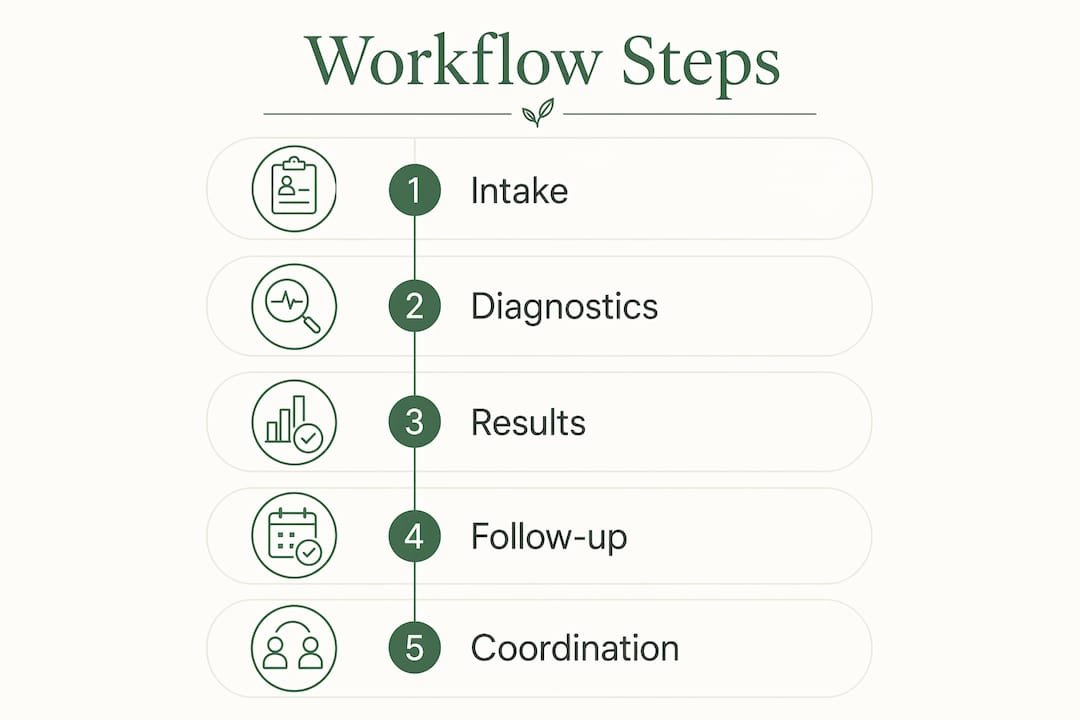
A functional cardiopulmonary health workflow covers five essential areas: patient intake, diagnostic ordering, results integration, longitudinal follow-up, and care coordination. Each area involves both clinical tasks and administrative tasks that must connect without gaps. When any one of these areas fails, the entire care chain suffers.
On the clinical side, your team manages imaging orders, EKG scheduling, spirometry results, and lab tracking. On the administrative side, the work includes appointment scheduling, prior authorization, and referral management. Both sides must share data in real time. Without that connection, clinicians make decisions on incomplete information.
Integrated electronic health record (EHR) platforms solve the biggest data gap problem. Unified EHR platforms allow multi-location cardiology practices to manage workflows consistently across sites using central protocols with site-specific configuration. That consistency reduces documentation errors and prevents care gaps from forming between visits.
Fragmented care in COPD patients is a documented problem. A multidisciplinary Belgian taskforce recommends embedding cardiopulmonary risk identification at every stage, from primary care through post-exacerbation management. That recommendation reflects a broader truth: workflow design must account for the full patient timeline, not just individual appointments.
Pro Tip: Establish shared protocols across your cardiopulmonary team before selecting technology. Technology enforces the protocol. It cannot replace one.
| Point | Details |
|---|---|
| Patient intake | Standardized intake forms reduce duplicate data entry and flag risk factors early. |
| Diagnostic ordering | Linked order sets connect imaging, labs, and EKGs to reduce missed steps. |
| Results integration | EHR-connected results routing gets findings to the right clinician without manual forwarding. |
| Longitudinal follow-up | Automated recall systems track patients between visits and flag those overdue for review. |
| Care coordination | Shared care plans across primary care, cardiology, and pulmonology reduce hand-off errors. |
How can automation and AI enhance cardiopulmonary workflows?
Automation targets the tasks that consume the most staff time without requiring clinical judgment. Appointment scheduling, eligibility verification, prior authorizations, referral management, and alert routing are all strong candidates. Removing manual steps from these processes frees your team to focus on patient contact and clinical decision-making.
The financial case for automation is direct. Automating prior authorization reduces cost per transaction from $45–90 down to $15–25, recovering significant coordinator capacity. That savings compounds across hundreds of authorizations per month in a busy cardiopulmonary practice.
AI adds a layer that rule-based automation cannot reach. AI agents handling unstructured inputs like faxes and free-text notes expand the addressable workflow surface area 3–5 times compared to rule-based automation alone. That means your team stops manually transcribing faxed referrals and starts receiving structured, actionable data instead.
The clinical impact of AI is equally significant. AI-powered care coordination reduces time to treatment for pulmonary embolism from 1.75 days to 0.56 days. That is nearly a two-thirds reduction in treatment delay for a condition where hours matter. The next frontier, according to healthcare IT leaders, is orchestrating entire workflows across multiple stakeholders and systems rather than automating individual tasks in isolation.
Here are the practical steps to implement automation safely in a cardiopulmonary setting:
- Audit your highest-volume administrative tasks and rank them by manual time cost.
- Select one rule-based process, such as eligibility verification, as your first automation target.
- Run a 30-day pilot with a small team and measure error rates and time savings.
- Expand to prior authorization and referral management after the pilot confirms stability.
- Introduce AI-assisted tools for unstructured data, such as fax-to-structured-note conversion.
- Set a review cycle every 90 days to catch exception cases and adjust rules.
Pro Tip: Start with high-volume, rule-based administrative workflows before touching clinical decision support. Building confidence in the system early prevents staff resistance and system instability later.
What tools and technology support an optimized cardiopulmonary workflow?
The technology stack for a cardiopulmonary workflow has four core layers: an integrated EHR platform, diagnostic imaging systems, AI-powered coordination tools, and secure communication channels including SMS and voice AI. Each layer must exchange data with the others. A system that cannot share data is a silo, and silos create the exact gaps that harm patients.

Interoperability standards make data exchange possible. FHIR (Fast Healthcare Interoperability Resources) and HL7 are the two dominant standards governing how clinical systems share patient data. Any platform you evaluate should support both. Without FHIR or HL7 compliance, your EHR, imaging system, and coordination tools cannot communicate reliably.
HIPAA compliance is non-negotiable across every layer. Secure data management applies to communication tools as well as clinical records. SMS-based patient outreach, voice AI for appointment reminders, and AI-generated clinical notes all require HIPAA-compliant infrastructure. Selecting tools without verifying compliance creates legal and clinical risk.
Maintenance costs for workflow automation systems average 10–15% of annual system costs to handle vendor updates, payer rule changes, and exception case management. Budget for this from the start. Practices that treat automation as a one-time purchase consistently run into performance degradation within 12–18 months.
Pro Tip: Request a FHIR compliance certification from every vendor before signing a contract. Vendors who cannot produce one will cost you more in integration work than they save in efficiency.
| Tool category | Key function | Cardiopulmonary workflow benefit |
|---|---|---|
| Integrated EHR platform | Central patient record and order management | Consistent protocols across care sites and specialties |
| Diagnostic imaging system | Imaging order routing and result delivery | Faster read-to-clinician turnaround for chest CT and echocardiograms |
| AI coordination suite | Referral management, alert routing, unstructured data processing | Reduces manual transcription and accelerates specialist notification |
| Secure communication tools | Patient outreach via SMS and voice AI | Improves appointment adherence and follow-up completion rates |
How do you implement and troubleshoot a cardiopulmonary workflow optimization process?
Implementation works best in three phases: crawl, walk, and run. The crawl phase covers assessment and tool selection. The walk phase covers a limited pilot with one team or one location. The run phase covers full rollout with continuous monitoring. Skipping the pilot phase is the most common mistake practices make, and it leads to staff frustration and system failures that could have been caught early.
Start the assessment phase by mapping your current workflow on paper. Identify every hand-off point between departments, every manual data entry step, and every place where patient information leaves one system and must be re-entered into another. Those re-entry points are your highest-risk locations for data loss and error.
Automated referral workflows increase consult note return rates from 40–60% up to 85–95%. That improvement directly reduces the number of patients who fall through the cracks between a primary care referral and a cardiology or pulmonology appointment. Tracking this metric before and after implementation gives you a clear measure of progress.
The biggest bottlenecks in cardiopulmonary care occur at hand-offs between departments. Unified platforms that bridge primary care, cardiology, and pulmonology reduce data loss and improve follow-up rates. Staff training must address these hand-off points specifically, not just general system use.
Common challenges and their solutions:
- Incomplete data at hand-off: Require structured data fields at every transition point and use EHR alerts to flag incomplete records before transfer.
- Staff resistance to new tools: Involve frontline staff in the pilot phase and address specific pain points before full rollout.
- Payer rule changes breaking automation: Schedule quarterly reviews of authorization rules and assign a staff member to monitor payer updates.
- Patient no-shows disrupting follow-up: Use automated SMS reminders at 72 hours and 24 hours before appointments.
- Siloed specialist data: Implement a shared care plan visible to primary care, cardiology, and pulmonology teams simultaneously.
The American Medical Association confirms that effective workflow optimization identifies inefficiencies and uses data to continually refine clinical processes, giving physicians more time for direct patient care. Build a 90-day review cycle into your implementation plan from day one. Workflows that are not reviewed degrade over time as patient volumes and payer rules change.
For patients navigating a cardiopulmonary care pathway, the most important thing you can do is confirm that your care team shares records across specialties. Ask your primary care physician directly whether your cardiologist and pulmonologist can see your full history. If the answer is no, that gap is worth addressing before your next appointment.
Key takeaways
A well-structured cardiopulmonary health workflow, supported by integrated EHR systems, automation, and AI coordination tools, is the most reliable way to reduce treatment delays and prevent patients from falling through the gaps between specialties.
| Point | Details |
|---|---|
| Define your workflow components | Map intake, diagnostics, results, follow-up, and coordination before selecting any technology. |
| Automate high-volume admin tasks first | Start with prior authorization and eligibility verification to build system confidence and recover staff capacity. |
| Require FHIR and HL7 compliance | Interoperability standards are the foundation of any multi-system cardiopulmonary workflow. |
| Budget for ongoing maintenance | Allocate 10–15% of annual system costs for updates, payer rule changes, and exception management. |
| Review outcomes every 90 days | Continuous data review keeps workflows aligned with changing patient volumes and clinical needs. |
What I have learned about cardiopulmonary workflow from the inside
The conversation about cardiopulmonary workflow optimization tends to focus on technology. I understand why. The numbers are compelling. Cutting pulmonary embolism treatment time by nearly two-thirds is not a marginal improvement. But after watching practices implement these systems, I am convinced that technology is the second problem, not the first.
The first problem is fragmentation at the human level. Cardiologists and pulmonologists often operate in separate clinical worlds even when they share the same building. Their notes live in different tabs. Their follow-up protocols are written independently. Their staff do not have a shared language for escalation. No EHR fixes that without deliberate workflow design that forces collaboration.
What actually works is starting with a shared protocol document before anyone logs into a new system. When the clinical team agrees on what a complete referral looks like, what triggers an alert, and who owns follow-up at each stage, the technology has something real to enforce. Without that agreement, automation just moves the confusion faster.
The other thing I would tell any practice starting this process: measure referral return rates before you do anything else. That single metric tells you more about your workflow health than any dashboard. If fewer than 70% of your cardiology referrals come back with a consult note, you have a structural problem that no scheduling tool will solve on its own.
The future of this field is AI orchestration across the full care team, not just task automation within one department. That shift is coming faster than most practices are prepared for. The practices that will benefit most are the ones that have already done the hard work of aligning their teams around shared protocols and clear accountability. The technology then becomes an accelerant, not a replacement for clinical judgment.
— Krunal
Cardiopulmonary care at Gardenstatemedicalgroup
Gardenstatemedicalgroup offers integrated cardiopulmonary care at its North Bergen and Secaucus, New Jersey locations, with a multidisciplinary team coordinating cardiac and pulmonary services under one practice. Patients benefit from connected care pathways that link primary care, specialty services, and advanced diagnostic testing without requiring them to manage referrals across disconnected systems.
The practice also offers specialized health programs designed to support patients managing chronic cardiopulmonary conditions. If you want to understand how your current care pathway works and where it can be strengthened, Gardenstatemedicalgroup is a practical starting point. Contact the team to schedule an appointment and get a clear picture of your cardiopulmonary care options.
FAQ
What is a cardiopulmonary health workflow?
A cardiopulmonary health workflow is the coordinated set of clinical and administrative processes that manage patient care across heart and lung conditions, from intake through long-term follow-up. It connects primary care, cardiology, and pulmonology teams through shared data and defined protocols.
How does automation improve cardiopulmonary care efficiency?
Automation reduces cost per prior authorization transaction from $45–90 down to $15–25 and increases referral consult note return rates from 40–60% to 85–95%. These gains free clinical staff to focus on direct patient care rather than administrative follow-up.
What interoperability standards matter for cardiopulmonary workflow tools?
FHIR and HL7 are the two standards that govern data exchange between EHR platforms, imaging systems, and coordination tools. Any technology you adopt for pulmonary health management should comply with both to avoid integration failures.
How do you troubleshoot bottlenecks in cardiac patient care flow?
The most common bottleneck is the hand-off between departments, where patient data is incomplete or not transferred at all. Structured data requirements at every transition point and unified platforms visible to all care team members resolve most of these gaps.
How much does it cost to maintain a cardiopulmonary workflow automation system?
Ongoing maintenance for workflow automation systems averages 10–15% of annual system costs, covering vendor updates, payer rule changes, and exception case management. Budget for this from the start to avoid performance degradation over time.