
How to Navigate Health Resources Online: 2026 Guide

TL;DR:
- Knowing how to navigate online health resources is essential for finding credible information, accessing medical records, and making informed health decisions. Using government portals, patient portals, and AI tools appropriately enhances research accuracy, while verification through lateral reading prevents misinformation. Remember, your legal right under HIPAA guarantees timely, affordable access to your health data, which supports effective communication with healthcare providers.
Knowing how to navigate health resources online is the process of efficiently locating, verifying, and using credible health information and medical records through digital tools and platforms. Done well, it helps you prepare for doctor appointments, understand diagnoses, and manage your family’s health with confidence. Done poorly, it leads to misinformation, unnecessary anxiety, and poor decisions. The difference comes down to knowing which tools to trust, how to verify what you find, and how to access your own medical data legally and quickly.
What tools are available for accessing health information online?
The most reliable tools for finding health information online fall into three categories: government health portals, patient portals, and AI-enhanced search tools. Each serves a different purpose, and knowing when to use each one saves you time and protects your health decisions.

Government portals like MedlinePlus, run by the National Library of Medicine, and the HHS health information portal give you peer-reviewed, professionally vetted content. These sites do not sell products or push treatments. They exist specifically to inform the public. The National Institutes of Health (NIH) and the World Health Organization (WHO) maintain similar databases covering conditions, medications, and clinical guidelines.
Patient portals are different. They are private platforms tied to your specific provider or hospital system. Through a patient portal, you can view your lab results, request prescription refills, message your care team, and download your medical records. Most major health systems in the United States now offer portals built on platforms like Epic MyChart or Cerner Patient Portal. These are not general health information sites. They are your personal health record hub.
AI-enhanced search tools represent a newer category. Over 60% of Americans now use AI tools to source medical information, and most take steps to verify what they find. That verification step is the critical one. Tools like Perplexity AI or Google’s AI Overviews can surface relevant information quickly, but they require cross-checking against authoritative sources. For a deeper look at AI-powered alternatives to traditional medical databases, this guide to health search tools covers several strong options.
| Tool Type | Examples | Best For | Reliability |
|---|---|---|---|
| Government portals | MedlinePlus, NIH, HHS | General health education | Very high |
| Patient portals | Epic MyChart, Cerner | Personal records, provider messaging | High (your data) |
| AI search tools | Perplexity AI, Google AI | Quick research starting points | Moderate, verify always |
| Medical news sites | Medical News Today, WebMD | Condition overviews, symptom info | Moderate, check sources |
Pro Tip: Choose tools that are HIPAA-compliant when accessing personal health data. Any platform that stores or transmits your health information must meet federal privacy standards. If a site asks for your health history without a clear privacy policy, do not use it.
How can you verify the credibility of online health information?
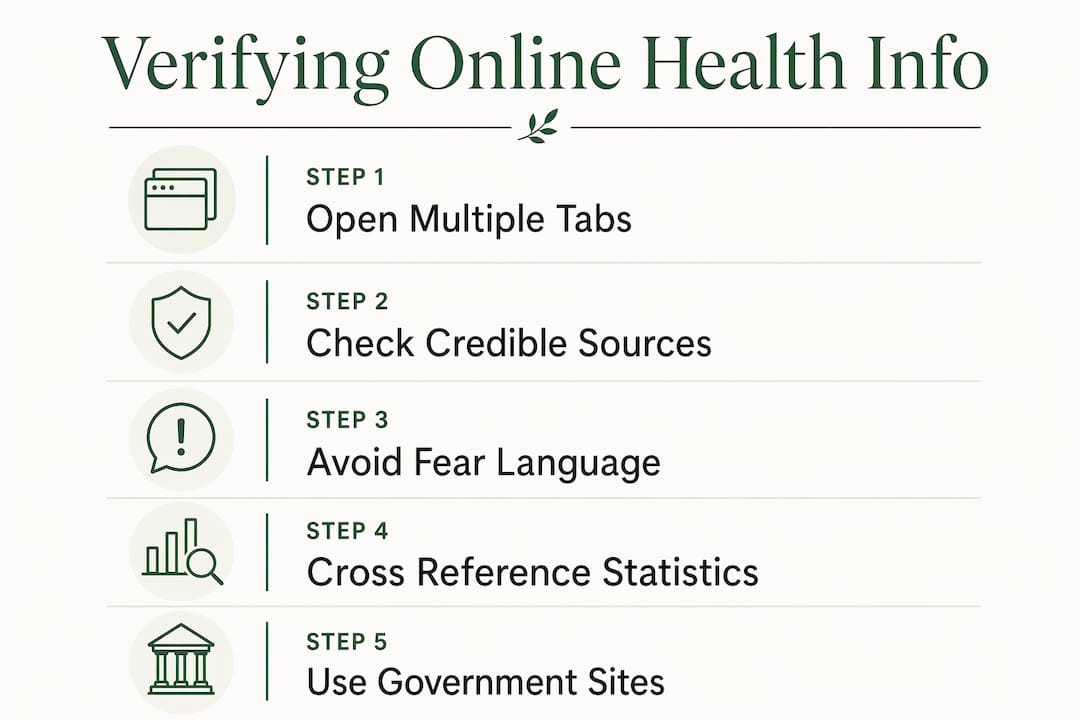
Lateral reading is the most effective technique for verifying online health information. It means opening multiple tabs and cross-checking a claim across several reputable sources before accepting it as true. Fact-checkers and professional researchers use this method routinely. You should too.
Credible health sources share several clear characteristics. The author is identified and holds relevant qualifications. The content cites peer-reviewed studies or government data. The language is balanced and does not push a specific product or outcome. The site discloses who funds it. When a source checks all four boxes, you can trust it as a starting point.
Red flags are equally important to recognize. Watch for these warning signs:
- Fear-inducing language designed to alarm rather than inform
- Claims of miracle cures or treatments not recognized by the FDA or NIH
- No author name or credentials listed
- Heavy advertising for supplements or unproven therapies
- No publication date or outdated references
Fear-inducing language and miracle cure claims are the clearest signals of misinformation. Credible sources present evidence without emotional manipulation. When you spot that pattern, close the tab.
The NIH, WHO, MedlinePlus, and the Centers for Disease Control and Prevention (CDC) are the four most reliable anchors for any health research. If a claim cannot be verified through at least one of these organizations, treat it as unconfirmed. For guidance on identifying trustworthy healthcare providers and sources, this article on finding a reputable doctor applies the same critical thinking framework.
Pro Tip: After reading any health article online, spend 60 seconds searching the same topic on MedlinePlus or the NIH website. If the core claim does not appear there, bring it to your doctor before acting on it.
What are the best practices for accessing your medical records online?
Your right to access your medical records is protected by federal law. HIPAA requires providers to fulfill record requests within 30 days, and patient portals often deliver them faster. Understanding this process means you never wait longer than necessary and never pay more than you should.
Here is a step-by-step process for requesting your medical records:
- Log into your provider’s patient portal and look for a “Request Records” or “Medical Records” section.
- If no portal exists, contact the provider’s medical records department directly by phone or in writing.
- Specify exactly which records you need. Requesting only recent lab results or immunization records is faster and cheaper than requesting your complete file.
- Submit a signed authorization form if required by the provider.
- Confirm the format. Electronic delivery is typically free or very low cost.
- Follow up if you have not received records within 15 business days.
On the topic of costs: electronic records cannot carry per-page fees. Providers can charge reasonable fees for paper copies, but electronic delivery is almost always free or minimal. Requesting specific parts of your records rather than your entire file reduces both cost and processing time significantly.
If your provider creates unreasonable delays or refuses access without cause, you have the right to file a formal complaint with the HHS Office for Civil Rights. Providers cannot impose barriers to record access under HIPAA, and violations carry real consequences.
Once you have your records, store them securely. Use password-protected folders or a HIPAA-compliant personal health record app. Do not store sensitive health documents in unencrypted email or shared cloud drives. Protecting your health data is as important as protecting your financial data.
Pro Tip: Create a dedicated folder on your device for each family member’s health records. Label files by date and record type, such as “2025-LabResults-Cholesterol.” This makes it easy to share accurate information with any new provider.
How do you use online health research during doctor appointments?
Online health information works best as a starting point, not a final answer. Your doctor’s role is to interpret that information in the context of your specific health history, current medications, and risk factors. No website can do that.
The most productive approach is to prepare before your appointment. Write down the specific questions your online research raised. Note the sources you consulted. Bring printed summaries if the topic is complex. This shows your provider you have done thoughtful research and makes the conversation more efficient. For a structured approach to appointment preparation, this guide on making the most of your appointment gives practical steps that work.
When discussing your findings with your doctor, keep these communication principles in mind:
- Do frame your research as questions, not conclusions. “I read that low vitamin D can cause fatigue. Could that be relevant for me?” works better than “I think I have a vitamin D deficiency.”
- Do share the source you used so your provider can assess its quality.
- Do not arrive with a self-diagnosis based on a single website.
- Do not dismiss your doctor’s assessment because it conflicts with something you read online.
- Do ask your provider to recommend specific websites or resources for your condition.
Caregivers and family members benefit from shared access to health records. Most patient portals allow you to designate a proxy, meaning a trusted family member can view records and communicate with your care team on your behalf. This is especially useful for managing the health of elderly parents or children with chronic conditions. For guidance on building a productive relationship with your provider, this resource on communicating with your doctor covers the key steps clearly.
Key takeaways
Accessing health information online effectively requires using the right tools, verifying every claim through lateral reading, and understanding your legal rights to your own medical records.
| Point | Details |
|---|---|
| Use tiered tools | Match the tool to the task: government portals for education, patient portals for your records, AI tools for initial research only. |
| Verify with lateral reading | Cross-check every health claim across NIH, WHO, or MedlinePlus before acting on it. |
| Know your HIPAA rights | Providers must deliver records within 30 days; electronic copies are typically free or low cost. |
| Request specific records | Ask for targeted records like recent labs or immunizations to reduce fees and speed up delivery. |
| Prepare before appointments | Bring written questions based on your research so your doctor can address them directly and efficiently. |
What i have learned about online health research after years of watching patients struggle with it
The biggest mistake I see is treating a Google search result as a diagnosis. Confirmation bias is real and it is powerful. When you type your symptoms into a search bar, you are primed to click on results that match what you already fear. Confirmation bias in symptom searching is one of the most documented patterns in digital health behavior, and it leads people to conclusions their doctors then have to spend time unwinding.
The fix is not to stop researching. The fix is to research better. Lateral reading, using government sources as anchors, and treating every online finding as a question rather than an answer changes the entire dynamic. I have seen patients come into appointments with well-organized notes from MedlinePlus and NIH, and those conversations are genuinely productive. The doctor learns something about what the patient has been experiencing, and the patient leaves with real answers.
The other thing I would push back on is the idea that managing your health records is complicated. It is not. Most patient portals are straightforward once you set them up. The 30-day HIPAA deadline exists precisely because access to your own records is a right, not a favor. If your current provider makes that process difficult, that tells you something important about how they view the patient relationship.
My honest recommendation: spend 20 minutes this week setting up your patient portal if you have not already, download your most recent records, and bookmark MedlinePlus as your default health reference. Those three steps put you ahead of most adults in terms of managing your own healthcare information.
— Krunal
How Gardenstatemedicalgroup supports your health record access and care
Gardenstatemedicalgroup serves patients in North Bergen and Secaucus, New Jersey, with a full range of primary care and specialty services designed to keep your health information organized and accessible. The practice’s patient portal gives you direct access to your records, lab results, and care team communication in one place.
Whether you are managing a chronic condition, coordinating care for a family member, or simply trying to stay on top of preventive health, Gardenstatemedicalgroup’s primary care services provide the coordinated support you need. The team also offers specialized health programs covering diabetes, bone health, lung health, and weight management. Schedule an appointment today and take the first step toward organized, informed healthcare.
FAQ
What is the most reliable source for health information online?
The NIH, MedlinePlus, WHO, and CDC are the four most reliable sources for general health information online. These organizations publish peer-reviewed, regularly updated content with no commercial agenda.
How long does a provider have to send my medical records?
HIPAA requires providers to fulfill medical record requests within 30 days. Patient portals often deliver records much faster, sometimes within minutes.
Can i be charged a fee for my electronic medical records?
Providers cannot charge per-page fees for electronic records. Fees for electronic copies must be reasonable and cost-based, and in many cases electronic delivery is free.
What should i do if my provider refuses to give me my records?
You can file a formal complaint with the HHS Office for Civil Rights. Unreasonable barriers to record access violate HIPAA, and the HHS Office for Civil Rights investigates and enforces these violations.
How do i avoid health misinformation online?
Use the lateral reading technique: open multiple tabs and verify any health claim across at least two trusted sources like NIH or MedlinePlus. Online health information should complement professional medical advice, not replace it.