
How Medicaid Supports Healthcare Access and Chronic Care in NJ
TL;DR:
- Medicaid in New Jersey covers over 1.7 million residents for diverse healthcare needs.
- Eligibility varies by income, age, and disability, with regular reviews to maintain coverage.
- The program emphasizes preventive care, chronic disease management, and long-term support services.
Medicaid is often misunderstood as a last-resort program with limited benefits. In reality, it is New Jersey’s largest public health program, and it covers over 1.7 million residents across a wide range of needs, from routine checkups to long-term care. Many people who qualify never realize the full scope of what is available to them. This guide is here to change that. Whether you are newly enrolled, helping a family member navigate coverage, or just trying to understand your options, you will find clear and practical answers here about how Medicaid works, who it covers, and why preventive and chronic care sit at the heart of what it offers.
Table of Contents
- Who is eligible for Medicaid in New Jersey?
- How Medicaid delivers healthcare in New Jersey
- Medicaid’s role in preventive and chronic care
- Long-term services and supports under Medicaid
- Why Medicaid’s full value often goes unrecognized: Our view
- Get care and support through trusted programs
- Frequently asked questions
Key Takeaways
| Point | Details |
|---|---|
| Broad eligibility | Medicaid in New Jersey covers children, adults, families, and seniors with flexible income guidelines. |
| Managed care delivery | Most care is coordinated by five managed care organizations and focuses on access and prevention. |
| Strong preventive care | Screenings, vaccines, and regular checkups are covered to help catch health problems early. |
| Long-term supports | MLTSS provides nursing home care and home-based solutions with no waitlist for those eligible. |
| Administrative help matters | Automation and support programs can reduce coverage gaps and help you keep your benefits. |
Who is eligible for Medicaid in New Jersey?
Now that you know Medicaid’s importance, let’s see who qualifies and how eligibility works.
NJ FamilyCare, which is the name New Jersey uses for its Medicaid program, covers low-income children, parents, pregnant women, adults between 19 and 64, and individuals who are aged, blind, or disabled. For most adults, income must fall at or below 138% of the federal poverty level (FPL) to qualify. Children and pregnant women may qualify at higher income levels, making the program accessible to a broader range of families.
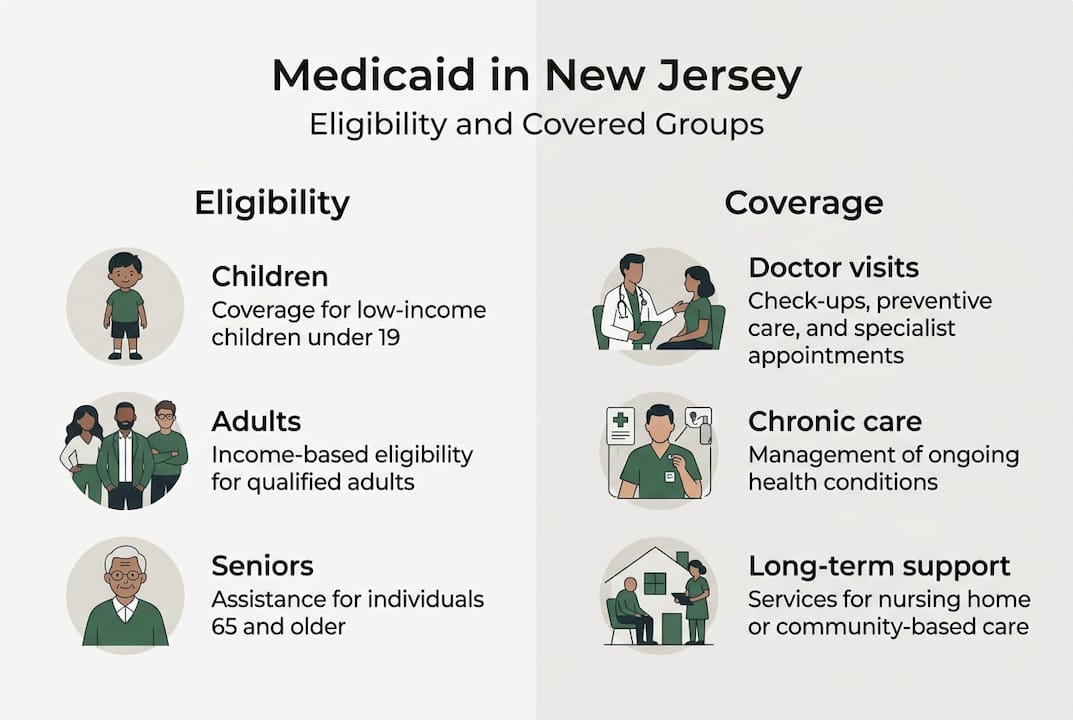
Here is a quick look at 2026 income eligibility thresholds by group:
| Group | Income Limit (% of FPL) |
|---|---|
| Adults (19-64) | Up to 138% |
| Children (0-18) | Up to 355% |
| Pregnant women | Up to 200% |
| Aged, blind, disabled | Asset and income limits apply |
For seniors and individuals with disabilities, eligibility works a little differently. Income trusts, sometimes called Qualified Income Trusts (QITs), may be used when income slightly exceeds the limit. There is also a five-year lookback period for those seeking long-term care, which means asset transfers made in the five years before applying can affect eligibility.
Some residents qualify under both Medicare and Medicaid. These individuals are called “dual eligibles,” and they receive additional coordination of benefits that reduces out-of-pocket costs significantly. Understanding your insurance coverage in NJ is a smart first step before applying.
Eligibility rules are reviewed and adjusted each year. Check the full eligibility details regularly to make sure your household still qualifies and that you are using the right income figures for your situation.
Pro Tip: Review your Medicaid eligibility every year, especially if your income or household size changes. Even small adjustments to the FPL can affect your status, and missing a renewal deadline can interrupt your coverage unexpectedly.
If you are unsure which services you are entitled to, a medical services guide for your area can help you understand what is available locally.
How Medicaid delivers healthcare in New Jersey
With eligibility established, it’s important to know how Medicaid actually delivers care across New Jersey.
Most Medicaid members in New Jersey receive their care through Managed Care Organizations, known as MCOs. These are health plans contracted by the state to coordinate and deliver covered services. Rather than interacting directly with the state, you work with your assigned MCO for appointments, referrals, and authorizations.
As of December 2024, five MCOs serve approximately 1.73 million NJ FamilyCare members. About 69,000 of those are enrolled in the Managed Long-Term Services and Supports (MLTSS) program for higher-need individuals.
Here is a basic comparison of what MCOs handle:
| Service Area | MCO Responsibility |
|---|---|
| Primary care | Assign and coordinate your doctor |
| Specialist visits | Referrals and prior authorizations |
| Behavioral health | Mental health and substance use services |
| Long-term care | MLTSS enrollment and service coordination |
If you switch MCOs or move between plans, there can be a transition period during which your care continuity may be at risk. It is important to notify your new plan about ongoing prescriptions, specialist relationships, and any pending procedures.
Administrative issues are one of the most common reasons people face disruptions in coverage. Missed renewal notices, address changes, or income reporting errors can trigger unintended disenrollment. Staying on top of paperwork and keeping your contact information current with your MCO is essential. Exploring your Medicare and Medicaid options together can also help you understand how both programs work when you qualify for each.
For those managing ongoing conditions, chronic care management services through your MCO can provide coordinated support, helping you avoid hospitalizations and manage your health more effectively day to day.
Medicaid’s role in preventive and chronic care
Understanding delivery, let’s focus next on how Medicaid keeps people healthy and out of the hospital.
Preventive care is one of Medicaid’s most valuable and often overlooked benefits. Medicaid covers comprehensive preventive services, including medical screenings, vaccines, immunizations, and well-child visits as outlined in the federal CMS Child Core Set. These are not optional add-ons. They are core benefits that help catch health problems early, before they become serious and expensive.
Here is what preventive coverage typically includes for eligible members:
- Annual physical exams and wellness visits
- Blood pressure, cholesterol, and diabetes screenings
- Cancer screenings such as mammograms and colorectal exams
- Childhood vaccines and adolescent immunizations
- Vision and dental screenings for children
- Depression and mental health screenings for adults
For people living with chronic conditions such as diabetes, heart disease, or asthma, Medicaid provides more than just doctor visits. It supports disease management programs, care coordination, and medication coverage that help stabilize these conditions over time. When chronic diseases are managed consistently, emergency room visits decrease and overall quality of life improves.
Regular preventive care is not just a benefit. It is one of the most effective tools you have for protecting your long-term health under Medicaid.
The CMS Core Set serves as a national quality benchmark, measuring how well state Medicaid programs deliver preventive and chronic care. New Jersey’s MCOs are evaluated against these standards, which creates accountability for the care you receive.
Pro Tip: Schedule your annual checkup at the start of the year so your preventive benefits reset without gaps. Consistent visits make it easier for your doctor to catch any changes in your health early and update your care plan accordingly.
If you are looking to access preventive care close to home, local providers in North Bergen and Secaucus offer programs specifically designed for Medicaid members. Learning about local health programs can help you take full advantage of what is available. You can also explore the preventive care benefits that come with staying consistent in your care.
Long-term services and supports under Medicaid
Chronic and preventive care are essential, but Medicaid also stands out in support for long-term health needs.
For seniors, adults with disabilities, and those managing complex medical conditions, Medicaid goes far beyond a doctor’s office. The MLTSS program provides a wide range of services designed to help people remain in their homes and communities rather than relying on institutional care.

MLTSS covers nursing home care, home-based personal care, adult day health services, and home modifications with no waitlists for those who meet eligibility criteria. That last point matters a lot. In many states, people wait years for home-based support. In New Jersey, eligible individuals can access these services without delay.
Here is what the application process generally looks like:
- Confirm your Medicaid eligibility through NJ FamilyCare.
- Request a functional needs assessment to determine MLTSS eligibility.
- Work with a care manager to identify which services fit your situation.
- Select an approved provider for each service you need.
- Review your care plan regularly and update as needs change.
Navigating the financial rules for long-term care can feel complex. The five-year lookback period means that asset transfers made within 60 months before applying may count against you. QITs allow those with income slightly above the limit to still qualify by placing excess income into a trust each month.
| MLTSS Service | Setting |
|---|---|
| Nursing home care | Facility-based |
| Personal care assistance | Home-based |
| Adult day health | Community center |
| Home modifications | Private residence |
Pro Tip: Even if you do not need long-term services right now, it is worth understanding MLTSS before a crisis occurs. Planning ahead can protect both your health and your finances. Explore programs for chronic and long-term care to understand your options before you need them urgently.
Why Medicaid’s full value often goes unrecognized: Our view
With a full view of how Medicaid operates, we want to share what often goes unnoticed and what really makes a difference.
One of the most consistent patterns we see is that eligible people lose coverage not because the program failed them but because they did not get the right information at the right time. A missed renewal letter, a confusing form, or a change of address that was never updated can interrupt coverage for months. After the COVID-19 pandemic, 25 million people lost Medicaid nationally, and states with strong ex parte automation, which means automatic renewal using existing data, kept more people covered. That tells us that process matters as much as policy.
We believe the real gap is not in coverage design. It is in guidance. When someone understands their rights, knows how to file a renewal, and has a trusted provider helping them stay on track, Medicaid delivers exactly what it promises. Supporting improving chronic care through consistent follow-up is one of the most practical ways we see this play out. The program works best when people know how to use it, and that starts with clear, accessible information.
Get care and support through trusted programs
If you are ready to make the most of your Medicaid coverage, here’s how to connect and get help.
At Garden State Medical Group, we welcome Medicaid members and work with you to build a care plan that fits your needs. Whether you need routine checkups, support for a chronic condition, or access to diagnostic services, our team in North Bergen and Secaucus is here for you.
Our primary care services include preventive screenings, wellness visits, and disease management tailored to Medicaid beneficiaries. We also offer specialized support programs for diabetes, bone health, lung health, and weight management. These programs are designed to help you stay healthy, stay covered, and stay informed every step of the way. Contact us today to schedule your visit and learn how we can support your healthcare goals.
Frequently asked questions
Who qualifies for Medicaid in New Jersey in 2026?
Children, parents, and pregnant women at higher income limits, along with adults up to 138% of the federal poverty level, qualify for NJ FamilyCare, with special rules applying to aged, blind, and disabled individuals.
What preventive services does Medicaid cover in NJ?
Medicaid covers screenings, vaccines, and well-child visits as core preventive benefits, including cancer screenings, immunizations, and mental health screenings for adults.
Does Medicaid cover long-term care or support services in New Jersey?
Yes, MLTSS covers long-term services including nursing home care, home-based personal care, and adult day health services with no waitlists for eligible individuals.
What happens if you lose Medicaid coverage?
Most coverage losses stem from administrative issues; ex parte renewals reduce disenrollment by using existing data to automatically renew eligible members, so updating your information promptly is the best way to protect your coverage.