
Smoking Cessation Medications: Clinical Steps and Garden State Support

Seven FDA-approved smoking cessation medications exist: five forms of nicotine replacement therapy (patch, gum, lozenge, nasal spray, inhaler) plus two prescription pills, varenicline and bupropion. Each one measurably increases your odds of quitting for good, but the strongest results come when you pair medication with counseling or clinician support. Talk to your doctor or pharmacist before you pick one.
TL;DR:
- Nicotine replacement therapies like patches, gums, lozenges, nasal spray, and inhalers vary in onset and convenience, with some available over the counter and others by prescription.
- Prescription pills varenicline and bupropion work differently by targeting brain receptors or chemical pathways, requiring medical supervision and often start one to two weeks before quitting.
- Combining medication with counseling or structured support significantly increases success rates, with about 60% achieving long-term cessation versus 13-17% with counseling alone.
- Side effects differ across medications, and health conditions like pregnancy or seizures influence which options are safest, requiring careful screening and possible medication adjustments.
- Cost and accessibility are manageable, with many options covered by insurance, available OTC, or offered at low cost through quitlines and clinics.
Table of Contents
- What Smoking Cessation Medications Are FDA-Approved?
- How Do These Medications Actually Reduce Cravings?
- Do Quit-Smoking Medications Really Work?
- What Side Effects and Risks Should You Watch For?
- How Do You Choose and Use a Smoking Cessation Medication?
- How Can You Get These Medications Affordably?
- How Garden State Medical Group Supports Your Quit Attempt
- A Clinician’s Note on Quitting for Good
- How Garden State Medical Group Helps You Quit With Confidence
- Sources
- FAQ
What Smoking Cessation Medications Are FDA-Approved?
You have seven approved options, and they fall into two camps: nicotine replacement therapy (NRT) and non-nicotine prescription pills.
The five NRT forms deliver controlled doses of nicotine without the tar and carbon monoxide that come from a lit cigarette, easing withdrawal while you break the behavioral habit.
- Nicotine patch — worn on the skin, releases a steady dose over 24 hours, available over the counter.
- Nicotine gum — chewed as needed for cravings, available over the counter.
- Nicotine lozenge — dissolves in the mouth for on-demand relief, available over the counter.
- Nicotine nasal spray — fast-acting relief for sharp cravings, available by prescription.
- Nicotine inhaler — mimics the hand-to-mouth motion of smoking, available by prescription.
The two non-nicotine pills work differently. Varenicline targets the brain’s nicotine receptors directly. Bupropion, originally an antidepressant, changes how your brain handles the chemicals tied to craving and mood. Both require a prescription, and both are considered first-line therapy alongside NRT in clinical reviews of cessation pharmacotherapy.
How Do These Medications Actually Reduce Cravings?
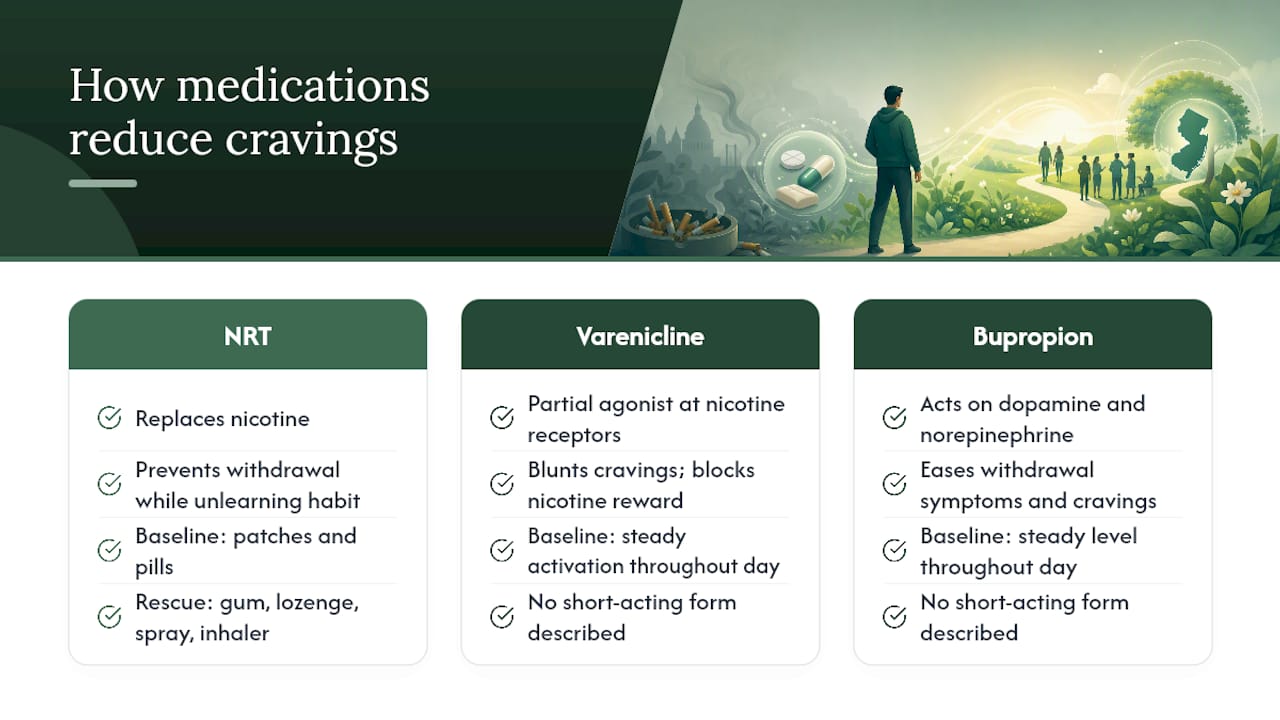
NRT works by replacing the nicotine you’d normally get from cigarettes, so your body doesn’t go into withdrawal while you unlearn the habit itself. Think of it as lowering the dose gradually instead of quitting nicotine and the ritual at the same time.
Varenicline takes a different route. It’s a partial agonist, meaning it partially activates the same brain receptors nicotine does, which blunts cravings, and it also blocks nicotine from binding fully if you slip and smoke, dulling the reward. Bupropion works on dopamine and norepinephrine pathways in the brain, easing withdrawal symptoms and cravings through a route that has nothing to do with nicotine at all.
This mechanism difference shapes how you use each one. NRT patches and the two pills create a steady baseline level in your system throughout the day. Gum, lozenges, spray, and the inhaler act fast for a specific moment of temptation. That’s why combining a long-acting baseline medication with a short-acting option is a frequently recommended tactic for the cravings that hit out of nowhere, like after a meal or during a stressful call.
Do Quit-Smoking Medications Really Work?
Yes, and the data on combining medication with structured support is the most compelling part of the picture. Medication alone reduces cravings and withdrawal symptoms, and pairing it with counseling or a quit program raises your odds further.
By the Numbers: Program data from the American Lung Association’s Freedom From Smoking initiative, cited in CDC clinical practice resources, shows success rates near 60% when a structured program is paired with one or more cessation medications, compared to roughly 13% to 17% for counseling alone.
That gap is the single strongest argument for treating this as a medical process, not a willpower contest. Clinical reviews consistently rank NRT, varenicline, and bupropion as first-line agents, with older drugs treated as second-line backups when the primary options don’t fit. Results still vary person to person. Adherence matters most. So does how many prior quit attempts you’ve made. Someone on their first try responds differently than someone on their fifth, and that’s worth mentioning to whoever is helping you build your plan.
What Side Effects and Risks Should You Watch For?
Every medication class carries its own risk profile, and some of them matter more depending on your health history.
- NRT — can cause skin irritation (patch), mouth soreness (gum, lozenge), or nasal irritation (spray); overuse alongside continued smoking can push nicotine intake too high.
- Varenicline — nausea and vivid dreams are common; label warnings historically flagged psychiatric symptoms and cardiovascular concerns in select patients, so anyone with a history of depression, anxiety, or heart disease should flag it before starting.
- Bupropion — carries a seizure risk, meaning it’s not appropriate for people with a seizure disorder or certain eating disorder histories; screening for these conditions matters before your first dose, and mood changes should be monitored closely in anyone with a psychiatric history.
Pregnancy and breastfeeding change the calculation. Clinicians generally recommend trying to quit without medication first when possible, since data on medication safety during pregnancy is limited. If you have reduced kidney function, your dosing may need adjustment, particularly with varenicline, since it clears through the kidneys.
If a medication causes side effects you can’t tolerate, switching to a different approved option is a reasonable and common next step rather than a reason to give up on medication altogether. Call your clinician if you notice new depression, agitation, or thoughts of self-harm on any of these drugs. Even people who consider themselves light or social smokers face real health risks worth addressing with medication support, not just occasional smokers who assume they’re in the clear.
How Do You Choose and Use a Smoking Cessation Medication?
Picking the right option comes down to a short list of personal factors, and running through them with a clinician takes only a few minutes.
- Review your medical history. Seizure disorders rule out bupropion; certain psychiatric or cardiovascular histories call for closer monitoring with varenicline.
- Check for pregnancy or breastfeeding. This shifts the conversation toward non-medication strategies first.
- Decide between steady relief and as-needed relief. If you crave predictability, a patch or pill works well. If cravings hit in unpredictable spikes, gum, lozenges, or the inhaler fit better.
- Consider timing before quit day. Varenicline and bupropion are typically started about one to two weeks before your quit date to let them build up in your system.
- Ask about combination strategies. Pairing a nicotine patch with gum or lozenges for breakthrough cravings is a well-established approach.
Varenicline dosing isn’t one-size-fits-all, either. Clinical guidance describes fixed quit-date approaches, flexible quit-date approaches, and gradual approaches that can extend treatment out to 24 weeks for people who want to taper smoking down before stopping completely. There’s no single right duration. It depends on how your body responds and how many prior attempts you’ve made.
Pro Tip: Bring your full medication list, including supplements, to whoever prescribes your quit medication. Bupropion and varenicline both interact with other drugs, and a pharmacist can flag conflicts in minutes that would otherwise take a phone call after the fact.
How Can You Get These Medications Affordably?
Cost shouldn’t be the reason you don’t try medication, because more low-cost paths exist than most people realize.
- Nicotine patch, gum, and lozenges are sold over the counter at any pharmacy, no prescription required.
- Nasal spray, inhaler, varenicline, and bupropion require a prescription, which you can get through a primary care visit, a telehealth appointment, or sometimes a pharmacy-based clinic.
- Many insurance plans cover tobacco-cessation medications as a specific benefit. It’s worth reviewing your plan’s coverage details before you assume it’s not included.
- State quitlines and Smokefree.gov often connect callers to free or reduced-cost NRT along with coaching, no insurance required.
- When you meet with a clinician, mention any prior quit attempts and what worked or didn’t. Ask directly whether a combination approach makes sense for you.
If you’re weighing whether switching nicotine products altogether fits your situation, resources on product transitions can offer useful context, though medication remains the evidence-backed starting point for most people trying to quit for good.
How Garden State Medical Group Supports Your Quit Attempt
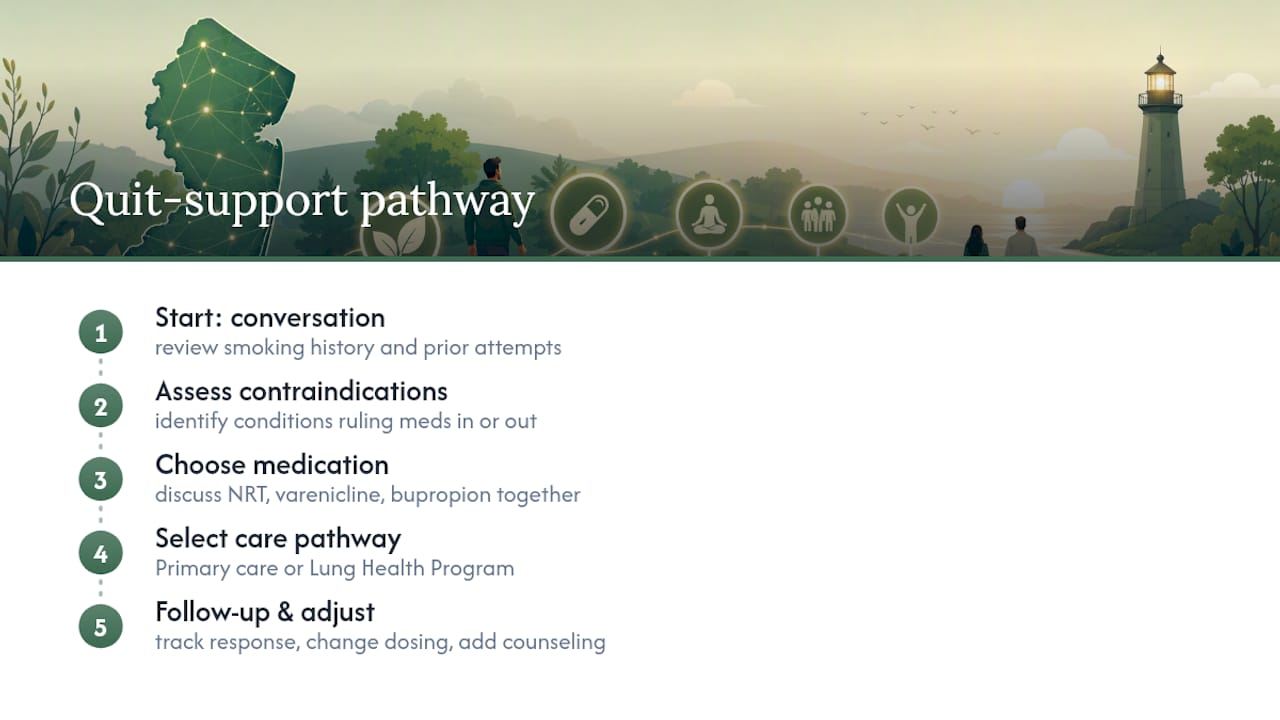
A typical visit starts with a real conversation, not a prescription pad. Your clinician reviews smoking history, prior quit attempts, and any conditions that rule certain medications in or out, then walks through NRT, varenicline, and bupropion options together with you.
Primary care visits cover the initial evaluation and medication selection, while the Lung Health Program is built for patients already dealing with smoking-related breathing issues who need coordinated monitoring alongside their quit plan. Follow-up appointments track how you’re responding, adjust dosing if needed, and connect you with counseling resources when the data shows that’s what actually moves the needle.
A Clinician’s Note on Quitting for Good
Setbacks happen, and they don’t mean the medication failed or that you’re out of options. Most people who eventually quit for good have tried more than once, often switching medications or adding counseling along the way before something clicked.
What matters most is that you don’t have to figure this out alone. Whether that means a telehealth visit squeezed between work meetings or an in-person appointment to walk through your history in detail, the first step is just picking up the phone.
— Garden State Medical Group
How Garden State Medical Group Helps You Quit With Confidence
There’s no single best medication for everyone, which is exactly why a clinical evaluation beats guessing at the pharmacy aisle. A primary care team can review your smoking history, current health conditions, and prior quit attempts to help choose between NRT, varenicline, or bupropion, adjusting the plan if your first choice doesn’t fit.
Before your visit, bring your current medication list, notes on any previous quit attempts, and details on what side effects (if any) you experienced before. Your clinician will use that history to build a plan and schedule follow-up to track your progress. If smoking has already affected your breathing, the Lung Health Program adds diagnostic monitoring alongside your cessation plan. Book a primary care appointment today to start your evaluation and get a medication plan built around your actual health history, not a generic checklist.
This article is general information, not a substitute for advice from a qualified doctor. Consult a qualified healthcare professional about your own circumstances before acting on anything here.
Sources
- Want to quit smoking? FDA‑approved and FDA‑cleared cessation products can help | FDA
- How quit smoking medicines work | CDC
- Smokefree
- Medications for smoking cessation | PMC (NIH)
FAQ
What is the most effective medication for smoking cessation?
No single medication works best for everyone; clinical reviews rank NRT, varenicline, and bupropion as first-line options with the strongest evidence behind them. Combining a medication with counseling consistently outperforms medication or counseling alone.
What are the seven FDA-approved tobacco cessation medications?
The seven FDA-approved options are the nicotine patch, gum, lozenge, nasal spray, and inhaler, plus the prescription pills varenicline and bupropion. Five are nicotine-based; two work through entirely different mechanisms.
What does the CDC recommend about quitting smoking?
The CDC recommends using FDA-approved quit-smoking medicines and notes that combining a long-acting option like the patch with a short-acting option like gum can help manage sudden cravings. Pairing medication with counseling support is part of that guidance.
What is the easiest way to quit smoking?
There’s no universally “easiest” path, but starting with a clinician-guided quit plan that includes medication and support tends to produce better results than trying to quit unassisted. Garden State Medical Group’s primary care team can help build that plan around your specific health history.
Can I switch medications if the first one doesn’t work for me?
Yes. Switching to a different approved medication is a common and reasonable step if side effects or ineffective cravings control show up with your first choice. Discuss the switch with your clinician rather than stopping treatment altogether.