
What to Bring to a Memory Loss Evaluation in New Jersey: Med List, B12, MRI

A memory loss evaluation starts with a brief office screening test, then adds a detailed history, medication review, blood work, and sometimes brain imaging or specialist testing. If you or a family member has noticed changes in memory or daily function, the right next step is to schedule an appointment with a primary care provider or memory program and bring a spouse, adult child, or close friend along. That informant’s observations, combined with tools like the MoCA, often matter more than the patient’s own account.
TL;DR:
- Most initial screens like MoCA and Mini-Cog are not definitive and can miss early or subtle cognitive decline, especially in cases of high education or language differences.
- Informant questionnaires such as the AD8 are often more reliable than patient self-reports because patients may lack insight into their own decline.
- Blood tests for B12, thyroid, and metabolic issues are standard to rule out reversible causes before proceeding to imaging or neuropsychological testing.
- Formal evaluations involve separate interviews with the patient and caregiver and a detailed review of medications to identify treatable influences.
- A thorough assessment can take multiple appointments, and results should be interpreted within the context of objective baseline data and clinical judgment.
Table of Contents
- Why “Memory Loss Evaluation” Deserves a More Precise Name
- When and Why to Get a Memory Assessment
- What Do Mini-Cog, MoCA, MMSE, and SAGE Actually Measure?
- What Happens During a Full Clinical Evaluation
- Which Lab Tests and Scans Are Typically Ordered?
- When Do You Need Neuropsychological Testing?
- How Are Results Interpreted, and What Comes Next?
- What Reversible Causes and Red Flags Should Worry You?
- How Should You Prepare for the Appointment?
- Practice Perspective: Setting Realistic Expectations
- Scheduling a Memory Evaluation With Garden State Medical Group
- Sources
- FAQ
Why “Memory Loss Evaluation” Deserves a More Precise Name
Patients searching for a memory loss evaluation are usually describing what clinicians call a cognitive assessment or, when symptoms are more advanced, a dementia evaluation. These terms show up throughout medical literature from the National Institute on Aging and the Alzheimer’s Association, and you’ll see both used interchangeably here. Whatever term your doctor uses, the process is the same: a structured, stepwise workup designed to figure out whether memory changes reflect normal aging, a treatable condition, or an early form of dementia.
When and Why to Get a Memory Assessment
You don’t need a dramatic symptom to justify an evaluation. Most patients who end up in a memory program got there because someone, often not the patient, noticed something first.
Common triggers include:
- Repeated concern voiced by the patient or a family member across several conversations, not just one bad day
- Noticeable changes in daily function, like forgetting bill payments, getting lost on familiar routes, or repeating questions
- A safety incident such as leaving the stove on, a fender bender, or missed medication doses
Routine care also creates a natural entry point. The Medicare Annual Wellness Visit includes a required cognitive assessment, which means many adults get screened as a matter of course rather than because something alarming happened. That structure exists for a reason: catching subtle decline early gives clinicians and families more room to act.
Early detection isn’t just about naming a diagnosis sooner. It establishes a cognitive baseline, which turns out to matter even when the first screening comes back normal. A documented baseline gives your care team something concrete to compare against a year or two later, so gradual changes don’t get dismissed as “just getting older.” According to the National Institute on Aging, this kind of baseline tracking is one of the more underused tools in primary care, largely because patients assume a normal score means the conversation is closed.
Early evaluation also opens the door to interventions, whether that’s adjusting medications, addressing a reversible cause, or connecting a family with planning resources before a crisis forces the issue.
What Do Mini-Cog, MoCA, MMSE, and SAGE Actually Measure?
Brief screening tools are the entry point for almost every memory assessment, and they are not interchangeable. Each was built to measure something slightly different, and knowing the differences helps you interpret your own results with more nuance.
- Mini-Cog: A three-minute test combining three-item word recall with a clock-drawing task, administered by trained staff as a quick first-pass screen for memory and executive function.
- MoCA (Montreal Cognitive Assessment): A 30-point test covering attention, executive function, language, and visuospatial skills. It tends to be more sensitive than older tools for catching mild cognitive impairment, which is why many memory programs have shifted toward it.
- MMSE (Mini-Mental State Examination): The historical standard, still widely used, but more prone to educational and cultural bias than the MoCA.
- SAGE (Self-Administered Gerocognitive Exam): A paper-based test patients can complete at home before a visit, giving clinicians a starting point without using appointment time.
- AD8: An eight-item informant questionnaire, not a patient-facing test at all. It asks a family member or close friend to rate observed changes over time.
Here’s the catch almost nobody explains upfront: a normal screening score does not rule out a problem. Cognitive tests are screens, not diagnoses. Scores shift based on education level, primary language, and how a person performed at their personal baseline. Someone with a graduate degree and high baseline function might score “normal” on a MoCA while still experiencing a real decline from where they used to be. That’s exactly why informant tools like the AD8 carry so much weight. Patients often lack insight into their own decline, so a spouse or adult child’s account can catch what a 10-minute office test misses entirely.
What Happens During a Full Clinical Evaluation
Once a screening test raises a flag, or a family’s concern is strong enough on its own, the evaluation moves into a more detailed clinical process. This is where most of the real diagnostic work happens.
- Separate interviews. Clinicians often speak with the patient and the caregiver individually. This isn’t about excluding the patient. It’s a practical way to get a caregiver’s candid, unfiltered account of day-to-day changes without the patient in the room, since people can feel protective of a spouse or parent and soften their descriptions otherwise.
- Medication and substance review. A clinician goes through every prescription, over-the-counter drug, and supplement looking for sedatives, anticholinergic medications, and other agents known to impair cognition. This step catches more reversible cases than most patients expect.
- Functional assessment. The evaluation also covers activities of daily living, driving safety, financial management, and medication adherence, since the practical impact of memory changes often matters more for planning than the test score itself.
Bringing a family member isn’t a formality. It’s often the single most useful thing you can do to make the evaluation accurate.
Which Lab Tests and Scans Are Typically Ordered?
Before anyone jumps to a dementia diagnosis, clinicians rule out reversible causes with a standard round of blood work. This step is not optional, and skipping it is one of the more common mistakes in less thorough evaluations.
- Vitamin B12: Deficiency can mimic cognitive decline and is fully reversible with supplementation.
- TSH (thyroid function): Both underactive and overactive thyroid can produce memory complaints.
- Complete metabolic panel and CBC: Screens for metabolic imbalances, kidney or liver dysfunction, and infection, all of which can affect mental clarity.
On imaging, MRI is the preferred choice for identifying structural causes like strokes, tumors, or patterns of brain atrophy. CT scanning is an acceptable substitute when MRI isn’t available or is contraindicated, such as for patients with certain implanted devices. Not everyone needs a scan right away, but certain findings push imaging up the priority list fast: rapid cognitive decline, new focal neurologic signs (weakness on one side, speech changes), or a recent head injury. Any of those warrants urgent imaging rather than a routine referral.
When Do You Need Neuropsychological Testing?
Screening tools and a clinical history answer most questions, but not all of them. When the diagnosis stays unclear, a full neuropsychological evaluation goes deeper.
This kind of testing runs several hours and covers memory, language, executive function, and visuospatial skills in far more detail than any office screen. A psychologist trained in test interpretation reviews the results, accounting for the patient’s age, education, and estimated baseline ability before drawing conclusions.
Referral usually makes sense when:
- The diagnosis remains unclear after initial screening and lab work
- Symptoms appear at a younger age than typically expected for dementia
- The presentation is atypical, such as language or behavior changes without obvious memory loss
- Safety concerns (driving, living alone, financial vulnerability) need a more precise answer than a screening score can give
The Alzheimer’s Association’s clinical practice guidance notes that full neuropsychological testing offers meaningfully higher diagnostic precision and domain-specific detail useful for rehabilitation planning, though access is often shaped by wait times and insurance coverage rather than clinical need alone.
Pro Tip: Ask your clinician directly whether a neuropsychological referral would change your treatment plan. If the answer is no, a repeat office screening in six to twelve months may serve you just as well without the wait.
How Are Results Interpreted, and What Comes Next?
A screening score is a flag, not a verdict. Understanding that distinction changes how you should read your own results.
Diagnostic categories generally fall into three buckets:
- Normal age-related change: Occasional forgetfulness without functional impact, common and not a sign of disease
- Mild cognitive impairment (MCI): Measurable decline beyond normal aging, but daily function remains largely intact
- Dementia: Cognitive decline severe enough to interfere with independence in daily activities
Getting placed in one of these categories isn’t the finish line. A baseline assessment, even a normal one, gives your care team a reference point for tracking change over time, which matters more than a single snapshot score.
From there, next steps depend on the category. Lifestyle interventions (exercise, sleep, vascular risk management), a fresh medication review, referral to neurology or geriatrics, safety planning around driving and living arrangements, and connection to community resources are all standard parts of a follow-up plan. None of this happens in a single visit, and that’s by design, not a delay.
What Reversible Causes and Red Flags Should Worry You?
Not every memory complaint points toward dementia. A meaningful share of cases trace back to conditions that improve or resolve entirely once treated, which is exactly why the Merck Manual puts identifying reversible causes at the top of the evaluation priority list.
Common reversible contributors include:
- Depression, which can produce memory and concentration problems that mimic early dementia
- Vitamin B12 deficiency and hypothyroidism, both correctable with treatment
- Medication side effects, especially sedatives and anticholinergic drugs
- Infection, alcohol use, or metabolic disturbances
Certain symptoms need urgent attention rather than a routine appointment. Rapid onset of confusion, fluctuating alertness, new focal neurologic deficits, unexplained falls, or a new seizure all warrant same-day medical evaluation, not a scheduled follow-up weeks out. In some of these cases, a supervised trial of stopping a suspect medication, or even short-term hospitalization, is the appropriate path rather than outpatient testing alone.
How Should You Prepare for the Appointment?
A little preparation turns a rushed 20-minute visit into a genuinely useful one.
- Bring a written medication list, including supplements, along with a rough timeline of when memory changes started and specific examples (missed appointments, repeated questions, a wrong turn on a familiar drive).
- Bring an informant. Ask your clinician about their process for a private caregiver interview. Many practices set aside a few minutes to speak with a family member alone, consistent with standard privacy practices, to get a more candid account.
- Prepare questions in advance, such as what follow-up testing might be ordered, how you’ll receive results, and what a normal score would still mean given your specific concerns.
Recent medical records and a brief family health history round out what your clinician needs on day one.
Practice Perspective: Setting Realistic Expectations
A single office visit almost never produces a definitive answer, and that catches people off guard. Comprehensive evaluations typically span more than one appointment, since gathering an accurate history and informant input takes time clinicians can’t compress into one slot. The most common misunderstanding is treating a screening test as a diagnosis. It isn’t. It’s a starting point. A multidisciplinary approach, pairing primary care with imaging, lab work, and specialist input when needed, tends to catch what a single test alone would miss.
— Garden State Medical Group
Scheduling a Memory Evaluation With Garden State Medical Group
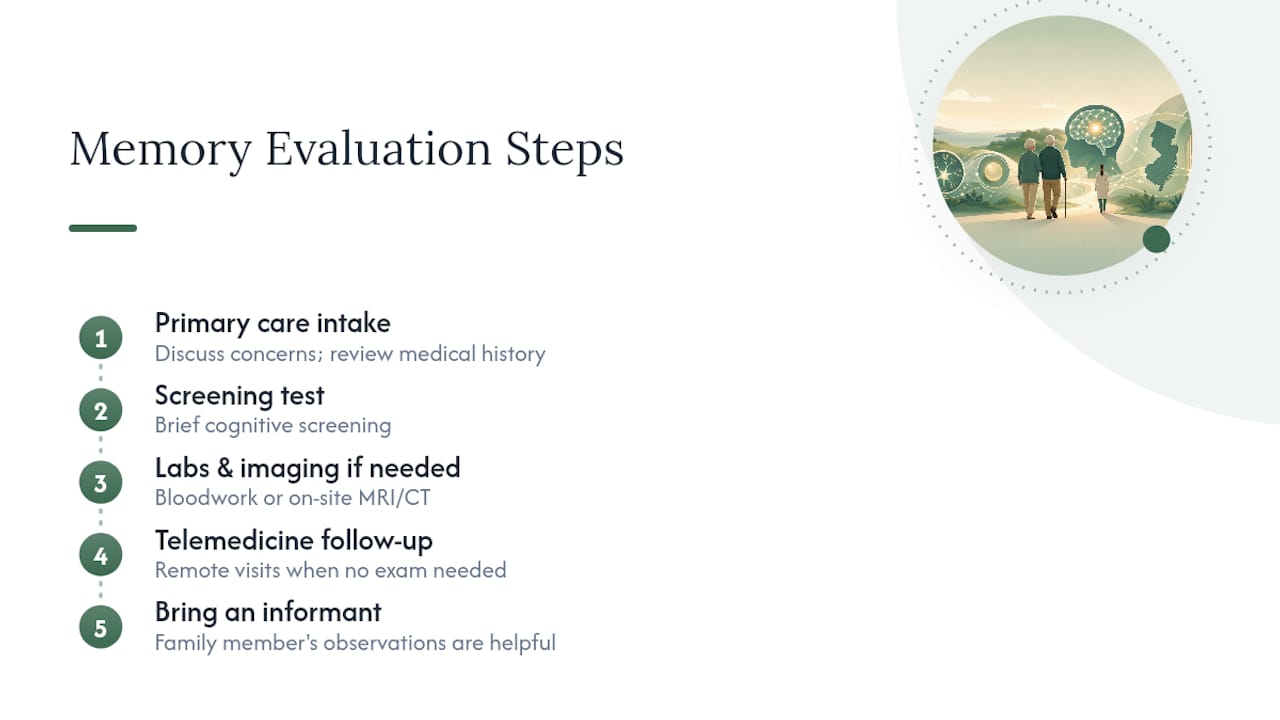
Getting from concern to clarity is easier when your primary care team, lab work, and imaging all sit under one roof. Garden State Medical Group’s Memory and Cognition Care Program coordinates exactly that kind of evaluation, starting with a primary care intake, moving through on-site diagnostics when needed, and pulling in telemedicine visits for follow-up conversations that don’t require an in-person exam.
Your first appointment typically starts with a conversation about your specific concerns and a review of your medical history, followed by a screening test and a discussion of whether lab work or imaging makes sense given your symptoms. Many insurance plans and Medicare may be accepted, and the Annual Wellness Visit cognitive check can serve as a natural starting point if you haven’t raised concerns before. If a family member has noticed changes you haven’t, that’s reason enough to book a visit rather than wait for something more definitive.
Schedule an appointment through Garden State Medical Group’s primary care services to begin the process, bring your informant along, and let the evaluation take its natural course from there.
Sources
For deeper reading, consult the National Institute on Aging’s clinical guidance, the Alzheimer’s Association’s cognitive assessment resources, and the Merck Manual’s memory loss evaluation summary. Bringing printed questions from these sources, or from a patient question checklist, can help you get more out of a limited appointment window.
This article is general information, not a substitute for advice from a qualified doctor. Consult a qualified healthcare professional about your own circumstances before acting on anything here.
- Assessing cognitive impairment in older patients
- Cognitive screening and assessment
- Memory loss: Evaluation — Merck Manual Professional Edition
- Cognitive Assessment - StatPearls
- Alzheimer’s Association clinical practice guideline (summary)
FAQ
What are the four types of cognitive impairment?
Clinicians generally group cognitive impairment into normal age-related change, mild cognitive impairment (MCI), dementia, and delirium, with delirium distinguished by its sudden onset and fluctuating course rather than gradual decline.
What is considered normal age-related memory loss?
Normal aging can bring occasional forgetfulness, like misplacing keys or briefly blanking on a word, without interfering with daily independence or safety; that’s different from the more consistent, functional impact seen in MCI or dementia.
What are the different types of memory loss?
Memory loss is typically categorized by cause, including reversible causes such as depression, vitamin B12 deficiency, and thyroid dysfunction, versus progressive causes tied to conditions like Alzheimer’s disease and other forms of dementia.
What is the 12-question test for dementia?
There isn’t a single standardized “12-question” test recognized across clinical guidelines; patients likely encounter this description informally, and the validated tools clinicians actually use are the Mini-Cog, MoCA, MMSE, and SAGE, each with a different item count and format.
Is a memory loss evaluation covered by insurance?
Cognitive assessment is included in the Medicare Annual Wellness Visit, and most major insurance plans cover diagnostic evaluation when medically indicated; Coverage details can be verified during scheduling.