
Understanding Medical Specialties: A Patient's Guide

TL;DR:
- Medical specialties are distinct branches focused on specific patient groups, organs, diseases, or treatments. Understanding these axes helps patients ask informed questions and navigate referrals more effectively.
Medical specialties are distinct branches of medicine focused on specific patient populations, organ systems, disease categories, or treatment approaches. Understanding medical specialties helps you make informed decisions about your care, ask better questions, and know when a referral to a specialist makes sense. The American Medical Association (AMA) and the National Uniform Claim Committee (NUCC) both play central roles in classifying and standardizing these specialties across the U.S. healthcare system. Whether you are managing a chronic condition or navigating a new diagnosis, knowing how specialties work puts you in a stronger position as a patient.
How are medical specialties categorized?
Medical specialties are classified along four primary axes: patient population, organ system, disease category, and treatment modality. These axes explain why certain referrals happen and what a specialist actually focuses on. A cardiologist, for example, is defined by organ system (the heart and blood vessels), while a pediatrician is defined by patient population (children). Understanding this framework makes it easier to see why your primary care doctor might send you to one specialist versus another.
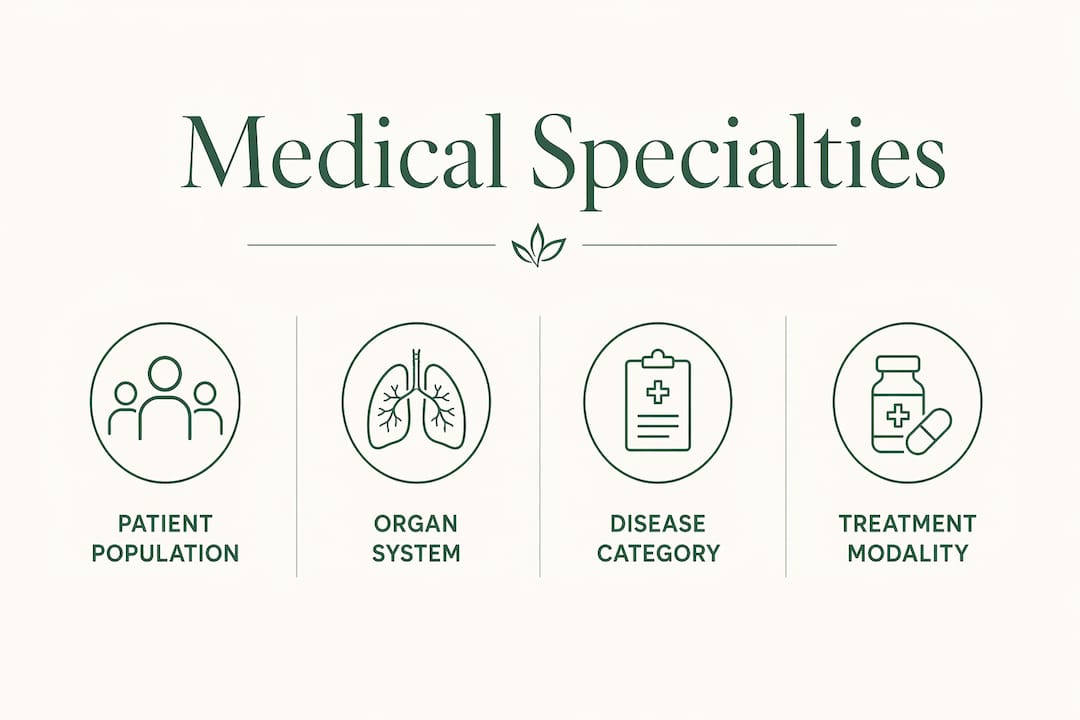
The four axes also map onto broader specialty types. Surgical specialties like orthopedics and general surgery focus on procedural treatment modalities. Internal medicine subspecialties like gastroenterology or nephrology focus on organ systems. Diagnostic specialties like radiology and pathology support other physicians by interpreting test results. Supportive specialties like physical therapy and psychiatry address function and mental health. Each type fills a specific gap in the care continuum.
Provider specialties are identified by 10-character taxonomy codes managed by the NUCC, updated twice annually. Hundreds of distinct provider classifications are maintained through the national NPI (National Provider Identifier) registry. That level of detail reflects just how many distinct specialty fields exist in modern medicine.
Pro Tip: When you receive a referral, ask your primary care doctor which classification axis drives the recommendation. Knowing whether you are being referred for your age group, a specific organ, or a particular treatment type helps you prepare the right questions for your specialist visit.
| Specialty type | Focus area | Example specialties |
|---|---|---|
| Surgical | Procedural treatment | Orthopedics, general surgery, urology |
| Internal medicine | Organ systems and disease | Cardiology, gastroenterology, nephrology |
| Diagnostic | Test interpretation | Radiology, pathology, nuclear medicine |
| Supportive | Function and mental health | Psychiatry, physical therapy, palliative care |
| Population-based | Specific patient groups | Pediatrics, geriatrics, obstetrics |
What role does primary care play in the specialty ecosystem?
Primary care physicians act as the central hub managing chronic conditions and coordinating referrals to specialists to prevent fragmented care. Without that coordination, patients with multiple conditions can end up seeing several specialists who never communicate with each other. A primary care provider (PCP) holds the full picture of your health and ensures that each specialist’s recommendations fit together.
The three main primary care fields are family medicine, internal medicine, and pediatrics. Internal medicine holds the most residency positions in the U.S., with 13,428 first-year slots as of 2025. Combined with family medicine and pediatrics, the top three primary care specialties account for 22,632 annual residency positions. That scale reflects how central primary care is to the entire healthcare system.
Your PCP does far more than treat colds and order annual labs. A strong primary care relationship delivers several concrete benefits:
- Chronic disease management: Your PCP monitors conditions like diabetes, hypertension, and asthma over time, adjusting treatment as your health changes. Gardenstatemedicalgroup offers a dedicated chronic care management program for patients managing multiple conditions.
- Preventive screening: Routine screenings for cancer, cardiovascular risk, and metabolic conditions catch problems early, when treatment is most effective.
- Referral coordination: Your PCP selects the right specialist, shares your medical history, and follows up after specialist visits to integrate new recommendations.
- Medication management: With multiple specialists potentially prescribing medications, your PCP monitors for interactions and redundancies.
- Continuity of care: A long-term relationship with one provider means your doctor knows your history, your preferences, and your risk factors without you having to repeat them every visit.
Pro Tip: If you see more than two specialists regularly, schedule a dedicated “care coordination” appointment with your PCP at least once a year. Bring a current medication list and a summary of each specialist’s recent recommendations. This single visit can prevent duplicate tests and conflicting treatments. You can also review primary care tips for chronic conditions to prepare for that conversation.
How do medical specialties differ in training and expertise?
The path to becoming a specialist starts with four years of medical school, followed by a residency program. Training length varies from three to seven years based on procedural complexity. A family medicine residency runs three years. A neurosurgery residency runs seven. That difference reflects the volume and complexity of procedures a specialist must master before practicing independently.

After residency, many physicians pursue fellowship training in a subspecialty. A fellowship typically adds one to three years of focused training in a narrower field. An internal medicine physician might complete a cardiology fellowship, then a further interventional cardiology fellowship. Each layer of training narrows the focus and deepens the expertise.
Here is how the training progression works in practice:
- Medical school (4 years): Covers foundational sciences and clinical rotations across all major specialties.
- Residency (3–7 years): Focused training in a chosen specialty, with increasing clinical responsibility.
- Board certification: A written and practical exam administered by a specialty board, such as the American Board of Internal Medicine (ABIM) or the American Board of Surgery (ABS).
- Fellowship (1–3 years, optional): Advanced subspecialty training for physicians who want to focus further.
- Subspecialty board certification: A second certification in the subspecialty, such as cardiology or gastroenterology within internal medicine.
Physicians often hold dual board certifications in related specialties, such as Internal Medicine and Pediatrics, a combination known as Med-Peds. Dual certifications allow broader patient care across closely related fields. A Med-Peds physician can treat both adults and children, which is particularly useful in underserved communities or family-centered practices.
Fellows are licensed physicians in advanced subspecialty training, not students or trainees in the traditional sense. In teaching hospitals, fellows often lead complex care decisions and serve as primary clinicians for difficult cases. Knowing this distinction matters when you are a patient at an academic medical center. The fellow managing your care has already completed medical school and a full residency.
What conditions do common medical specialties treat?
The major specialties each cover a defined set of conditions, and knowing those boundaries helps you understand why your doctor refers you where they do.
Cardiology specialists manage heart disease using diagnostic tools like EKGs and echocardiograms, and perform procedures like angioplasty and stenting. Gardenstatemedicalgroup provides cardiopulmonary care that integrates both cardiac and pulmonary services under one roof. Dermatologists diagnose and treat skin conditions ranging from acne to skin cancer, and also offer cosmetic procedures. The table below maps major specialties to their primary focus areas and common conditions.
| Specialty | Primary focus | Common conditions treated |
|---|---|---|
| Cardiology | Heart and blood vessels | Heart disease, arrhythmia, heart failure |
| Dermatology | Skin, hair, nails | Acne, eczema, skin cancer |
| Neurology | Brain and nervous system | Stroke, epilepsy, multiple sclerosis |
| Oncology | Cancer | Breast, lung, colorectal, blood cancers |
| Orthopedics | Bones and joints | Fractures, arthritis, sports injuries |
| Psychiatry | Mental health | Depression, anxiety, schizophrenia |
| Endocrinology | Hormones and metabolism | Diabetes, thyroid disorders, osteoporosis |
| Pulmonology | Lungs and respiratory system | Asthma, COPD, sleep apnea |
Gender representation also varies significantly by specialty. As of 2025, 88.6% of obstetrics and gynecology residents are female, while 87.1% of orthopedic sports medicine residents are male. These workforce patterns reflect historical trends and are gradually shifting as medical school enrollment becomes more balanced. Knowing this context helps patients understand the diversity they may encounter across different specialty practices.
Effective communication between specialties also depends on good coordination infrastructure. Phone triage in specialty practices is one tool that improves how patients are routed to the right provider quickly, reducing delays in care.
Key Takeaways
Knowing the four classification axes of medical specialties, the coordinating role of primary care, and the depth of specialist training gives you the clearest possible map for navigating your own healthcare.
| Point | Details |
|---|---|
| Four classification axes | Specialties are organized by patient population, organ system, disease category, and treatment modality. |
| Primary care as coordinator | Your PCP manages chronic conditions and coordinates referrals to prevent fragmented, disconnected care. |
| Training depth signals complexity | Residencies run 3–7 years; longer programs reflect more procedural and complex specialty demands. |
| Fellows are not trainees | Fellows are licensed physicians in advanced subspecialty training who often lead complex care decisions. |
| Dual certifications expand scope | Physicians with dual board certifications, such as Med-Peds, can serve broader patient populations effectively. |
Why knowing your specialists actually changes your care
Most patients I have spoken with over the years treat a specialist visit like a one-way consultation. They show up, answer questions, and leave with a prescription or a procedure date. What they miss is that the specialist’s scope is narrow by design, and that narrowness is a feature, not a limitation.
The real confusion I see is around fellows and residents in academic settings. Patients sometimes feel unsettled when a younger physician leads their care. But a fellow managing your complex arrhythmia has completed medical school and a full internal medicine residency. They are not learning on you. They are applying the most current subspecialty knowledge available, often under direct attending supervision.
The other thing patients consistently underestimate is the value of their PCP as a translator. After a specialist visit, most patients leave with a report full of clinical language they cannot parse. Your primary care doctor’s job is to translate that into a plan you can actually follow. The duties of a primary care physician go well beyond annual checkups. They are the one provider who sees your whole health picture, not just one organ or one condition.
My honest advice: before any specialist appointment, call your PCP’s office and ask them to send a referral summary. That single step ensures your specialist knows your full history before you walk in the door. It saves time, reduces duplicate testing, and often changes the specialist’s initial recommendations.
— Krunal
Integrated specialty care at Gardenstatemedicalgroup
Gardenstatemedicalgroup serves patients in North Bergen and Secaucus, New Jersey, with a multidisciplinary approach that connects primary care directly to specialized services. You do not have to manage referrals across disconnected offices or repeat your medical history at every visit.
The practice integrates primary care services with cardiopulmonary care, radiology, and targeted health programs including diabetes prevention and chronic disease management. Patients with complex or ongoing conditions benefit from having their care team in one coordinated system. Gardenstatemedicalgroup also accepts a wide range of insurance plans and offers convenient scheduling at both locations. If you are ready to establish care or need a referral to a specialist, contact Gardenstatemedicalgroup to schedule your appointment.
FAQ
What are the main types of medical specialties?
Medical specialties are classified by patient population, organ system, disease category, and treatment modality. Major types include surgical, internal medicine, diagnostic, supportive, and population-based specialties.
How long does it take to become a medical specialist?
Becoming a specialist requires four years of medical school plus a residency of 3–7 years, depending on the specialty’s procedural complexity. Fellowship training adds one to three additional years for subspecialties.
What is the difference between a resident and a fellow?
A resident is a physician completing their first post-medical-school training in a chosen specialty. A fellow is a fully licensed physician pursuing advanced subspecialty training, often managing complex cases in teaching hospitals.
Why does primary care matter if I already see specialists?
Primary care coordinates all specialist input, manages your medications, and prevents fragmented care across multiple providers. Without a PCP, conflicting treatments and duplicate tests are common outcomes.
How do I know which specialist I need?
Your primary care physician determines the right specialist based on your symptoms, test results, and medical history. The referral decision follows the four classification axes: population, organ system, disease, or treatment type.
Recommended
- Types of Medical Specialists: Your Guide to Finding the Right Doctor
- Understanding medical groups: what patients need to know
- Our Guide on Making the Most of Your Medical Check-Up - What to Ask & Expect | Garden State Medical Group | Garden State Medical Group
- How medical services work: A clear guide to care in NJ